CVT Gearbox Replacement Cost in South Africa (2026 Guide)

Replacing a CVT gearbox in South Africa costs roughly R8,000 to R45,000 fitted, depending on the make, model and whether you use a used or reconditioned unit — a Honda Jazz CVT typically lands in the R8,000–R22,000 range, while a Nissan Qashqai 2.0 CVT can push to R30,000–R45,000 once you include labour and the mandatory fluid service. CVT units are more expensive to source and more specialised to fit than a conventional torque-converter automatic, which is why prices at the lower end still run higher than many owners expect. Because the same box costs vastly different amounts depending on your supplier, the most reliable way to get a real number is to compare several quotes — Engine Finder connects you with verified gearbox suppliers across the country who price your specific unit and model.
Key Takeaways
| Question | Quick Answer |
|---|---|
| How much does CVT replacement cost (fitted)? | R8,000–R45,000 depending on make and model |
| Honda Jazz CVT (fitted)? | R8,000–R22,000 |
| Nissan Qashqai 2.0 CVT (fitted)? | R25,000–R45,000 |
| Nissan Juke 1.6 CVT (fitted)? | R18,000–R40,000 |
| CVT unit only (used, Honda Jazz)? | R3,500–R12,500 |
| CVT unit only (Nissan Juke/Qashqai, used)? | R1,800–R34,500 |
| Labour to replace a CVT? | R2,000–R7,200 (4–6 hrs at R450–R1,200/hr) |
| CVT fluid change cost? | R2,800–R5,500 |
| Can a CVT be rebuilt? | Rarely in SA — replacement is almost always cheaper |
| Worst CVT for reliability in SA? | Nissan JATCO Xtronic (Juke 1.6, Qashqai pre-2018) |
💡 CVT fluid is non-negotiable: using standard ATF instead of manufacturer-specified CVT fluid destroys the belt and pulleys within weeks. ⚠️ Most CVTs in SA cannot be economically rebuilt — sourcing a used or reconditioned unit is almost always the practical route. 📩 The price varies widely by supplier — compare quotes before committing to a single workshop.
What Is a CVT Gearbox?
A continuously variable transmission (CVT) replaces the fixed gear steps of a conventional automatic with two variable-diameter pulleys connected by a steel push-belt or chain. By continuously adjusting the ratio between the pulleys, the engine stays in its most efficient rev range regardless of road speed — which is why CVT-equipped cars typically return better fuel figures in city driving than a traditional four- or six-speed automatic.
The trade-off is cost and complexity. The belt-and-pulley system generates more friction heat than a torque-converter automatic, which means the transmission fluid works harder and must be replaced more often with a manufacturer-specified CVT fluid — not the generic ATF used in conventional gearboxes. When fluid is neglected or the wrong type is used, metal particles from belt and pulley wear contaminate the whole unit, and at that point the box must be replaced rather than repaired.
Understanding which CVT you have matters a great deal before you get quotes. The two most common CVT families in the SA market are very different units:
- JATCO Xtronic (Nissan models): The Nissan Juke 1.6L uses the JF015E (Nissan code RE0F11A), a smaller JATCO CVT-7. The Qashqai J10 2.0L and X-Trail T31 use the larger JF011E (RE0F10A). These are separate units with different failure profiles — always confirm the code before ordering a replacement.
- Honda Multi-Matic CVT (SWRA / SE5A / SR0A): Used across the Jazz generations — the GD (2003–2008) used the SWRA unit; the GE (2008–2013) used the SE5A; the GK (2015–2021) used the SR0A (“Earth Dreams” CVT). On the earlier GD and GE, a separate start clutch — rather than a torque converter — is responsible for the well-known Honda Jazz “judder on take-off,” which is often curable with a fluid flush if caught early; the GK switched to a torque-converter CVT.
Toyota, Suzuki and some Hyundai/Kia models also use CVTs, but their units are generally more reliable in SA conditions than the JATCO Xtronic.
Our guide to DSG, CVT and torque-converter gearboxes explained covers the differences between the three automatic families — worth reading before you request quotes, because suppliers will ask which type your car has.
CVT Gearbox Replacement Cost by Model (South Africa 2026)
The table below shows fitted replacement costs — unit plus labour plus CVT fluid — based on supplier-network pricing via the Engine Finder marketplace. “Used” means a low-mileage breaker unit; “reconditioned” means a rebuilt and tested unit with a warranty.
| Make / Model | CVT Code | Used unit (fitted) | Reconditioned unit (fitted) |
|---|---|---|---|
| Honda Jazz GD (2003–2008) | SWRA | R8,000 – R15,000 | R18,000 – R28,000 |
| Honda Jazz GE / GK (2008–2021) | SE5A / SR0A | R10,000 – R18,000 | R22,000 – R35,000 |
| Honda CR-V 2017+ / Civic 1.5T | Honda CVT | R15,000 – R24,000 | R24,000 – R35,000 |
| Nissan Micra / Note / Juke 1.6 | JF015E (RE0F11A) | R10,000 – R22,000 | R22,000 – R40,000 |
| Nissan Qashqai 2.0 / X-Trail | JF011E (RE0F10A) | R18,000 – R32,000 | R32,000 – R45,000 |
| Toyota Yaris CVT | Toyota K-series | R6,000 – R22,000 | R20,000 – R35,000 |
| Suzuki Swift / Baleno CVT | Suzuki CVT (JATCO) | R9,000 – R20,000 | R20,000 – R32,000 |
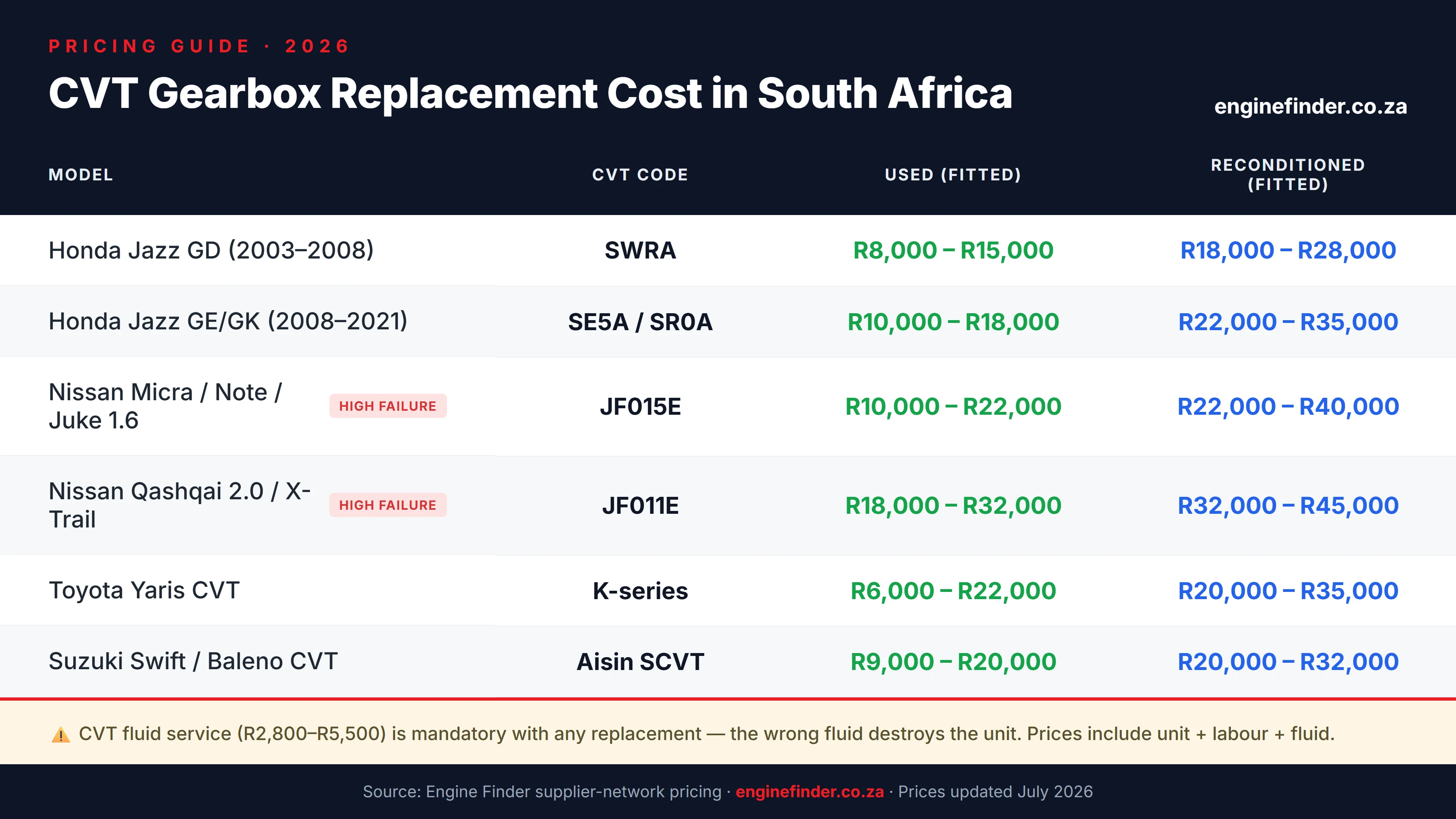
A few caveats on the numbers: used-unit prices vary significantly based on mileage and condition. A used Toyota Yaris 1.3L CVT unit can be found from around R3,950, while a newer Yaris 1.5L (2018–2022) unit costs about R24,500 — which illustrates how the year of the car, not just the make, drives the price. On a Nissan Xtronic especially, the internal wear is invisible until the box is on the bench, so the warranty on a reconditioned unit matters more than the sticker price. Reconditioned units from specialist suppliers typically carry a 6–12 month warranty; always get that in writing.
Did You Know?
CVT failure rates in South Africa are higher than European equivalents for the same models. The combination of high ambient temperatures, steep mountain passes, stop-and-go Johannesburg or Cape Town traffic, and stretched service intervals is the most common cause of premature CVT failure locally — not inherent design weakness.
What Drives the CVT Replacement Cost
1. Unit type: used vs reconditioned
The biggest price lever. A used breaker unit costs the least but carries unknown internal wear — a real risk on any CVT, where belt wear, pulley scoring and bearing condition are invisible without stripping the unit. A reconditioned unit costs two to three times more but is inspected, worn components replaced, and pressure-tested before it leaves the rebuild bench. On a Nissan Xtronic (JF011E or JF015E), the reconditioning almost always includes new bearings and a valve body service; skimping on these is why cheap “rebuilt” CVTs fail within a year.
2. CVT code and parts availability
Availability in the SA breaker market drives price as much as the unit’s age. Common units — the JATCO JF011E from Qashqai and X-Trail, and Honda’s SWRA from Jazz GD — are in ample supply through auto-dismantlers. Less common units are sourced in smaller numbers and price accordingly. Dealers and importers also bring in recon units from Japan and Australia, which adds to the spread.
3. Labour: 4–6 hours
A CVT swap is comparable in labour time to a conventional automatic replacement. Typical labour runs R450–R800 per hour at a competent independent workshop, or R1,000–R1,500 per hour at a franchised dealer. Total labour cost is therefore roughly R2,000–R9,000 depending on the car and workshop. Specialist CVT workshops — who do this work daily — generally offer the best combination of price and experience.
4. CVT fluid — mandatory and model-specific
Every CVT replacement must include a flush and refill with manufacturer-specified CVT fluid. Honda specifies HMMF (Honda Multi-Matic Fluid) for the older Jazz GD and GE CVTs and HCF-2 for the newer GK-generation CVT — never DW-1 (ATF-DW1), which is a conventional torque-converter automatic fluid and will destroy a CVT. Nissan specifies JATCO NS-3 or NS-2; Toyota specifies Toyota CVT Fluid TC. Using the wrong fluid destroys the new unit almost immediately. A CVT fluid service adds R800–R2,000 to the job.
5. Adaptation and calibration
Most CVTs do not require the intensive electronic coding a DSG mechatronic unit needs. However, a replacement Nissan Xtronic unit (or a new valve body/TCM) requires writing the transmission’s calibration/conformance data — the file supplied with the reman unit — with a scan tool before the judder fault codes will clear; a plain relearn is not enough. Confirm this is included in any workshop quote.
Wrong Fluid = Total Loss
Using standard automatic transmission fluid (ATF) in a CVT — even once — can shred the steel push-belt and score the pulleys within days. Always confirm the fluid specification with your parts supplier before any CVT service, and ask the workshop exactly what fluid they are using before the job begins.
CVT Failure Symptoms: When Does Replacement Become Necessary?
A CVT can often be saved with early intervention — particularly the Honda Jazz start-clutch judder, which independent CVT specialists report a fluid flush resolves in the majority of early cases (often cited as roughly nine in ten) when caught before the judder becomes constant. Nissan Xtronic failures are more serious and more commonly require full replacement. Recognise these symptoms early:
Symptoms that may be fixable without full replacement:
- Judder or shudder on take-off (Honda Jazz/City): often a start-clutch and fluid issue; a fluid flush costs R2,800–R5,500 and resolves the problem in the majority of early cases
- Jerky or erratic shifts at low speed: may be a valve body or solenoid fault rather than mechanical failure
- Fault code P17F1 (Nissan) — a CVT-judder code usually resolved with a CVT-fluid change and a calibration re-write (occasionally a valve-body service), without replacing the whole unit
Symptoms that usually mean replacement:
- Slipping at highway speed: the belt can no longer grip the pulleys — internal wear is beyond economical repair
- Loud whining, grinding or clanging: bearing collapse or belt breakage
- Burning smell or dark, gritty fluid: contamination from metal-on-metal wear; the whole unit is compromised
- Limp mode with fault code P17F0 (Nissan) — a CVT-judder code (worn clutch plates or degraded fluid); first addressed with the correct CVT fluid and a calibration re-write, escalating to unit replacement only if slipping or internal wear is confirmed on the bench (not from the code alone)
- Complete loss of drive: catastrophic failure — tow, do not drive
When the Nissan Juke 1.6’s input-shaft bearing fails — a known weak point on 2010–2017 models, typically between 80,000 km and 120,000 km — its closed, oil-starved design lets it overheat and break up, contaminating the CVT internals with metal debris and causing rapid wear (an early warning is a rotation noise at idle with the car in Park). The unit must then be replaced; repair is neither economical nor reliable.
Pro Tip: CVT Fluid Interval in SA Conditions
South African driving — heat, hills and heavy traffic — degrades CVT fluid faster than a European climate. Change your CVT fluid every 40,000–60,000 km using manufacturer-specified fluid, even if the owner’s manual says 80,000–100,000 km. A R2,800–R5,500 fluid service every 50,000 km is far cheaper than a R20,000–R45,000 unit replacement.
Can a CVT Be Rebuilt in South Africa?
Unlike a conventional automatic gearbox — where a skilled rebuilder can replace clutch packs, resurface drums and hone valve bores — a CVT rebuild requires a dust-free environment, specialist tooling for the push-belt assembly, and access to belt and pulley components that are generally not stocked by SA parts suppliers. Meaningful CVT rebuilds in South Africa are rare, expensive and limited to a handful of Gauteng specialists who import the rebuild kits.
For most SA owners, the practical choice is between a used unit (lower cost, little or no warranty), a reconditioned unit (higher cost, 6–12 month warranty — the preferred option on Nissan Xtronic), or a factory-new unit (rarely worth the cost on a car more than five years old). Our automatic gearbox replacement cost guide covers the cost of conventional alternatives if a CVT replacement is out of budget.
For sourcing, Nissan CVT units (Juke, Qashqai, X-Trail) on the Engine Finder marketplace run from R1,800 for a used unit to R34,500 for a fully reconditioned unit. Honda CVT gearboxes (Jazz, Ballade, HR-V) are available from R3,500 for a used unit. These are unit-only prices; add labour and fluid as above for the total fitted cost.
Frequently Asked Questions
How much does it cost to replace a CVT gearbox in South Africa?
Expect R8,000 to R45,000 fitted, depending on the model and whether you choose a used or reconditioned unit. A Honda Jazz CVT replacement typically costs R8,000–R22,000 all-in, while a Nissan Qashqai 2.0 CVT can run R25,000–R45,000 once the unit, labour and mandatory CVT fluid service are included.
What is the CVT gearbox code for the Nissan Juke and Qashqai?
The Nissan Juke 1.6L (2010–2019) uses the JF015E (Nissan code RE0F11A), a JATCO CVT-7 unit. The Nissan Qashqai J10 2.0L and X-Trail T31 use the larger JF011E (RE0F10A) — these are separate units. Always confirm the exact code from your VIN decoder or the gearbox identification plate before ordering a replacement; the wrong unit will not fit.
What CVT does the Honda Jazz use?
The Honda Jazz CVT code varies by generation. The GD Jazz (2003–2008) uses the SWRA Multi-Matic CVT. The GE (2008–2013) uses the SE5A, and the GK (2015–2021) uses the SR0A (“Earth Dreams”). The earlier GD and GE use a separate start clutch (not a torque converter) — the source of the well-known Honda Jazz take-off judder when the fluid is old; the GK switched to a torque-converter CVT.
Can you use normal automatic transmission fluid in a CVT?
No. CVTs require manufacturer-specific CVT fluid — Honda specifies HMMF for the older Jazz (GD/GE) CVTs and HCF-2 for the newer GK CVT (never DW-1, which is a torque-converter ATF that will wreck a CVT); Nissan specifies NS-3 or NS-2; Toyota specifies Toyota CVT Fluid TC. Using standard ATF even once can shred the push-belt and pulley surfaces within days. The fluid cost is R800–R2,000 per service and must be included in any CVT replacement or top-up.
Why is the Nissan Juke CVT so unreliable?
The JATCO JF015E CVT in the 2010–2017 Juke has a known input-shaft bearing weakness, typically between 80,000 km and 120,000 km. The bearing’s closed, oil-starved design lets it overheat and break up — often first heard as a rotation noise at idle with the car in Park — contaminating the CVT internals and causing rapid wear. South Africa’s hot climate and stop-and-go driving conditions accelerate the failure compared to milder markets.
Is it worth replacing the CVT on an older car?
Use the 50% rule as a starting point: if the total repair cost exceeds 50% of the car’s current market value, weigh replacement carefully against the car’s remaining life. A CVT replacement on a 12-year-old Nissan Juke worth R60,000 at R35,000–R40,000 fitted is borderline; on a well-maintained Honda Jazz worth R120,000 at R10,000–R18,000 it is almost always worth it.
How long does CVT replacement take in South Africa?
A typical CVT swap takes 4–6 hours of workshop time. Most independent workshops complete the job in a single day. For common models like the Jazz or Juke where exchange units are available off the shelf, same-day or next-day turnaround is realistic.
How do I prevent CVT failure in South Africa?
Change your CVT fluid every 40,000–60,000 km using manufacturer-specified fluid (not standard ATF). Avoid towing, aggressive acceleration and prolonged heavy traffic where possible — all increase heat loading. For Honda Jazz owners, a fluid flush at the first sign of take-off judder — caught early — resolves the problem in most cases without a full replacement, according to independent CVT specialists.
Sources
- CVT Transmissions: Smooth Operators or Problematic Gearboxes — StartMyCar.co.za (2023)
- The CVT Crossover: What South African Drivers Need to Know — AutoTrader.co.za
- Toyota Yaris 1.3L CVT Gearbox (Used) — Engines For Africa
- List of JATCO transmissions (JF011E / JF015E model applications) — Wikipedia
- Honda ATF-DW1 — OEM fluid listing (a conventional automatic transmission fluid, not for CVTs)
Related Articles
Explore more insights on similar topics
Ford PowerShift Gearbox Replacement Cost in South Africa (2026 Guide)
How much does it cost to fix or replace a Ford PowerShift gearbox in South Africa? Real SA prices for the DPS6 (Focus, Fiesta, EcoSport) and MPS6 (Kuga, Mondeo) — clutch service, full swap, and when repair makes sense.
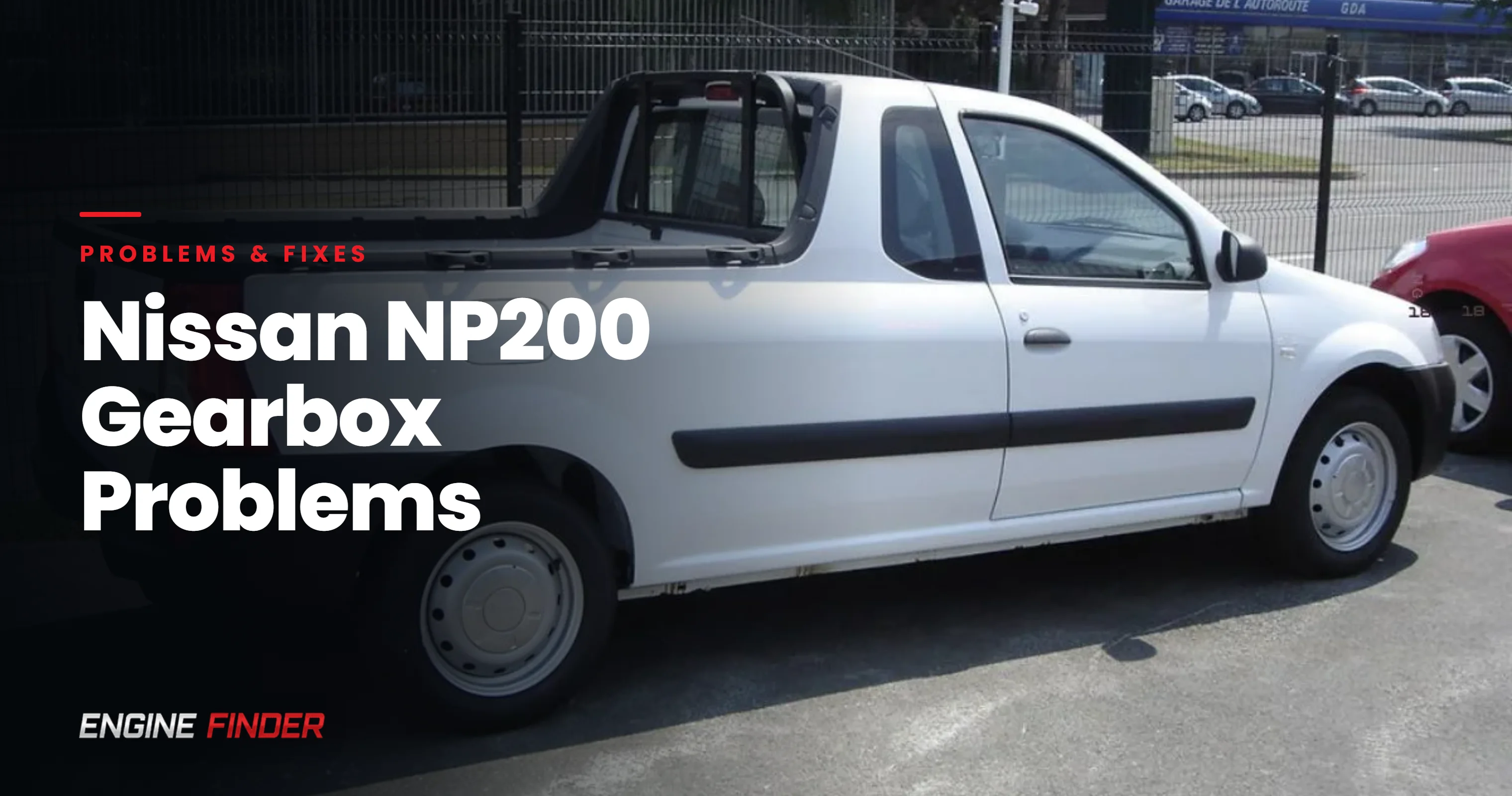
Nissan NP200 Gearbox Problems: JR5 Manual, Clutch & Costs (SA Guide)
Nissan NP200 gearbox problems explained — the Renault JR5/JH3 manual, crunchy shifts, 5th-gear whine, soft-clutch cylinder faults, and what a used or recon NP200 gearbox costs in SA.
Gearbox Exchange in South Africa: How It Works & What It Costs (2026)
A gearbox exchange swaps your faulty unit for a reconditioned one — usually back on the road in 1–2 days. See how it works, SA price ranges, warranty and the core charge explained.
Important Disclaimer
This content is for informational purposes only and is based on research from automotive industry sources. Engine Finder is not a certified automotive repair facility. Always consult with qualified automotive professionals before performing any repairs or maintenance. Improper repairs can result in personal injury, property damage, or vehicle malfunction. We assume no responsibility for actions taken based on this information.