DSG vs CVT vs Torque-Converter: Automatic Gearboxes Explained

There are three families of automatic gearbox on South African roads, and telling them apart is the single most important thing before you buy a replacement: dual-clutch (badged DSG, S-tronic, DCT, PowerShift or EDC, two computer-controlled clutches that pre-select the next gear), CVT (Multitronic, X-Tronic, IVT, a belt or chain running between cone-shaped pulleys, with no fixed gears at all), and the conventional torque-converter automatic (ZF, Aisin, Tiptronic — a fluid coupling driving a set of planetary gears). They feel similar from the driver’s seat, but inside they share almost no parts. Order “an auto gearbox” for your car without knowing which family it is, and you’ll be quoted for the wrong unit every time.
That mix-up is the number-one mistake buyers make. A DSG mechatronic unit won’t fit a CVT, a CVT belt assembly is useless to a torque-converter car, and the prices, repairability and failure points are wildly different across the three. This guide explains each family in plain terms, how it works, what tends to break, and what it all means when you’re comparing quotes for a used or reconditioned gearbox.
Key Takeaways
| Gearbox family | What it is | Common badge names | What you need to know |
|---|---|---|---|
| Dual-clutch | Two clutches pre-selecting gears | DSG, S-tronic, DCT, PowerShift, EDC | Fast shifts, but shudder + mechatronic faults are common; the mechatronic unit is sold separately |
| CVT | Belt/chain on variable pulleys, no fixed gears | Multitronic, X-Tronic, IVT, i-CVT | Smooth “rubber-band” feel; usually replaced rather than internally repaired |
| Torque-converter auto | Fluid coupling + planetary gears | ZF, Aisin, Tiptronic | The proven workhorse; most repairable of the three |
🔑 The rule that saves you money: the three families share almost no parts. Always tell the supplier which one your car has, ideally the exact gearbox code, before asking for a price.
The Three Automatic Gearbox Types at a Glance
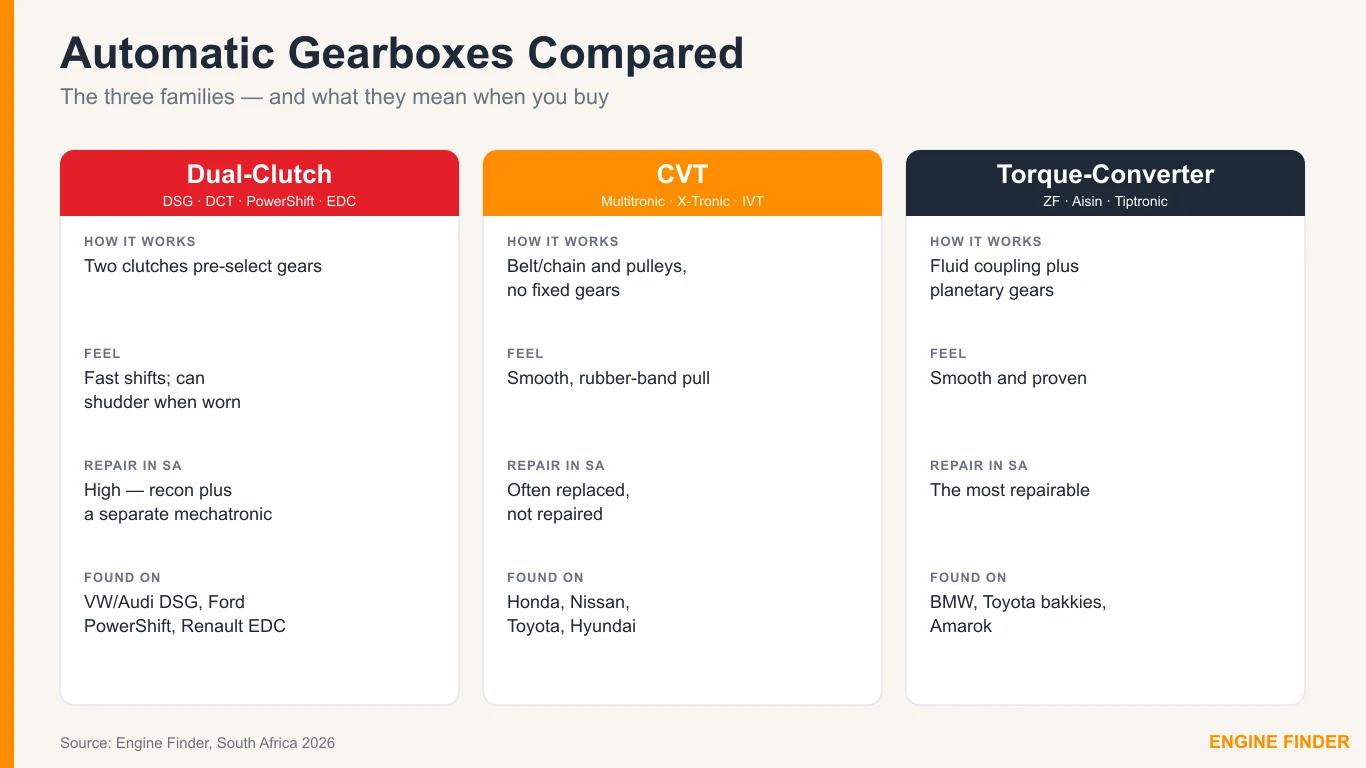
Here’s the whole picture in one view. Use it to work out which family your car belongs to, then read the matching section below for the detail.
| Type | How it works | Feel | Repair cost in SA | Found on |
|---|---|---|---|---|
| Dual-clutch (DSG/DCT/PowerShift/EDC) | Two clutches, pre-selects gears | Fast, can shudder when worn | High (recon + mechatronic) | VW/Audi DSG, Ford PowerShift, Renault EDC, Hyundai DCT |
| CVT (Multitronic/X-Tronic/IVT) | Belt/chain + pulleys, no fixed gears | Smooth, “rubber-band” | Often replace not repair | Honda, Nissan, Toyota, Hyundai, Audi A4/A6 |
| Torque-converter auto (ZF/Aisin/Tiptronic) | Fluid coupling + planetary gears | Smooth, proven | Most repairable | BMW, Toyota bakkies, Amarok, larger autos |
Why the names confuse everyone
Each manufacturer brands the same underlying technology differently. “DSG” (Volkswagen) and “S-tronic” (Audi) are both dual-clutch boxes. “Multitronic” (Audi) and “X-Tronic” (Nissan) are both CVTs. “Tiptronic” usually means a torque-converter auto with manual-style paddle shifting. The marketing name tells you the family, once you know which name maps to which family, the rest gets simpler.
Dual-Clutch Gearboxes (DSG, S-tronic, DCT, PowerShift, EDC)
A dual-clutch gearbox is essentially two manual gearboxes sharing one housing, each with its own clutch. While you’re in third, the box has already pre-selected fourth on the second clutch, so the shift happens in milliseconds with almost no power interruption. That’s why these boxes feel quick and sporty. Volkswagen calls it DSG (the wet DQ250 and dry DQ200 being the common ones), Audi calls it S-tronic (the DL501/DL382 family), Ford’s version is PowerShift (the notorious dry 6DCT250 and wet 6DCT450), Renault’s is EDC (Getrag 6DCT250), and Hyundai’s is DCT (the D7UF1 7-speed).
The catch is reliability. The dry-clutch versions in particular, VW/Audi’s DQ200 and Ford’s dry PowerShift — are well known for a low-speed shudder and clutch wear, and for failures in the mechatronic unit (the hydraulic-and-electronic brain that controls the clutches). Crucially, the mechatronic is sold as a separate part, so a “DSG for sale” listing may or may not include a healthy one. A buyer at a Pretoria workshop recently chased a persistent take-off shudder on a Golf 1.4 TSI that turned out to be a failing DQ200 mechatronic, a reconditioned unit alone ran close to R20,000 before fitment. If you’re shopping VW or Audi, look at VW DSG gearboxes and Audi gearbox options, and confirm whether the mechatronic is part of the deal. Ford owners can compare a Ford PowerShift gearbox the same way.
Don’t ignore a dual-clutch shudder
A juddering take-off on a DSG, PowerShift or EDC car is usually an early warning of clutch or mechatronic trouble, not something that “settles down”. Driving on it can turn a clutch-pack repair into a full unit replacement. Get it scanned for clutch-adaptation and mechatronic fault codes before the problem compounds.
CVT Gearboxes (Multitronic, X-Tronic, IVT)
A CVT, continuously variable transmission, throws out fixed gears entirely. Instead it runs a steel belt or chain between two cone-shaped pulleys that change diameter on the fly, giving an infinite range of ratios. The result is exceptionally smooth, stepless acceleration, but also the trademark “rubber-band” sensation: the revs flare and hold while the car catches up, which some drivers love and others can’t stand. Audi badges its CVT Multitronic (the 01J and 0AW, found on FWD A4/A6 models), Nissan calls it X-Tronic (the JATCO RE0F-series used across Qashqai, X-Trail and Micra), and Hyundai’s newer Smartstream version is IVT (sometimes i-CVT).
CVTs are common on Honda, Nissan, Toyota and Hyundai’s smaller petrol models, and they’re where modern fuel-economy gains come from. The downside is repairability: when the belt/chain or the pulleys wear — a frequent issue particularly in Nissan’s JATCO-built CVTs (spanning broadly the 2012–2021 model years), which are prone to judder and power loss — Toyota and Honda CVTs from the same era typically have a better reliability record, most workshops replace the whole unit rather than open it up, because internal CVT overhaul is specialised and often uneconomical. That makes a sound used or reconditioned unit the practical route. Nissan owners, for instance, can compare a Nissan CVT gearbox rather than gamble on an internal repair. When you ask for a price, give the model, year and engine, CVT case codes vary by build, so an exact match matters.
Torque-Converter Automatics (ZF, Aisin, Tiptronic)
The torque-converter automatic is the original “auto” and still the most durable of the three. Instead of clutches, it uses a torque converter, a fluid coupling that multiplies engine torque and lets the car idle in gear — feeding a set of planetary gears that the box shifts hydraulically. The two big suppliers are ZF (the celebrated 6HP and 8HP families used right across BMW, plus the VW Amarok’s 8HP) and Aisin (used in many Toyotas, the VW Touareg and others). “Tiptronic” is the marketing name for one of these boxes with a manual override mode.
These are the gearboxes you’ll find in BMWs, Toyota bakkies, the Amarok and most larger automatics, and they earn their reputation for durability. Because they’re built around serviceable mechanical and hydraulic parts, they’re also the most repairable family: a worn ZF 6HP mechatronic bridge-seal or a tired valve body can often be fixed without scrapping the whole unit, and a fluid-and-filter service genuinely extends their life (despite the “sealed for life” myth on the 8HP). If you’re after a BMW unit, a reconditioned BMW ZF gearbox is usually the strongest-value automatic of the three families.
Which Is Most Reliable, and What It Means When You Buy
If reliability is your priority, the order is clear: the torque-converter automatic (ZF/Aisin) is the proven workhorse, the dual-clutch box is the fastest but the most failure-prone, especially the dry-clutch DSG and PowerShift variants — and the CVT sits in between, smooth and efficient but usually a replace-don’t-repair proposition once it wears. None of that means a given car is a bad buy; it means you should know what you’re committing to and budget for the right part.
When the gearbox is beyond economical repair, a sound used or reconditioned unit is almost always cheaper than a new one, and Engine Finder lets you put that decision out to several yards at once. Suppliers are independent businesses; we simply connect you so you can compare gearboxes from verified suppliers across South Africa instead of phoning around. Get a couple of quotes, confirm exactly what each one includes (a dual-clutch quote especially should spell out whether the mechatronic is part of it), and you’ll avoid both overpaying and buying the wrong family.
Get the gearbox code, not just the car name
“It’s a 2016 Tiguan auto” isn’t enough, that car could carry a DQ200, DQ250 or DQ500 DSG depending on the engine and drivetrain. The gearbox code (stamped on the casing, e.g. DQ200, 0AW, ZF 8HP) lets a supplier match the exact unit and saves you a costly mis-buy. Ask the seller for it up front.
How to Tell Which Gearbox You Have
Start with the obvious: the badge or gear-lever surround often tells you (DSG, S-tronic, Tiptronic, Multitronic, X-Tronic). Failing that, your owner’s manual and the model/engine combination narrow it down fast, a 1.4 TSI VW is almost certainly a dry DSG, a pre-2015 FWD Audi A4 is likely a Multitronic CVT (the B9 generation from 2015 onward uses S-tronic dual clutch), a BMW 320i auto is a ZF torque-converter. The definitive answer is the gearbox code stamped on the casing, which you (or a workshop) can read directly, and your VIN, which a dealer or parts specialist can decode to the exact unit fitted at the factory.
Once you have the model, year, engine and ideally the code, give all of it to the supplier. The single most useful thing you can do is ask them to confirm the code matches before you pay — gearboxes that look identical can have different internals, electronics or ratios. If you’re unsure whether your symptoms point to the gearbox at all, our rundown of common gearbox problems helps you separate a gearbox fault from a clutch, sensor or fluid issue first.
FAQ
Is a DSG gearbox reliable?
The wet-clutch DSG units (like VW’s DQ250) have a reasonable record when serviced on schedule. The dry-clutch versions (DQ200) and Ford’s dry PowerShift are the ones with a reputation for shudder and mechatronic failure. Regular fluid changes and addressing any judder early make a big difference.
Can a CVT gearbox be repaired?
Sometimes, but most South African workshops replace rather than internally rebuild a worn CVT, overhauling the belt/chain and pulleys is specialised and often costs close to a replacement unit. A sound used or reconditioned CVT is usually the more economical route.
Which automatic gearbox lasts the longest?
Generally the conventional torque-converter automatic, particularly the ZF and Aisin units. They’re built around serviceable parts and respond well to regular fluid services, which is why they dominate larger vehicles and bakkies.
Is a dual-clutch gearbox the same as a normal automatic?
No. A dual-clutch box (DSG/DCT) uses two computer-controlled clutches and is mechanically closer to a manual, while a “normal” automatic uses a torque converter and planetary gears. They drive similarly but share no internal parts, so a replacement for one will never fit the other.
Do I need to buy the mechatronic with a DSG?
Often, yes, the mechatronic is the control brain of a dual-clutch box and a common failure point, and it’s sold as a separate part. Always confirm with the supplier whether a DSG unit includes a healthy mechatronic, or whether you’ll need to source one as well.
How do I know if my car has a CVT or a torque-converter auto?
Check the badge (X-Tronic, Multitronic and IVT are CVTs), then the model and engine. As a rule of thumb, smaller modern petrol cars from Honda, Nissan, Toyota and Hyundai tend to be CVT, while BMWs, bakkies and larger autos are torque-converter. The gearbox code on the casing confirms it.
Sources
Related Articles
Explore more insights on similar topics
Ford PowerShift Gearbox Replacement Cost in South Africa (2026 Guide)
How much does it cost to fix or replace a Ford PowerShift gearbox in South Africa? Real SA prices for the DPS6 (Focus, Fiesta, EcoSport) and MPS6 (Kuga, Mondeo) — clutch service, full swap, and when repair makes sense.
Nissan NP200 Gearbox Problems: JR5 Manual, Clutch & Costs (SA Guide)
Nissan NP200 gearbox problems explained — the Renault JR5/JH3 manual, crunchy shifts, 5th-gear whine, soft-clutch cylinder faults, and what a used or recon NP200 gearbox costs in SA.
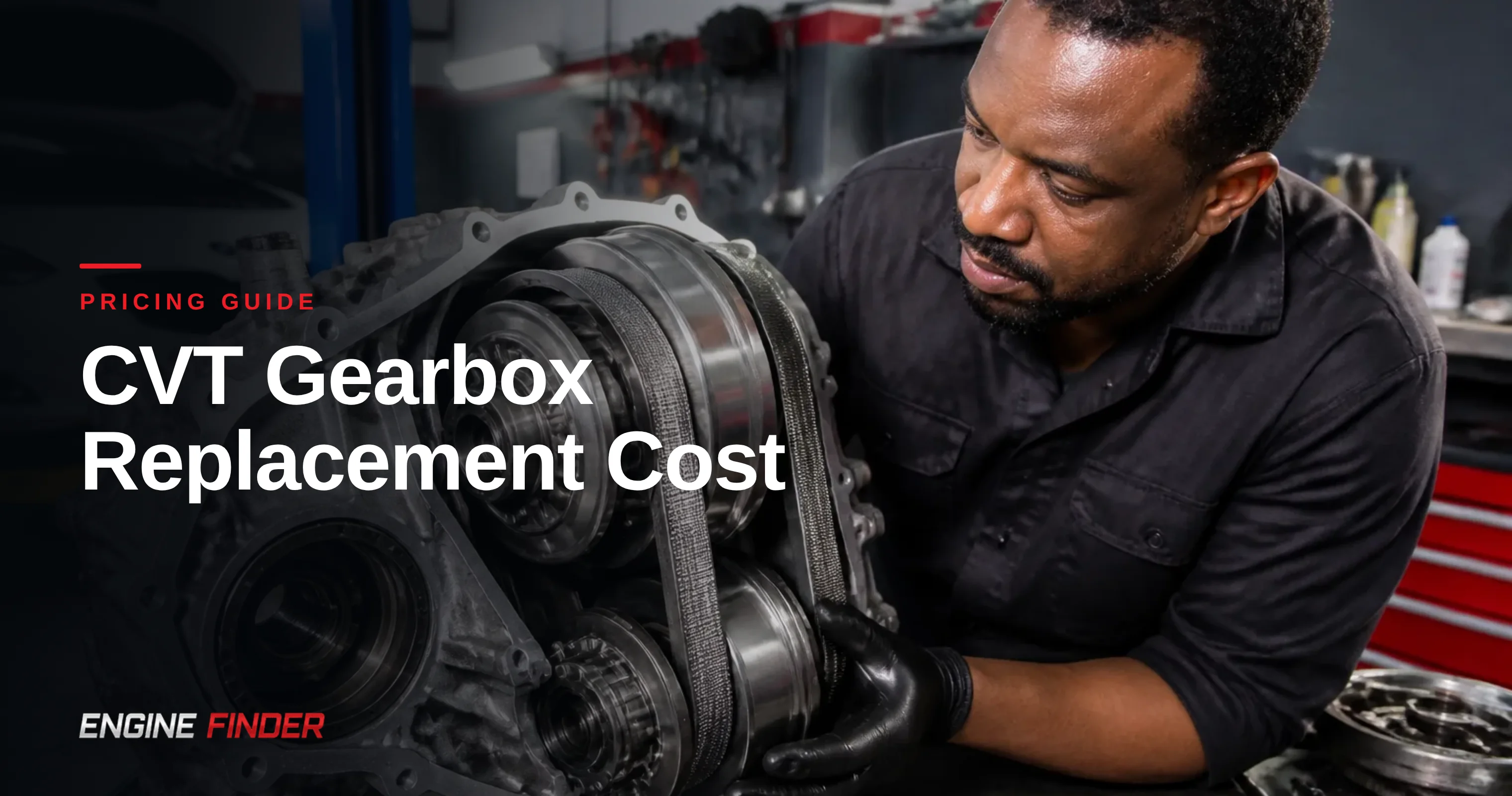
CVT Gearbox Replacement Cost in South Africa (2026 Guide)
CVT gearbox replacement in South Africa costs R8,000–R45,000 fitted, depending on make and model. See Honda Jazz, Nissan Qashqai and Juke prices, gearbox codes, failure symptoms and what drives the cost.
Important Disclaimer
This content is for informational purposes only and is based on research from automotive industry sources. Engine Finder is not a certified automotive repair facility. Always consult with qualified automotive professionals before performing any repairs or maintenance. Improper repairs can result in personal injury, property damage, or vehicle malfunction. We assume no responsibility for actions taken based on this information.