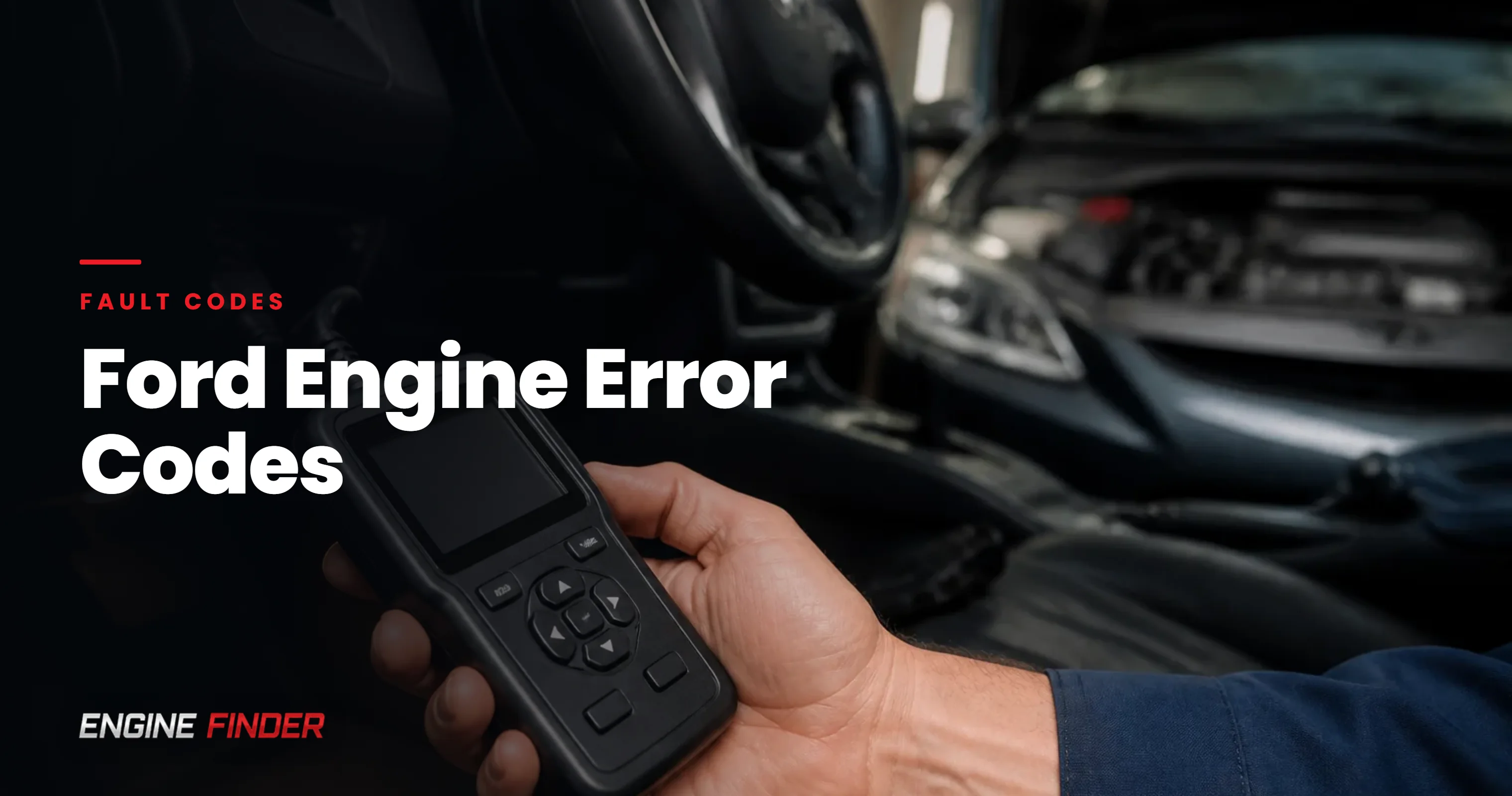
Complete Ford Engine Error Codes Guide: Diagnostic Trouble Codes & Solutions

A Ford error code is a five-character diagnostic trouble code (DTC) — such as P0299 or P246C — that the engine control module stores when a sensor reading falls outside its expected range. The letter and first digit tell you the family (P0xxx codes are generic and mean the same across every carmaker; P1xxx codes are Ford-specific), and the code points you to the system at fault, not always the failed part. On South African Fords, the most common codes cluster around the turbo, the diesel particulate filter (DPF), the EGR system and fuel pressure — especially on the Ranger and Everest 3.2/2.2 TDCi and the Fiesta, Focus, EcoSport and Kuga EcoBoost. Below is a verified reference to the codes you’re most likely to see, what each one actually means, and when a code is warning you of engine or turbo damage serious enough to need a replacement part.
- P0xxx = generic, P1xxx = Ford-specific. A generic code means the same on any car; a Ford P1xxx code (like P1299) needs Ford data to interpret fully.
- A code names the system, not the part. P0299 (underboost) can be a leaking hose, a stuck wastegate or a dying turbo — diagnose before you buy parts.
- Turbo and DPF codes dominate SA diesels. On the 3.2/2.2 TDCi Ranger, P0299, P246C, P2002 and P0087 are the everyday offenders.
- Some codes point to real engine damage. P1299 (cylinder-head overheat), P0016 (timing correlation) and repeat P0087 (low rail pressure) can precede a failed head, turbo or high-pressure pump.
- Read it before you clear it. Note the freeze-frame data, then decide — clearing a code without fixing the fault only hides the problem until the next drive cycle.
How to read a Ford error code
Every Ford sold in South Africa since 1996 has a 16-pin OBD-II port, usually under the dashboard near the driver’s right knee. To pull codes you need nothing more exotic than a basic OBD-II scanner, though a Ford-aware tool (or the workshop’s Ford IDS software) reads the P1xxx manufacturer codes and live data that a cheap generic reader can miss.
- Locate the OBD-II port under the dash.
- Plug the scanner in with the ignition off.
- Turn the ignition to ON (position II) — don’t start the engine.
- Select Read Codes and record every stored and pending code.
- Save the freeze-frame data (the sensor snapshot at the moment the fault set) — it’s the single most useful clue for diagnosis.
A DTC is structured, not random. The first character is the system (P = powertrain, B = body, C = chassis, U = network/communication). The second digit tells you whether it’s a generic SAE code (0) or a manufacturer-specific one (1). The remaining three characters identify the exact fault. That’s why P0299 reads the same on a Ford as on a VW, while P1299 only makes sense with Ford’s own definitions.
The most common Ford error codes explained
The table below lists the codes SA Ford owners see most often, split into generic OBD-II codes (valid on any make) and Ford-specific codes. Every definition is drawn from the SAE J2012 generic standard and reputable DTC references — see the sources at the end.
Generic OBD-II codes (P0xxx / P2xxx)
| Code | What it means (verified) | Common cause | Typical fix |
|---|---|---|---|
| P0016 | Crankshaft Position – Camshaft Position Correlation (Bank 1, Sensor A) — cam and crank timing out of sync | Stretched timing chain/belt, worn tensioner, cam/crank sensor fault; on 1.0 EcoBoost a degraded wet timing belt | Verify timing; replace timing chain/belt kit or the offending sensor |
| P0087 | Fuel Rail/System Pressure Too Low — actual rail pressure below the commanded target | Weak lift pump, clogged fuel filter, failing high-pressure pump, faulty rail-pressure sensor | Replace fuel filter; test lift/HP pump and rail sensor pressure |
| P0234 | Turbocharger/Supercharger “A” Overboost Condition — boost above spec | Stuck/sticking wastegate, faulty boost sensor, wastegate actuator fault | Free or replace wastegate/actuator; check boost sensor and hoses |
| P0299 | Turbocharger/Supercharger “A” Underboost Condition — boost below spec | Split intercooler/boost hose, leaking wastegate, faulty vacuum control valve, failing turbo | Pressure-test the boost system, replace leaking hoses/valve; rebuild or replace turbo if worn |
| P0401 | Exhaust Gas Recirculation “A” Flow Insufficient Detected | Clogged/carboned EGR valve or passages, faulty EGR sensor | Clean or replace EGR valve; clear carbon from EGR passages |
| P0420 | Catalyst System Efficiency Below Threshold (Bank 1) — cat not converting effectively | Aged/failed catalytic converter, faulty O2 sensor, upstream misfire/oil burn | Confirm with O2 data; replace catalytic converter or sensor |
| P2002 | Diesel Particulate Filter Efficiency Below Threshold (Bank 1) — DPF not trapping soot properly | Heavy soot load from short trips, DPF near end of life, faulty pressure sensor | Forced regeneration; replace DPF if it fails the efficiency test |
| P2263 | Turbocharger/Supercharger Boost System Performance — boost doesn’t match commanded value | Failed turbo, boost/exhaust-pressure sensor fault, wastegate failure, major boost leak | Diagnose boost system; repair leaks, replace sensor or turbo |
| P246C | Diesel Particulate Filter Restriction – Forced Limited Power (Bank 1) — DPF blocked, engine in limp mode | Blocked DPF from repeated short trips, failed regens, faulty DPF pressure sensor | Service-tool forced regen or DPF clean/replace; fix the cause of failed regens |
Ford-specific codes (P1xxx)
| Code | What it means (verified) | Common cause | Typical fix |
|---|---|---|---|
| P1299 | Cylinder Head Temperature (CHT) Sensor Detected Engine Overheating — protection mode active | Low coolant, failed thermostat, water-pump or radiator-fan failure, head-gasket loss | Stop driving; fix cooling fault. Check for head-gasket/head damage if it overheated |
⚠️ Critical Warning
Do not keep driving with an active P1299. It means the cylinder-head temperature has crossed a safety limit — continued running risks a warped head or blown head gasket within minutes.
Which codes point to major engine or turbo damage
Most DTCs are warnings you can act on before anything breaks. A handful, though, either signal existing damage or reliably lead to it if ignored:
- P1299 (cylinder-head overheat). This is a protection code — by the time it sets, the head has already run hot. If the engine overheated hard, budget to check the head gasket and the head itself for warping before you trust the motor again.
- P0016 (timing correlation). On the 1.0 EcoBoost this is the classic symptom of a degraded “wet” cam belt. That failing belt sheds material into the oil, which can starve and kill the turbo and the engine — this is one code you never defer.
- P0087 (low fuel-rail pressure), recurring. Sustained low rail pressure on a common-rail TDCi can wreck the high-pressure pump and injectors. A one-off from a blocked filter is cheap; a repeat after the filter is renewed points at pump or injector wear.
- P0299 / P2263 (turbo underboost / boost performance). Often just a split intercooler hose — but if the boost system is sealed and the code persists, the turbo itself is failing. Left running, a disintegrating turbo can send debris downstream into the engine.
- P2002 / P246C (DPF efficiency / restriction). A blocked DPF forcing limited power (P246C) usually means failed regens, and the root cause — high oil consumption, EGR or injector faults — is often an engine problem in its own right.
If the diagnosis lands on a failed turbo, a damaged head or a worn-out engine, replacing the part is frequently more economical than a full workshop rebuild — see the next section.
When to source a used engine or part
Some codes are a R900 EGR clean; others end with a quote for a new turbo, cylinder head or long block. Once a Ford dealer or independent workshop has confirmed the failed component — a scored turbo behind a persistent P0299, a cracked head behind P1299, or a tired common-rail pump behind repeat P0087 — a good-quality used or reconditioned part is usually the smart buy on an out-of-warranty Ford.
That’s where Engine Finder helps: post one enquiry and verified Ford engine suppliers across South Africa quote you on used and reconditioned engines, turbos, DPFs and cylinder heads with nationwide delivery. For deeper background on the codes above as they appear on the best-selling diesel, our guide to Ford Ranger 3.2 TDCi engine problems walks through the EGR-cooler, oil-pump and piston failures that sit behind many of these DTCs.
Frequently Asked Questions
What does a P0xxx code mean versus a P1xxx code on my Ford?
P0xxx codes are generic SAE codes that mean exactly the same thing on any make of car — P0299 is “turbo underboost” whether it’s a Ford or a Toyota. P1xxx codes are manufacturer-specific; a Ford P1299 (“cylinder-head over-temperature”) needs Ford’s own definitions to interpret, and the same number could mean something different on another brand.
What are the most common Ford Ranger 3.2 fault codes in South Africa?
On the 3.2 and 2.2 TDCi Ranger and Everest, the codes that come up most are turbo and after-treatment related: P0299 (turbo underboost), P2002 and P246C (DPF efficiency and restriction), P0401 (EGR flow) and P0087 (low fuel-rail pressure). Most trace back to the DPF, EGR, boost hoses or fuel system.
Can I keep driving my Ford with a check-engine light on?
It depends entirely on the code. A steady light for something like P0420 (catalyst efficiency) is safe to drive to the workshop. But a P1299 overheat warning, a flashing engine light, or a P246C forced-limited-power code means stop and diagnose — continuing risks serious engine or turbo damage.
Why does my Ford error code keep coming back after I clear it?
Clearing a code only erases the stored fault; it doesn’t fix anything. The ECM re-runs its monitors every drive cycle, so if the underlying fault is still present the code returns. A code that comes straight back after clearing is telling you the repair isn’t done.
Do I need a Ford-specific scanner or will a generic OBD-II reader work?
A basic generic reader will pull every P0xxx code and clear it. To read the Ford-specific P1xxx codes and the live data needed to diagnose turbo, DPF and injector faults properly, you (or your workshop) need a Ford-aware tool or Ford IDS software.
The bottom line
A Ford error code is a starting point, not a diagnosis. Read the code, note the freeze-frame data, and separate the generic P0xxx families from the Ford-specific P1xxx codes so you know exactly which system is complaining. Most codes you can chase down to a hose, a sensor or a service item. But when the trail ends at a failed turbo, a cracked cylinder head or a worn common-rail pump, a quality used or reconditioned part is usually the cheapest way back onto the road. Post your Ford’s details on Engine Finder and let verified suppliers quote you on the exact engine, turbo or part your codes point to — no obligation, delivery countrywide.
References and Sources
- OBD-Codes.com — P0299 Turbocharger/Supercharger “A” Underboost Condition
- AutoZone — P2002 Diesel Particulate Filter Efficiency Below Threshold (Bank 1)
- RepairPal — P246C Diesel Particulate Filter Restriction, Forced Limited Power
- AutoZone — P0016 Crankshaft Position – Camshaft Position Correlation (Bank 1, Sensor A)
Related Articles
Explore more insights on similar topics
Ford Ranger Gearbox Replacement Cost in South Africa (2026 Guide)
Ford Ranger automatic gearbox replacement costs R19,500–R37,000 for the 6R80 (3.2 TDCi) and R34,000–R55,000 for the 10R80 (2.0 BiTurbo). Real SA prices, gearbox codes, 6R80 failure modes, labour hours, and a worth-it calculator.
Nissan NP200 Gearbox Problems: JR5 Manual, Clutch & Costs (SA Guide)
Nissan NP200 gearbox problems explained — the Renault JR5/JH3 manual, crunchy shifts, 5th-gear whine, soft-clutch cylinder faults, and what a used or recon NP200 gearbox costs in SA.
BMW B47 Engine Problems: EGR Recall & SA Repair Costs (2026)
BMW fixed the N47's chain-snap epidemic with the B47 — but the EGR cooler fire-risk recall, DPF clogging and carbon build-up became the new headaches. Symptoms, SA repair costs, and when a used engine wins.
Important Disclaimer
This content is for informational purposes only and is based on research from automotive industry sources. Engine Finder is not a certified automotive repair facility. Always consult with qualified automotive professionals before performing any repairs or maintenance. Improper repairs can result in personal injury, property damage, or vehicle malfunction. We assume no responsibility for actions taken based on this information.