BMW B47 Engine Problems: EGR Recall & SA Repair Costs (2026)

Key Takeaways
| Problem | Main Symptoms | Possible Causes |
|---|---|---|
| EGR Cooler Leak (Recall) | Unexplained coolant loss, burning smell, smoke | Cracked EGR cooler — subject of a global fire-risk recall |
| EGR & Swirl-Flap Carbon | Rough idle, limp mode, low-end torque loss | Soot coking the intake on short-trip city cars |
| DPF Clogging | DPF warning, limp mode, poor economy | Incomplete regeneration in stop-start driving |
| Injector / HP Fuel Pump | Hard starting, power loss, fuel-pressure codes | Pump wear, low-lubricity diesel, long service gaps |
| Turbo VGT Actuator | Over/under-boost, limp mode, turbo lag | Soot binding the variable-geometry vanes |
| Timing Chain (rare/late) | Faint rattle at very high mileage | Improved chain still wears eventually — far later than N47 |
If you searched “B47 engine problems” expecting the BMW N47’s infamous timing-chain death rattle, here’s the good news: the B47 (2014-onward) largely fixed it. BMW revised the chain guides, oil feed and tensioner, so chain failures on the B47 are now rare and late rather than the 60,000–100,000 km write-off that plagued the N47. The bad news is what replaced it — the EGR cooler became the B47’s Achilles’ heel, serious enough to trigger a multi-country fire-risk recall. This guide covers the EGR recall, the DPF and carbon issues that bite hardest in South African city driving, and the fuel and turbo faults worth knowing before you buy or repair a B47-powered 320d, 520d, X3 20d or 118d.
Quick B47 triage — what your symptom usually means
- Coolant disappearing with no puddle under the car, sometimes a burning/exhaust smell — suspect the EGR cooler (see #1). This is the recall issue — check your VIN before paying for anything.
- Rough idle, hesitation or limp mode on a town-driven car — carbon-clogged EGR valve, intake or swirl flaps (#2), or a blocked DPF (#3).
- Hard starting, fuel-pressure fault codes, loss of power — high-pressure fuel pump or injector wear (#4).
BMW B47 Engine Specifications
| Specification | Detail |
|---|---|
| Engine Code | B47D20 (RWD), B47C20 (FWD/MINI) |
| Displacement | 1,995 cc |
| Configuration | Inline-4 turbodiesel, DOHC 16v, common rail |
| Power Output | 85–165 kW (114–221 hp) |
| Torque | 270–450 Nm |
| Turbocharger | Variable-geometry (twin-turbo on 125d/325d) |
| Emissions | Euro 6b; Euro 6d “B47TÜ” (2018+) adds AdBlue/SCR |
| Production | 2014–present (replaced the N47) |
| Service Interval | Every 15,000–25,000 km (shorten for city use) |
Specifications vary by variant and market — always confirm against your car’s VIN and build data (BMW B47 reference).
BMW Models with the B47 Engine (sold in South Africa)
1 & 2 Series: 118d, 120d, 125d (F20/F21), 220d (F22) 3 & 4 Series: 318d, 320d (F30/F31 and G20), 420d (F32/F33/F36) 5 Series: 518d, 520d (F10 and G30) X range: X1 sDrive18d/20d (F48), X2 (F39), X3 xDrive20d (F25 and G01), X4 xDrive20d (F26/G02)
Is it an N47 or a B47?
Rough rule of thumb: 2007–2014 = N47, 2014-onward = B47. There’s overlap around 2014–2015 as models switched over, so confirm against the VIN and build date — the two share the 2.0-litre four-cylinder diesel layout but have different failure profiles.
1. EGR Cooler Coolant Leak (the recall issue)
This is the B47’s defining defect. The EGR cooler can crack internally, letting engine coolant leak into the EGR module where it mixes with dry soot at high exhaust temperatures. The result is smouldering deposits that can melt the intake manifold — a genuine engine-bay fire risk. It was serious enough that BMW issued a large diesel recall covering the N47, N57 and B47 engines (Consumer Reports).
Causes
- Internal crack in the EGR cooler allowing coolant into the hot EGR path
- Coolant mixing with accumulated soot and igniting under heat
- Manufacturing/design defect — not a wear item or a maintenance failure
Symptoms
- Unexplained coolant loss with no visible external leak
- Burning smell, white steam or smoke from the engine bay
- EGR or coolant-temperature warning lights, reduced power
- In the worst cases, visible smoke or a melted intake manifold
Solution
- Check your VIN against BMW’s recall list first — eligible cars get the fix free
- EGR cooler (and often the EGR module) replacement with the revised part
- Coolant system flush and pressure test to confirm no further leak
- Intake manifold replacement if soot damage has already occurred
DIY Difficulty / Hours
- Diagnosis: Advanced / 2–3 hours
- EGR cooler + module replacement: Expert only / 6–10 hours
Check the recall before you pay
BMW’s EGR-cooler fire-risk recall covers this exact failure. The US action began with the N47 and N57 diesels (NHTSA campaign 18V-755, 2018) and was later broadened into a worldwide recall of roughly 800,000 diesels that also swept in the B47, spanning roughly the 2013–2018 model years. If your car is in scope, BMW replaces the cooler at no charge — never pay an independent for a repair a recall covers. Confirm eligibility by VIN with a franchised BMW dealer.
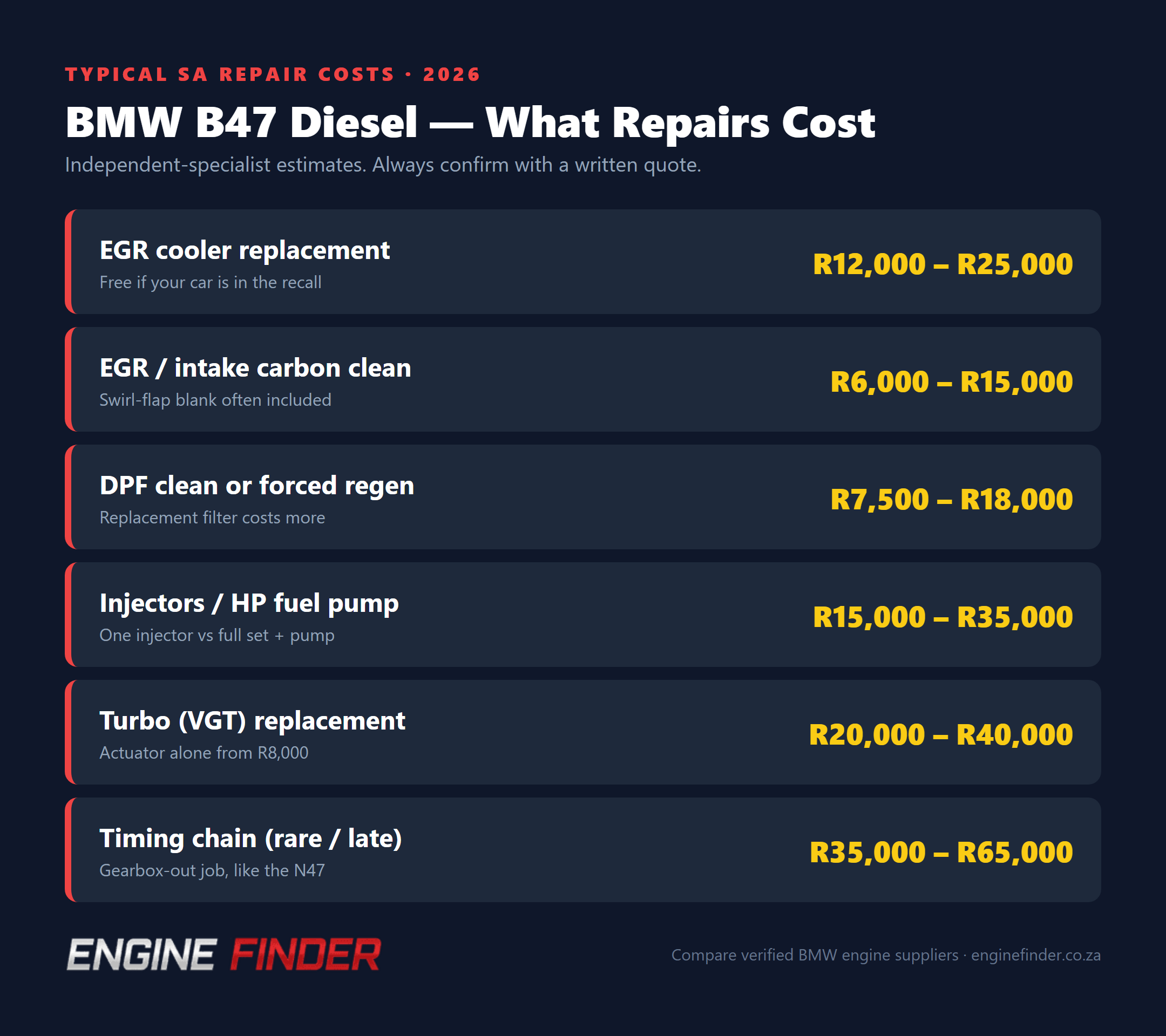
Estimated cost (outside recall): R12,000–R25,000 for the cooler, module, coolant and labour at an independent specialist. Get a written quote — this is a bigger job than a simple EGR valve.
A cracked EGR cooler stripped and replaced — the exact failure behind the recall (shown on a six-cylinder diesel; the B47 cooler fails the same way).
2. EGR Valve and Swirl-Flap Carbon Build-Up
Like every modern diesel, the B47 recirculates exhaust gas back through the intake. On short-trip, stop-start city cars the engine never gets hot enough to burn that soot off, so the EGR valve, intake manifold and swirl flaps slowly coke up with carbon. It’s the single most common reason a well-cared-for B47 ends up in limp mode.
Causes
- Soot deposits from EGR recirculation building up over time
- Short urban trips that prevent the intake from staying hot enough to self-clean
- A partly-failed EGR valve dumping excess exhaust gas into the intake
Symptoms
- Rough or lumpy idle, hesitation and misfire-like stumbles
- Loss of low-end torque and general sluggishness
- Limp mode with airflow or EGR-related fault codes
- Increased smoke and worse fuel economy
Solution
- Diagnostic scan to confirm EGR vs swirl-flap vs DPF cause
- EGR valve and intake manifold clean or replacement
- Swirl-flap inspection — many SA specialists blank/delete worn flaps preventively to stop a broken flap being swallowed by the engine
- Walnut-blast or manual de-coke of the intake tract
DIY Difficulty / Hours
- EGR/intake clean: Intermediate / 3–5 hours
- Swirl-flap blank + manifold clean: Advanced / 4–6 hours
City driving is the enemy
Give the car a proper 20–30 minute highway run at motorway revs every week or two. It lets the intake and DPF get hot enough to burn off soot, and it’s the cheapest carbon-prevention there is.
Estimated cost: R6,000–R15,000 for an EGR/intake clean and swirl-flap blank, depending on how far the carbon has spread.
Fitting a swirl-flap delete kit to a 2016 B47 420d — the common fix once the intake and swirl flaps carbon up.
3. DPF (Diesel Particulate Filter) Clogging
The DPF traps soot and periodically burns it off in a regeneration cycle — but that cycle needs sustained heat. A B47 that only ever does short school-run and traffic trips never completes a proper regen, so the filter loads up with soot until it blocks and forces the car into limp mode.
Causes
- Incomplete passive/active regeneration on short, low-speed trips
- Repeatedly interrupted regen cycles (switching the car off mid-regen)
- An upstream problem (EGR, injectors, boost) dumping extra soot into the filter
Symptoms
- DPF warning light and eventual limp mode
- Noticeably worse fuel economy
- More frequent forced regeneration cycles
- A faint smell of burning during attempted regens
Solution
- A sustained highway drive to trigger a full regeneration (catch it early)
- Forced/service regeneration via diagnostic equipment
- Professional DPF clean if soot loading is too high to burn off
- DPF replacement if the filter is cracked or fully blocked
DIY Difficulty / Hours
- Forced regen: Intermediate / 1–2 hours
- DPF removal and professional clean: Advanced / 3–5 hours
DPF delete is not a free pass
Removing the DPF and remapping the ECU is common and cheap in SA (often from around R4,000), but it makes the car non-compliant and can fail a roadworthy. Weigh that against a proper clean before you commit — especially if you plan to resell.
Estimated cost: roughly R7,500–R18,000 for a professional clean or forced regen; a genuine replacement filter costs considerably more.
How a BMW DPF regeneration actually works — and why short, stop-start city trips stop it completing.
4. Injector and High-Pressure Fuel Pump Wear
The B47’s common-rail system runs at very high pressure, and both the pump and injectors are sensitive to fuel quality and maintenance. Running the tank low, poor-lubricity diesel, or stretching service intervals all accelerate wear.
Causes
- High-pressure pump plunger wear, worsened by low fuel levels and long service gaps
- Injector nozzle fouling or leaking (high return flow)
- Contaminated or low-lubricity diesel
Symptoms
- Hard starting, especially when cold
- Power loss, rough running and elevated smoke
- Fuel-pressure or injector fault codes
- Noisy fuel system operation
Solution
- Fuel-pressure and injector return-flow testing to isolate the culprit
- Injector cleaning, or replacement of failed injectors
- High-pressure pump replacement if worn
- Fresh fuel filter and a habit of not running the tank to empty
DIY Difficulty / Hours
- Fuel-system diagnosis: Advanced / 2–3 hours
- Injector replacement: Advanced / 4–6 hours
- HP pump replacement: Expert only / 6–8 hours
Estimated cost: R15,000–R35,000 depending on whether it’s one injector or the pump and full set.
Spotting leaking or clogged injectors on a BMW diesel before they cause hard starting and power loss.
5. Turbo VGT Actuator and Boost Problems
The B47 uses a variable-geometry turbo, and as with its N47/M47 predecessors the vanes can bind up with soot or the electronic actuator can fail. The engine then can’t control boost properly and drops into limp mode.
Causes
- Soot binding the variable-geometry vanes
- Electronic actuator or linkage failure
- Oil contamination or a starved oil feed to the turbo bearing
Symptoms
- Over-boost or under-boost with boost-deviation fault codes
- Turbo lag, flat-spots or sudden limp mode
- Whistling or grinding from the turbo, blue smoke if seals fail
Solution
- Actuator test and recalibration, or replacement
- Turbo vane clean where soot is the cause
- Full turbo rebuild or replacement if the bearing or wheels are damaged
- Address any upstream EGR/DPF issue feeding it extra soot
DIY Difficulty / Hours
- Actuator diagnosis: Advanced / 2–3 hours
- Actuator replacement: Advanced / 3–5 hours
- Turbo replacement: Expert only / 8–12 hours
Estimated cost: R8,000–R20,000 for an actuator; R20,000–R40,000 for a complete turbo replacement.
Diagnosing a BMW 2.0-litre diesel boost fault — the same variable-geometry turbo the B47 inherited from the N47.
6. Timing Chain — Much Improved, Not Immortal
The reason so many people search “B47 timing chain” is the N47’s reputation. It’s worth being clear: BMW genuinely improved the chain on the B47 — better guide material, a revised oil feed, a shorter primary chain and a new tensioner (timing-chain specialist comparison). Failures are now rare and, when they happen, tend to be at very high mileage (well beyond 200,000 km) on cars with neglected oil changes.
Causes
- Long-term wear on a still-improved chain and guides
- Skipped or extended oil-change intervals accelerating wear
- Wrong oil specification or chronic low oil level
Symptoms
- A faint rattle at cold start on very high-mileage engines
- In rare advanced cases, timing fault codes or rough running
Solution
- Stick to fresh oil at sensible intervals with BMW Longlife-04 spec oil
- Investigate any cold-start rattle promptly — it’s cheap to check, expensive to ignore
- Full chain kit replacement only if wear is confirmed
DIY Difficulty / Hours
- Diagnosis: Advanced / 2–3 hours
- Chain replacement: Expert only / 12–16 hours
Still a gearbox-out job
BMW improved the chain but did not move it — it’s still at the gearbox end of the block. So on the rare occasion a B47 chain does need doing, it’s the same labour-heavy job as the N47. And it’s still an interference engine, so a snapped chain wrecks the head. That’s why the bill lands at R35,000–R65,000, and why a used engine is often the smarter call after a failure.
Estimated cost: R35,000–R65,000 if the full timing system needs replacing.
A specialist inspects a 130,000-mile B47 chain and weighs up whether it actually needs doing — the improved-but-not-immortal reality.
When a Used B47 Engine Beats a Repair
Once a repair bill stacks up — a fire-damaged EGR job with a melted manifold, a failed HP pump plus injectors, or a rare chain failure that’s touched the head — the numbers can climb past R60,000 fast. At that point a low-mileage used B47 replacement engine with a short warranty is often the cheaper, faster route back onto the road. It’s worth comparing verified BMW 320d and 520d engine supplier prices before you commit to an open-ended repair.
Preventive Maintenance for the B47
Every 10,000–15,000 km (shorten for city use)
- Oil and filter change with BMW Longlife-04 approved oil — don’t stretch the interval
- Visual check for coolant loss (the early EGR-cooler warning sign)
Every 25,000–40,000 km
- Fuel filter replacement and a fuel-system health check
- EGR and intake inspection on town-driven cars
- A deliberate long highway run before this service to help the DPF regenerate
Every 60,000 km
- EGR/swirl-flap and intake de-coke if carbon symptoms have appeared
- Turbo actuator operation check
- DPF soot-load check via diagnostics
FAQ
Is the BMW B47 engine reliable?
The B47 is meaningfully more reliable than the N47 it replaced — BMW fixed the notorious timing-chain failure that wrote off so many N47s. Its main weaknesses are the EGR cooler (subject of a fire-risk recall), and the usual modern-diesel issues of DPF clogging and carbon build-up, which hit hardest on short-trip city cars. Looked after with regular oil changes and the odd long highway run, a B47 is a dependable engine.
What is the BMW B47 EGR recall about?
The EGR cooler can crack internally and let coolant leak into the hot EGR path, where it mixes with soot and can smoulder or catch fire. BMW recalled affected diesels — the US N47/N57 action (NHTSA campaign 18V-755, 2018) was later broadened into a worldwide recall that also covered the B47 — spanning roughly 2013–2018 model years. Eligible cars get the cooler replaced free, so check your VIN with a BMW dealer before paying for any EGR work.
Does the BMW B47 still have timing chain problems?
Rarely. BMW revised the guide material, oil feed, chain length and tensioner, so B47 chain failures are uncommon and usually occur only at very high mileage on cars with neglected servicing — unlike the N47, which often failed at 60,000–100,000 km. It’s still a gearbox-out job if it ever needs doing, so keep the oil fresh.
How much does it cost to fix common B47 problems in South Africa?
As a rough guide at an independent specialist: EGR cooler replacement around R12,000–R25,000 (free if your car is in the recall), an EGR/intake carbon clean R6,000–R15,000, a DPF clean R7,500–R18,000, injectors or the HP fuel pump R15,000–R35,000, and a turbo R20,000–R40,000. Always get a written quote — and once a repair passes about R60,000, price a used replacement engine too.
Which BMW models use the B47 engine?
In South Africa the B47 powers the 118d/120d/125d, 220d, 318d/320d, 420d, 518d/520d, and the X1, X2, X3 and X4 20d/18d diesels, from roughly 2014 onward. Earlier 2007–2014 cars use the N47.
Should I delete the DPF on my B47?
It’s common and cheap in SA, but a DPF delete makes the car non-compliant and can fail a roadworthy inspection, which also hurts resale. For most owners a professional DPF clean plus a habit of regular highway driving is the better long-term answer.
Conclusion
The BMW B47 is the engine BMW got largely right after the N47 — the timing-chain lottery is effectively over. What replaced it is a more familiar modern-diesel story: an EGR cooler serious enough to recall, plus DPF and carbon issues that reward highway driving and punish short city trips. If your dashboard is throwing codes, our BMW error codes diagnostic guide explains the most common ones and their fixes.
When a repair stops making financial sense, BMW owners can source parts through BMW scrap yards or professional BMW stripping for spares services. Engine Finder connects you with vetted engine specialists across South Africa — so whether you need a diagnosis, a used B47 or a full replacement, you can compare real suppliers in one place.
Related Articles
Explore more insights on similar topics
BMW 3 Series Gearbox Replacement Cost in South Africa (2026 Guide)
Full 2026 cost guide for BMW 3 Series (E46, E90, F30) automatic gearbox replacement in South Africa. ZF 6HP and 8HP prices, mechatronic repair vs full replacement, and how to find a quality recon unit.
Ford Focus Gearbox Replacement Cost in South Africa (2026 Guide)
Ford Focus gearbox replacement costs R6,000–R18,000 for a manual and R18,000–R38,000 for the PowerShift DCT in South Africa. Full price breakdown by variant, known DPS6 problems, and how to save.
Nissan NP200 Gearbox Problems: JR5 Manual, Clutch & Costs (SA Guide)
Nissan NP200 gearbox problems explained — the Renault JR5/JH3 manual, crunchy shifts, 5th-gear whine, soft-clutch cylinder faults, and what a used or recon NP200 gearbox costs in SA.
Important Disclaimer
This content is for informational purposes only and is based on research from automotive industry sources. Engine Finder is not a certified automotive repair facility. Always consult with qualified automotive professionals before performing any repairs or maintenance. Improper repairs can result in personal injury, property damage, or vehicle malfunction. We assume no responsibility for actions taken based on this information.