Ford Ranger 3.2 TDCi Engine Problems: Common Faults, Costs & Solutions (SA Guide)

The Ford Ranger 3.2 TDCi is powered by the Duratorq P5AT — a 3.2-litre five-cylinder turbo diesel engine fitted to the T6 Ranger from 2011 through 2022 (and the Everest and Mazda BT-50 over a similar period). It’s a capable, torquey workhorse that produces around 147 kW and 470 Nm, but after a decade in South African conditions — dusty Highveld air, variable diesel quality, and plenty of short urban trips — a clear pattern of recurring faults has emerged.
This guide focuses on the five most common Ford Ranger 3.2 engine problems South African owners report, with realistic rand repair costs, symptoms to watch for, and when replacement makes more sense than another expensive fix. All prices below are indicative South African ranges based on parts and labour at independent diesel specialists — main-dealer quotes will typically be 30–50% higher.
For broader Ranger model issues across all engine variants, see our complete Ford Ranger problems guide. Independent SA workshop Steves Auto Clinic and the Cars.co.za 2015–2022 Ranger buyer’s guide both flag the same recurring P5AT faults we cover below — EGR coolers splitting, oil-pump wear and turbo failures top the SA mechanic complaint list.
Key Takeaways
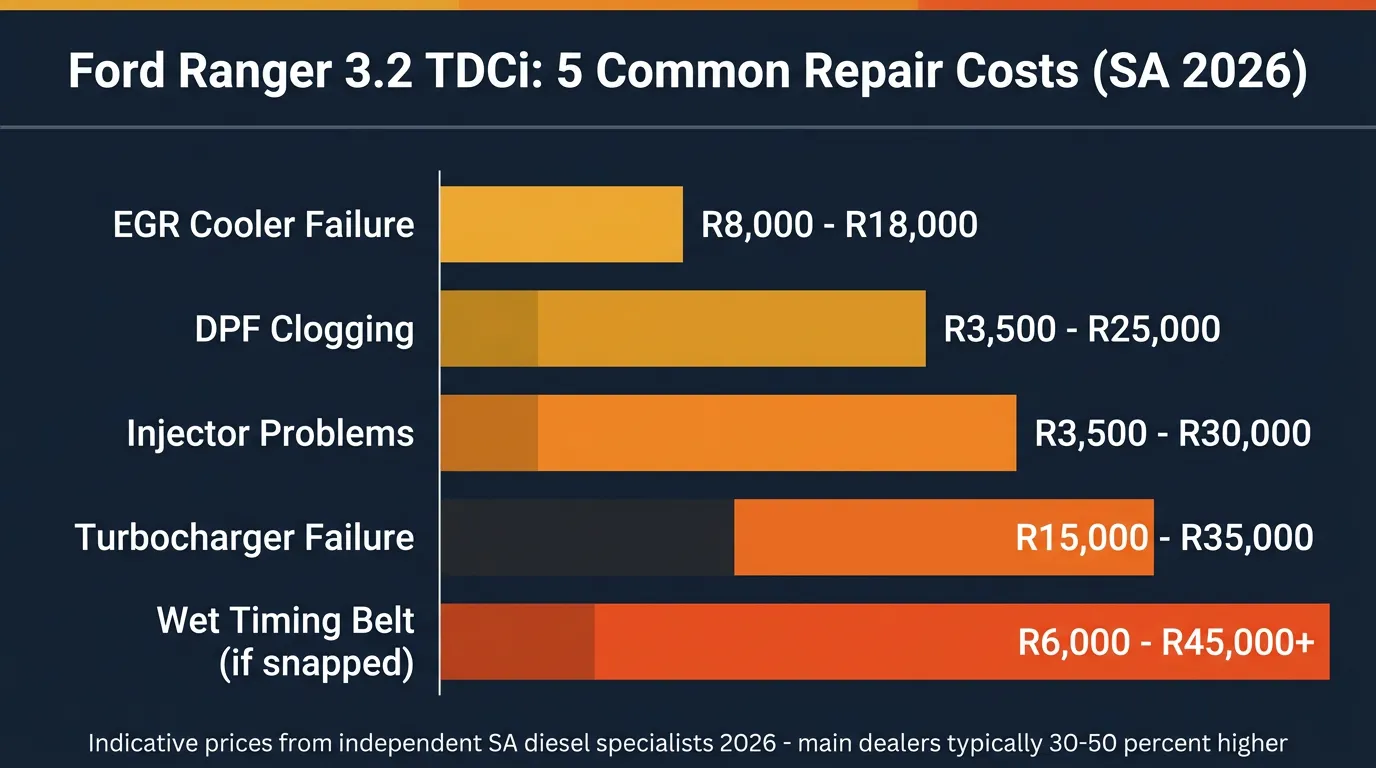
| Problem | Main Symptoms | Indicative Repair Cost (SA) |
|---|---|---|
| EGR Cooler Failure | White smoke, coolant loss, overheating | R8,000 – R18,000 |
| Turbocharger Failure | Whistling, power loss, oil consumption | R15,000 – R35,000 |
| Injector Problems | Rough idle, smoke, hard cold start | R3,500 – R30,000 |
| DPF Clogging | Limp mode, regen warning, power loss | R3,500 – R25,000 |
| Timing Chain Wear | Chain rattle, oil-pump warning, timing slip | R6,000 – R45,000+ |
Ford Ranger 3.2 (P5AT) Engine Specifications
| Specification | Details |
|---|---|
| Engine Code | P5AT (Duratorq 3.2 TDCi) |
| Configuration | Inline-5, DOHC, turbocharged diesel |
| Displacement | 3,198 cc |
| Fuel System | Common-rail direct injection |
| Power / Torque | 147 kW / 470 Nm |
| Emissions Kit | EGR + DPF (Euro 5) |
| Fitted To | Ford Ranger T6, Ford Everest, Mazda BT-50 |
| Production | 2011 – 2022 |
1. EGR Cooler Failure
The EGR (exhaust gas recirculation) cooler on the P5AT is one of the engine’s weakest components. It uses engine coolant to drop exhaust-gas temperatures before re-injecting them into the intake, and the internal tubes are prone to cracking from constant thermal cycling. Once they crack, coolant leaks directly into the exhaust stream — or worse, into the cylinders.
Symptoms
- Persistent coolant loss with no visible external leak.
- White, steam-like smoke from the exhaust on start-up and under load.
- Overheating, particularly when towing or climbing.
- Milky or “chocolate-milkshake” oil if coolant reaches the sump.
Causes
- Thermal fatigue cracking of the cooler’s internal matrix.
- Coolant degradation from skipped service intervals — old coolant becomes acidic and accelerates corrosion.
- Carbon build-up restricting flow and creating localised hot spots.
Solution
- Replace the EGR cooler with an updated revision (Ford released improved units mid-production).
- Flush the entire cooling system and replace all coolant.
- Change engine oil and filter immediately if any coolant contamination is suspected.
- Inspect the cylinder head for warping if the engine has overheated repeatedly.
Indicative Cost
- EGR cooler part: R4,500 – R9,000. Labour: R3,500 – R9,000. Total: R8,000 – R18,000.
- If coolant has reached the cylinders, add a top-end inspection and possible head skim (R10,000+).
2. Turbocharger Failure
The P5AT’s variable-geometry turbocharger (VGT) is highly stressed and depends entirely on a clean supply of oil. South African owners frequently report turbo failures between 180,000 km and 280,000 km, and almost every case traces back to lubrication or air-filtration shortcomings.
Symptoms
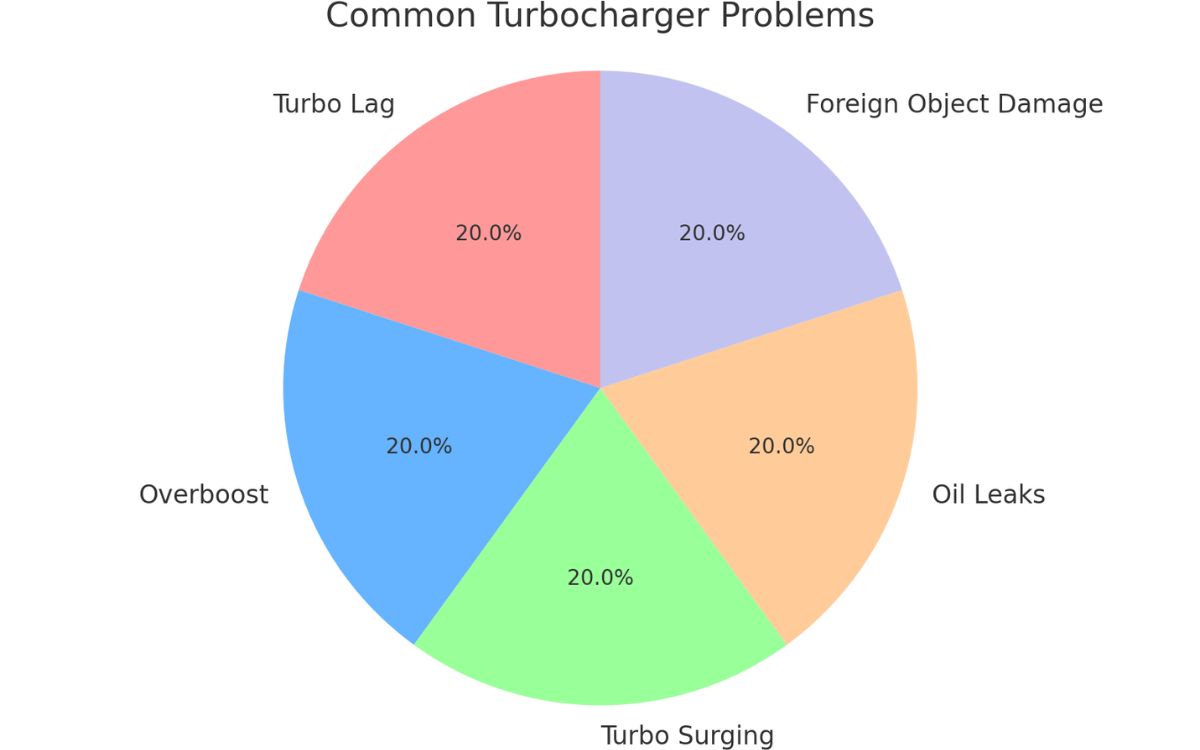
- A high-pitched whistle, whine or “siren” sound under acceleration.
- Noticeable power loss, especially at altitude or under load.
- Blue-grey exhaust smoke (oil burning in the exhaust) and rising oil consumption.
- Sticking VGT actuator producing intermittent limp mode.
Causes
- Oil starvation from extended service intervals or low-grade engine oil — by far the most common root cause.
- Contaminated intake air from a poorly serviced air filter (a real risk on SA gravel roads).
- Carbon-clogged actuator vanes restricting boost-pressure regulation.
- Hot shut-down — switching the engine off immediately after hard driving, before the turbo has cooled.
Solution
- Replace the turbocharger with a new or fully reconditioned unit. Avoid the cheapest “remanufactured” turbos from unknown sources — failure rates are high.
- Replace the oil-feed and return pipes at the same time; restricted feed lines kill new turbos within months.
- Service the actuator (or replace it) and flush the intercooler to remove any oil residue.
- Change oil and filter immediately, then again at 5,000 km.
Indicative Cost
- New OE turbo: R22,000 – R32,000 (part only). Reconditioned: R9,000 – R15,000.
- Labour: R4,500 – R8,000. Total: R15,000 – R35,000 fitted.
3. Injector Problems
Common-rail diesel injectors operate at extreme pressures (over 1,800 bar on the P5AT), and they’re sensitive to fuel quality. South African diesel quality has improved, but water contamination from older underground tanks and the occasional bad-batch incident still claims plenty of injectors. Age also plays a role — internal seals harden after 200,000 km.
Symptoms
- Rough idle, with the engine “hunting” up and down at standstill.
- Hard cold-starting, particularly on the first start of the day.
- Black or grey exhaust smoke under acceleration.
- Misfire codes and a noticeable diesel knock.
- Higher-than-normal fuel consumption.
Causes
- Water in the fuel — the single biggest killer of common-rail injectors in SA.
- Particulate contamination from neglected fuel filter changes.
- Worn injector tips after high mileage.
- Cheap or non-spec aftermarket replacements failing prematurely.
Solution
- Diagnose first — a return-flow test will identify the leaking injector(s). Don’t replace the full set unless testing confirms it.
- Replace failed injectors with genuine or Bosch OE-equivalent units only.
- Coding is mandatory — each new injector must have its IMA/correction code programmed into the ECU.
- Replace the fuel filter and inspect the water-separator at the same service.
Indicative Cost
- Single injector replacement (including coding): R3,500 – R8,000.
- Full set of 5 injectors plus coding and filter: R15,000 – R30,000.
- Always factor in a fuel-system clean if water contamination caused the failure.
4. DPF Clogging
The diesel particulate filter (DPF) on the P5AT requires regular high-temperature “regeneration” cycles to burn off accumulated soot. The duty cycle most SA owners run — short urban trips, idling in traffic, occasional school runs — is exactly the wrong recipe, and clogged DPFs are one of the most common reasons a 3.2 ends up in limp mode.
Symptoms
- Sudden power loss and engine running in “limp” mode (reduced power).
- DPF or “engine service” warning light on the dashboard.
- Excessive fuel consumption as the ECU repeatedly attempts regeneration.
- Strong diesel or “burning” smell, especially after stop-start driving.
Causes
- Predominantly short, low-speed trips — regeneration needs ~20 minutes of motorway driving at 80 km/h+.
- Poor-quality diesel producing higher soot loads.
- Missed Eolys additive top-ups (where applicable) which lower the soot-burn temperature.
- Underlying issues — a failing EGR or injector dumps extra soot into the DPF.
Solution
- Forced regeneration at a diesel specialist is the first step — costs R1,500 – R3,500 and works if the filter isn’t fully blocked.
- If regen fails, attempt a chemical clean (off-vehicle ultrasonic flush) at R3,500 – R6,500.
- In severe cases, the DPF must be replaced. Always fix the underlying cause first (EGR, injectors) or the new DPF will clog again.
Indicative Cost
- Forced regen: R1,500 – R3,500.
- Chemical clean: R3,500 – R6,500.
- Replacement DPF (genuine): R12,000 – R25,000 fitted.
5. Timing Chain and Oil Pump Drive Chain Wear
This is the issue that turns a good 3.2 into scrap metal. Unlike the newer Ford 2.0L EcoBlue engine (which uses a wet timing belt), the P5AT uses a conventional roller timing chain together with a secondary oil pump drive chain. Both are engineered to last the engine’s lifetime under correct maintenance — but skipped oil changes or low-quality oil cause chain stretch, tensioner wear, and can lead to catastrophic oil pump failure.
The oil pump drive chain is the more vulnerable of the two: when it stretches or snaps, oil pressure collapses suddenly. The P5AT is an interference engine — severe timing slip from a jumped or broken chain drives pistons into open valves, bending valves, damaging pistons, and frequently destroying the cylinder head. Australian 4WD publication Unsealed 4X4 lists oil pump failure as the single most common cause of catastrophic P5AT engine damage in the Australian market — driven by exactly the same neglected oil changes SA owners are prone to.
Symptoms (Chain Wear)
- A faint ticking or rattling from the front of the engine, especially on cold start.
- Oil-pressure warning light — early oil pump chain stretch reduces pump output.
- Timing-related fault codes stored in the ECU.
- Hard-starting or running rough due to slipped cam timing.
Causes
- Neglected oil changes — the single biggest driver of premature chain and tensioner wear on the P5AT.
- Use of incorrect or low-quality engine oil.
- Extended intervals between oil changes under SA urban stop-start conditions.
- High mileage beyond 200,000 km without a chain inspection.
Solution
- Use only the correct oil specification (Ford WSS-M2C913-D, 5W-30). Fresh oil at the right interval is the most effective prevention.
- From 150,000–200,000 km, have both chains and tensioners inspected by a diesel specialist.
- Replace the oil pump drive chain kit (chain, tensioner, guides) at the first sign of rattle or slack — do not delay.
- Replace the oil pump at the same time if there is any history of low oil pressure.
Indicative Cost
- Preventive chain kit + oil pump + tensioners fitted: R6,000 – R12,000.
- If the chain has already caused oil pump failure or timing slip: top-end strip, valve replacement, possible head — R25,000–R45,000+, and often more cost-effective to source a replacement P5AT engine than rebuild.
Recommended Maintenance Schedule
Stick to this schedule and the P5AT can comfortably reach 400,000 km. Skip any of it and you’ll meet one of the problems above.
| Service Item | Interval |
|---|---|
| Engine oil + filter | Every 15,000 km or 12 months (5W-30 Ford WSS-M2C913-D, or 0W-30 WSS-M2C950-A) |
| Fuel filter | Every 30,000 km — sooner if poor-quality fuel suspected |
| Air filter | Every 30,000 km — sooner on gravel/dusty routes |
| Coolant | Every 60,000 km / 4 years |
| Eolys DPF additive | Top up every ~120,000 km (where fitted) |
| DPF inspection | Every 60,000 km |
| Timing chain + oil pump drive chain | Inspect from 150,000 km; replace on wear — no OEM fixed interval |
When Replacement Makes More Sense Than Repair
A few simple decision rules for when to stop spending and source a used or reconditioned engine:
- Major internal damage (snapped timing belt, hydrolocked engine, coolant in cylinders) — replacement is almost always cheaper than rebuild.
- Repair quote exceeds 50% of the vehicle’s market value — at this point, a second-hand engine swap usually returns better long-term value.
- Multiple major systems failing simultaneously (e.g. turbo + injectors + DPF) — the cumulative repair bill quickly approaches the cost of a replacement unit.
- Engine over 350,000 km with significant oil consumption — even a perfect repair leaves you with a tired engine.
If you’re considering a full rebuild instead, our guide on how an engine overhaul actually works walks through the process, timeline and decision points in detail.
Frequently Asked Questions
What is the most common Ford Ranger 3.2 engine problem?
EGR cooler failure is the single most reported P5AT issue, particularly on units built before the mid-cycle revision. Turbocharger failure runs a close second.
How long does the Ford Ranger 3.2 engine last?
A well-maintained P5AT will reach 350,000 – 450,000 km. The biggest determinants are strict adherence to oil-change intervals, keeping the timing chains and tensioners in good condition, and keeping the air and fuel filters fresh.
Is the Ford Ranger 3.2 TDCi reliable?
Mechanically yes — with the asterisk that the wet timing belt and EGR cooler need pre-emptive attention. Serviced properly, it’s one of the more durable diesel engines in its class. Neglected, it can be expensive very quickly.
How much does it cost to replace a Ford Ranger 3.2 engine in South Africa?
A complete used P5AT engine typically lands between R45,000 and R85,000 depending on mileage and condition. A reconditioned engine costs R85,000 – R140,000. New crate engines from Ford are significantly higher and rarely justified for vehicles outside warranty. You can browse current options on our used Ford engines listings.
Should I avoid buying a Ford Ranger 3.2?
No — but inspect carefully before purchase. Confirm the wet timing belt has been replaced (or budget for it immediately), check the service history, scan for stored fault codes, and watch for any white smoke on cold start. A well-kept 3.2 is an excellent buy at the right price.
What turbo problems should I watch for?
A whistling or “siren” sound under acceleration, blue smoke at start-up, and any unexplained drop in pulling power — particularly when towing. Address it early: a worn turbo that disintegrates can send debris through the intercooler into the engine, turning a R20,000 repair into a R60,000 one.
Need a Replacement Engine?
If repair costs no longer make sense, Engine Finder has been connecting South African Ranger owners with verified engine suppliers since 2016. Browse current Ford Ranger 3.2 replacement engines from independent specialists and scrap yards nationwide — or submit a single enquiry and let multiple suppliers come back to you with quotes. Suppliers will contact you directly. For more on turbo-related diagnosis specifically, our turbocharger problems and how to fix them deep-dive covers warning signs and triage in detail.
Related Articles
Explore more insights on similar topics
Ford Focus Gearbox Replacement Cost in South Africa (2026 Guide)
Ford Focus gearbox replacement costs R6,000–R18,000 for a manual and R18,000–R38,000 for the PowerShift DCT in South Africa. Full price breakdown by variant, known DPS6 problems, and how to save.
Nissan NP200 Gearbox Problems: JR5 Manual, Clutch & Costs (SA Guide)
Nissan NP200 gearbox problems explained — the Renault JR5/JH3 manual, crunchy shifts, 5th-gear whine, soft-clutch cylinder faults, and what a used or recon NP200 gearbox costs in SA.
Manual Gearbox Replacement Cost in South Africa (2026 Guide)
How much does manual gearbox replacement cost in South Africa? Budget exchange from R4,000 fitted; heavy-duty bakkie installs reach R32,000+. Real SA prices by model, gearbox codes, labour hours, and a worth-it decision framework.
Important Disclaimer
This content is for informational purposes only and is based on research from automotive industry sources. Engine Finder is not a certified automotive repair facility. Always consult with qualified automotive professionals before performing any repairs or maintenance. Improper repairs can result in personal injury, property damage, or vehicle malfunction. We assume no responsibility for actions taken based on this information.