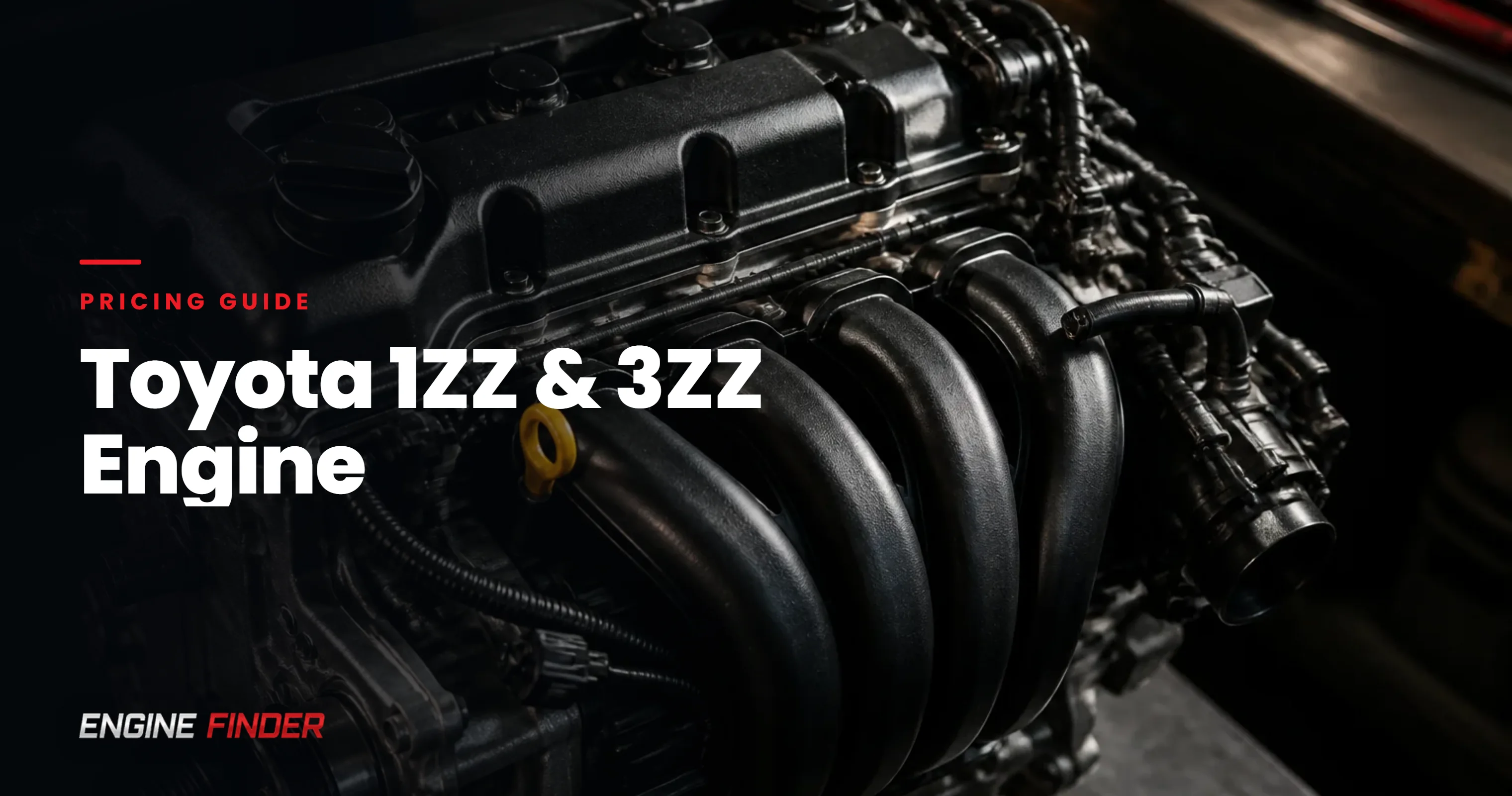
Toyota 1ZZ & 3ZZ Engine Guide: Specs, Problems & SA Prices

Toyota ZZ Engine Family: 1ZZ, 2ZZ & 3ZZ Complete Guide
The Toyota ZZ engine family is one of the most widely used four-cylinder petrol engine lineages in the world. Built on an aluminium block with a cast-iron cylinder liner, the ZZ family replaced the older Toyota S-series and A-series engines across the late 1990s and 2000s. If you drive a Toyota Corolla, Celica, or Matrix from this era, you almost certainly have one of these units under the bonnet.
This guide covers every variant sold in South Africa — specs, known faults, timing details, oil recommendations, and what a replacement engine costs at SA scrap yards and suppliers.
Table of Contents
- ZZ Family Overview
- 1ZZ-FE: Specs & Common Problems
- 2ZZ-GE: The High-Revving Sports Variant
- 3ZZ-FE: The Entry-Level Variant
- Timing Chain, Not Belt
- VVT-i vs VVTL-i Explained
- Oil Recommendations
- SA Used Engine Prices
- Should You Replace or Repair?
Key Takeaways
| Engine | Displacement | Power | VVT System | Used In |
|---|---|---|---|---|
| 1ZZ-FE | 1,794 cc | ~100 kW | VVT-i (intake cam only) | Corolla E110/E120, Celica ZZT230 |
| 2ZZ-GE | 1,796 cc | ~141 kW (USDM) | VVTL-i (both cams + lift) | Celica SS-II, Corolla XRS |
| 3ZZ-FE | 1,598 cc | ~82 kW | VVT-i (intake cam only) | Corolla E120 entry |
All three variants use a timing chain — not a timing belt.
ZZ Family Overview
Toyota introduced the ZZ engine series in 1997 as a modern, lightweight, aluminium-intensive design intended to improve fuel economy and emissions over the outgoing iron-block engines. All ZZ engines share:
- Aluminium block (with cast-iron sleeves) and aluminium cylinder head
- DOHC 16-valve configuration (four valves per cylinder)
- Sequential multi-port fuel injection
- Timing chain (maintenance-free — no scheduled replacement)
- An electronic throttle body on later variants
The family was replaced in the 2000s/2010s by the ZR series (1ZR-FE, 2ZR-FE), which are larger-displacement and more modern.
1ZZ-FE: Specs & Common Problems
The 1ZZ-FE is the variant you are most likely to encounter in South Africa, fitted to the eighth-generation Corolla (E110, sold here as the “Corolla 160i”) and ninth-generation Corolla (E120, “Corolla 180i RSi”). It was also used in the 7th-generation Celica (body code ZZT230) in some markets.
1ZZ-FE Specifications
| Specification | Details |
|---|---|
| Displacement | 1,794 cc |
| Configuration | Inline-4, DOHC, 16-valve |
| Power Output | ~100 kW @ 6,000 rpm |
| Torque | ~170 Nm @ 4,400 rpm |
| Compression Ratio | 10.0:1 |
| Fuel System | Multi-point EFI |
| Variable Valve Timing | VVT-i (intake camshaft only) |
| Timing System | Chain |
| Production Years | 1997–2008 |
1ZZ-FE Common Problems
1. Oil Consumption (the big one)
The 1ZZ-FE has a well-documented oil consumption problem. The engine can consume up to 1 litre of oil per 1,000 km without showing any external leaks or blue smoke under light driving. Toyota acknowledged the issue and released Technical Service Bulletins (TSBs) covering piston ring replacement as the primary fix.
Root cause: The piston rings — specifically the oil control rings — were designed with a low-tension specification to reduce internal friction and improve fuel economy. Over time (typically after 80,000–150,000 km) the rings lose their ability to scrape oil off the cylinder walls effectively. Oil enters the combustion chamber and burns off, dropping the sump level silently.
Symptoms:
- Engine oil level drops between services (check every 1,000–2,000 km)
- Occasional blue-grey smoke at startup or on overrun
- Spark plugs develop an oily/black carbon deposit
Fix:
- Toyota’s official repair is a full set of revised piston rings (higher-tension spec)
- This requires an engine strip — expect R8,000–R18,000 in labour and parts at a reputable workshop
- Many South African owners opt for a reconditioned or low-mileage imported 1ZZ-FE as a cost-effective alternative
Maintenance Tip
If you own a 1ZZ-FE Corolla, check your oil every 2,000 km rather than relying on the service interval. Budget for oil top-ups between changes and monitor spark plug condition. Catching the issue early avoids a seized engine.
2. Thermostat & Water Pump Failures
The plastic-impeller water pump on the 1ZZ-FE is a known weak point. The plastic impeller can detach from the shaft, causing sudden coolant circulation loss and overheating. If your temperature gauge climbs quickly while the heater blows cold air, suspect the water pump.
Fix: Replace with a metal-impeller aftermarket pump. Cost: R1,200–R2,500 including labour.
3. Coil-On-Plug Failures
Individual ignition coils can fail, causing a misfire on the affected cylinder. Symptoms include a lumpy idle, flashing check-engine light under load, and a P030x misfire code. Individual coils can be sourced from Toyota scrap yards for R200–R600 each.
4. IACV Hunting Idle
The Idle Air Control Valve (IACV) can carbon up, causing an unstable idle — surging between 500 and 1,500 rpm when the engine is warm. Cleaning with throttle-body cleaner is usually sufficient.
2ZZ-GE: The High-Revving Sports Variant
The 2ZZ-GE is the performance sibling — developed in partnership with Yamaha — and found in the Toyota Celica GT-S (SS-II) and the Corolla XRS in the US market. It is comparatively rare in South Africa but prized by enthusiasts.
2ZZ-GE Specifications
| Specification | Details |
|---|---|
| Displacement | 1,796 cc |
| Configuration | Inline-4, DOHC, 16-valve |
| Power Output | ~141 kW @ 7,600 rpm (USDM); ~192 PS (JDM Celica SS-II) |
| Torque | ~180 Nm @ 6,800 rpm |
| Compression Ratio | 11.5:1 |
| Fuel System | Multi-point EFI |
| Variable Valve Timing | VVTL-i (intake AND exhaust cams + variable valve lift) |
| Timing System | Chain |
| Rev Limit | ~8,200 rpm |
| Production Years | 1999–2006 |
2ZZ-GE Key Differences from the 1ZZ-FE
The 2ZZ-GE’s party trick is VVTL-i (Variable Valve Timing and Lift — intelligent). Unlike the 1ZZ-FE’s VVT-i system, which only advances or retards the intake camshaft, VVTL-i operates on both the intake and exhaust camshafts and adds a second, more aggressive valve-lift profile that engages at approximately 6,200 rpm. This is Toyota’s equivalent of Honda’s VTEC — below the crossover point the engine feels like a normal four-cylinder; above it, power delivery sharpens noticeably as the high-lift lobes take over.
2ZZ-GE Common Problems
- VVTL-i actuator oil starvation: The lift-change mechanism depends on oil pressure. Low oil level or neglected oil changes can cause actuator failure, resulting in the engine staying on the low-lift cam profile (loss of top-end power). Always use the correct oil weight and change at recommended intervals.
- High-RPM oil surge: The 11.5:1 compression ratio and 8,000+ rpm capability mean oil starvation under hard cornering is possible in stock form. Aftermarket baffled sumps are common on track cars.
- Same piston-ring concern as 1ZZ-FE — the oil consumption issue is present, though typically less severe due to the higher-tension rings used on some variants.
3ZZ-FE: The Entry-Level Variant
The 3ZZ-FE is a smaller-displacement member of the ZZ family, fitted to entry-level versions of the E120 Corolla in some markets. It is less common in South Africa than the 1ZZ-FE.
3ZZ-FE Specifications
| Specification | Details |
|---|---|
| Displacement | 1,598 cc |
| Configuration | Inline-4, DOHC, 16-valve |
| Power Output | ~82 kW @ 6,000 rpm |
| Torque | ~148 Nm @ 4,200 rpm |
| Compression Ratio | 10.5:1 |
| Fuel System | Multi-point EFI |
| Variable Valve Timing | VVT-i (intake camshaft only) |
| Timing System | Chain |
| Production Years | 2000–2008 |
The 3ZZ-FE shares most of the 1ZZ-FE’s architecture and is susceptible to the same oil consumption issue, though with a shorter stroke it typically presents the problem at higher mileages. The timing chain and water pump advice above applies equally.
Timing Chain, Not Belt
A common misconception is that the ZZ-family engines use a timing belt. They do not. All three variants — 1ZZ-FE, 2ZZ-GE, and 3ZZ-FE — use a timing chain. This is important for two reasons:
- No scheduled replacement: A timing chain does not have a fixed replacement interval the way a belt does. Under normal conditions with regular oil changes, the chain lasts the life of the engine.
- Oil quality matters more: Because the chain is lubricated by engine oil (not sealed away like a belt), dirty or degraded oil accelerates chain wear. Stretched chains produce a rattling noise at cold startup.
If someone quotes you a large service bill for a “timing belt replacement” on a 1ZZ or 3ZZ Corolla, they are either confused about the engine or referring to the accessory drive belt (serpentine/V-belt), which does require periodic replacement.
VVT-i vs VVTL-i Explained
Understanding the difference between these two Toyota variable valve timing systems is important when shopping for a replacement engine or interpreting fault codes.
| Feature | VVT-i (1ZZ-FE, 3ZZ-FE) | VVTL-i (2ZZ-GE) |
|---|---|---|
| Camshafts controlled | Intake only | Intake AND exhaust |
| Valve lift change | No — timing only | Yes — two-stage lift profile |
| Mechanism | Hydraulic phaser on intake cam | Hydraulic phasers + oil-pressure lift actuators |
| Engagement RPM | Continuous variable | Lift changes at ~6,200 rpm |
| Power benefit | Improved low/mid-range torque | Significant high-RPM power increase |
VVT-i (Variable Valve Timing — intelligent) adjusts the timing (phase angle) of the intake camshaft continuously relative to the crankshaft. This optimises the intake valve opening/closing timing across the rev range, improving torque at low revs and power at high revs without changing how far the valves open.
VVTL-i (Variable Valve Timing and Lift — intelligent) does everything VVT-i does, but also switches to a higher-lift cam lobe on both camshafts above approximately 6,200 rpm. The additional lift and duration dramatically increases airflow into the cylinder, enabling the 2ZZ-GE to produce usable power well beyond 7,000 rpm.
Oil Recommendations
All ZZ-family engines are designed for relatively low-viscosity oil to support VVT-i and (on the 2ZZ) VVTL-i hydraulics.
| Engine | Recommended Oil | Grade |
|---|---|---|
| 1ZZ-FE (earlier) | 5W-30 API SM or better | Mineral or synthetic |
| 1ZZ-FE (later/LHD JDM) | 0W-20 full synthetic | Toyota Genuine or equivalent |
| 2ZZ-GE | 5W-30 API SM or better | Full synthetic recommended |
| 3ZZ-FE | 5W-30 API SM or better | Mineral or synthetic |
Important for South African conditions: If your Corolla is used for long highway trips in summer heat, 5W-30 full synthetic is preferable to mineral oil. Avoid 10W-40 or thicker grades — these can impede VVT-i phaser response, causing hesitation and potentially triggering cam timing fault codes.
Change interval: every 10,000 km or 12 months, whichever comes first. Given the piston-ring oil consumption issue, check the level every 2,000 km.
SA Used Engine Prices
Used ZZ-series engines are available from Toyota scrap yards and specialist engine importers throughout South Africa. Prices vary by mileage, source (local vs Japanese import), and whether the engine comes tested.
| Engine | Typical SA Price Range | Notes |
|---|---|---|
| 1ZZ-FE (local scrap yard) | R8,000 – R15,000 | Mileage unknown, sold as-is |
| 1ZZ-FE (Japanese import, low km) | R12,000 – R22,000 | Usually 50,000–90,000 km with export certificate |
| 2ZZ-GE | R18,000 – R35,000 | Rare locally; most are Japanese imports |
| 3ZZ-FE | R7,000 – R14,000 | Less common; usually from E120 parts cars |
Prices correct as of mid-2026. Verify current availability and pricing through Engine Finder.
What to Ask Before You Buy
- What is the mileage? Japanese import engines typically arrive with a mileage export certificate.
- Does it come with a warranty? Reputable suppliers offer a 3–6 month warranty on used engines.
- Was the engine running when removed? Cold-pull engines (removed from intact running cars) are preferred over accident salvage.
- Is the VVT-i cam gear included? Some suppliers strip the gear before sale. Replacement gears cost R1,500–R3,000.
Should You Replace or Repair?
For the 1ZZ-FE oil consumption problem specifically:
| Option | Approx. Cost | When to Choose |
|---|---|---|
| Piston ring replacement (machine shop rebuild) | R10,000–R18,000 | Engine is otherwise sound, < 200,000 km |
| Used 1ZZ-FE (local) | R8,000–R15,000 + R3,000–R5,000 fitment | If the block is worn or original mileage is very high |
| Low-km Japanese import 1ZZ-FE | R12,000–R22,000 + fitment | Best value for long-term reliability |
| Upgrade to 1ZR-FE (newer engine) | Custom fab required | Only for dedicated builds |
For most South African owners, a low-mileage Japanese import 1ZZ-FE provides the best combination of cost and reliability, provided you buy from a reputable importer who tests the engine before shipping.
Find a Toyota ZZ engine near you →
Related Articles
Explore more insights on similar topics
Volkswagen VR6 Engine Guide: The Revolutionary Narrow-Angle Six-Cylinder
Complete guide to Volkswagen's revolutionary VR6 engine. Discover its unique narrow-angle design, technical innovations, and 33-year production legacy that redefined compact performance.
Toyota 2JZ-GTE Engine Guide: The Legendary 3.0L Twin-Turbo Powerplant
Complete guide to Toyota's legendary 2JZ-GTE engine. Discover its technical specifications, history, applications, and why it remains the ultimate tuning platform.
Toyota 2.8 GD6 Engine Problems: 5 Known Issues
Toyota 2.8 GD6 DPF clogging, injector failure, and manifold leaks — the top Hilux diesel problems. SA repair costs from R5,000-R60,000 and how to fix them.
Important Disclaimer
This content is for informational purposes only and is based on research from automotive industry sources. Engine Finder is not a certified automotive repair facility. Always consult with qualified automotive professionals before performing any repairs or maintenance. Improper repairs can result in personal injury, property damage, or vehicle malfunction. We assume no responsibility for actions taken based on this information.