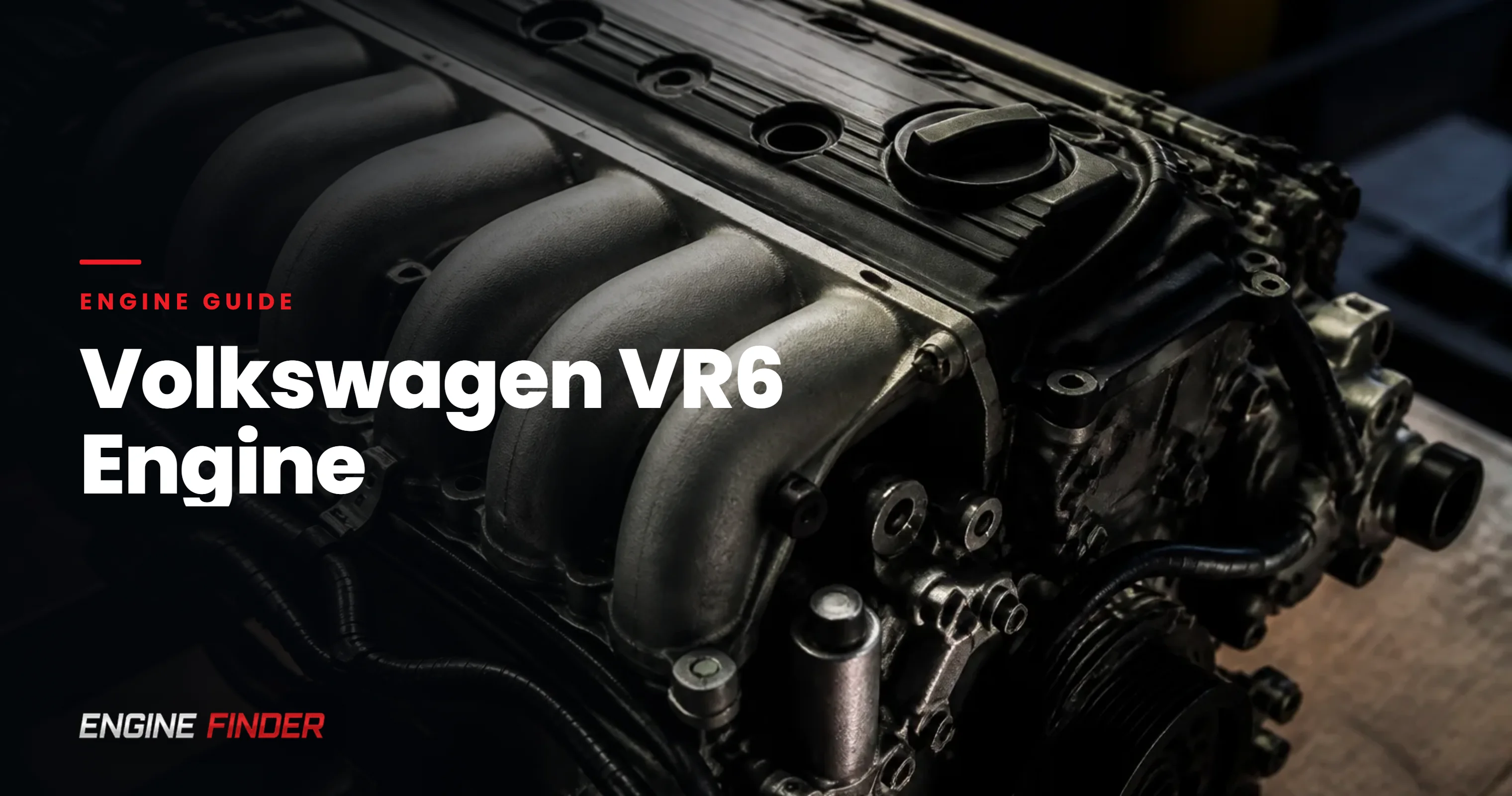
Volkswagen VR6 Engine Guide: The Revolutionary Narrow-Angle Six-Cylinder

Key Takeaways
| Topic | Key Information | Important Details |
|---|---|---|
| Design | Narrow-angle (15°) V configuration, NOT a straight-6 or traditional V6 | Single cylinder head for both banks |
| 12v Specifications | 2.8L (2,792cc), 128 kW / 235 Nm | Engine codes: AAA, AES, AFP (ABV = 2.9L/140kW Corrado EU) |
| 24v Specifications | 3.2L (3,189cc), 177–184 kW / 320 Nm | Engine codes: BFH (R32 Mk4), BUB (R32 Mk5), BHE (TT), AXZ (Passat) |
| Timing | Timing CHAIN — all VR6 variants | Never a timing belt |
| Oil Spec | VW 502.00 / 504.00 approval required | Full synthetic 5W-40 recommended |
| Applications | Golf Mk3/Mk4, Corrado, Passat, Sharan, T4 | Production 1991–present (3.6L still active) |
What Is the Volkswagen VR6?
The Volkswagen VR6 is one of the most ingenious engine designs of the 20th century. Introduced in 1991, it solved a fundamental packaging problem: how do you fit a six-cylinder engine into an engine bay designed for a four-cylinder? VW’s answer was the narrow-angle V — a configuration so compact it barely takes up more space than an inline-4.
The “VR” designation comes from the German Vierzylinder Reihe concept adapted to six cylinders — V-Reihe, meaning V-row. The engine features two banks of cylinders set at an extremely narrow 15° angle to each other, sharing a single cylinder head. This makes it physically impossible to confuse with either:
- A straight-6 (inline-6): which has all cylinders in a single row, 0° angle
- A traditional V6: which typically uses 60°, 90°, or 54° bank angles with separate cylinder heads per bank
The VR6’s genius is that its 15° angle is narrow enough for a single head casting to span both cylinder banks while still allowing adequate airflow and combustion chamber geometry. The result is an engine no wider than a 4-cylinder but with the smoothness of a 6-cylinder — a genuine engineering achievement.
VR6 Engine Codes and Variants
The VR6 family splits cleanly into two generations: the original 12-valve 2.8L and the later 24-valve 3.2L. Understanding which variant you have is critical for sourcing parts, oil specifications, and understanding power expectations.
12-Valve 2.8L VR6 (1991–2004)
| Specification | Details |
|---|---|
| Engine Codes | AAA, AES, AFP |
| Displacement | 2,792 cc (2.8L) |
| Configuration | 15° narrow-angle V, single cylinder head, 12 valves |
| Camshafts | Two camshafts (one per bank), SOHC per bank |
| Power Output | 128 kW (174 PS) @ 5,800 rpm |
| Torque | 235 Nm @ 4,200 rpm |
| Fuel System | Multi-point fuel injection (MPI) |
| Compression Ratio | 10.0:1 |
| Firing Order | 1-5-3-6-2-4 |
| Timing | Chain (not belt) |
The 12-valve VR6 is the engine that made VW performance accessible. The AAA code is the most common and widely sourced unit in South Africa — found in the Golf Mk3 VR6 and early Passat VR6. The AES was used in the T4 Transporter and some export markets. The AFP fitted to Golf Mk4 (pre-R32) features a variable intake manifold and produces slightly more than the AAA.
Note on the ABV: The European Corrado VR6 used the ABV code, which is technically a 2.9L (2,861cc) engine producing 140 kW (190 PS) / 245 Nm — a larger bore and higher output than the 2.8L AAA. The North American Corrado received the 2.8L AAA instead. The ABV is often grouped loosely with the 2.8L family due to its shared architecture, but it is a distinct displacement with meaningfully different output.
24-Valve 3.2L VR6 (1999–2010)
| Specification | Details |
|---|---|
| Engine Codes | AXZ, BFH, BHE, BUB |
| Displacement | 3,189 cc (3.2L) |
| Configuration | 15° narrow-angle V, single cylinder head, 24 valves |
| Camshafts | Four camshafts (two per bank), DOHC |
| Power Output | 184 kW (250 PS) @ 6,300 rpm |
| Torque | 320 Nm @ 2,800 rpm |
| Fuel System | Multi-point fuel injection / FSI variants |
| Compression Ratio | 11.3:1 (MPI) / 11.5:1 (FSI) |
| Timing | Chain (not belt) |
The 24-valve 3.2L VR6 is a fundamentally different engine despite sharing the VR6 concept. Four camshafts, four valves per cylinder, and a 400cc displacement increase deliver a 44% torque improvement and significantly better high-rpm breathing. The AXZ powers the Passat 3.2 FSI and related applications. The BFH is the Golf R32 Mk4 code (177 kW in North American specification). The BHE is the Audi TT 3.2 quattro code (184 kW). The BUB is the Golf R32 Mk5 code (184 kW). Note: the AUE and BDE codes sometimes associated with the VR6 24v range are actually 2.8L 24-valve variants used in Golf Mk4 and Bora non-R32 models — they share the 24v architecture but differ in displacement and output from the 3.2L R32 engine.
R32 Variant Note
The Golf R32 uses the 3.2L 24v VR6 — engine code BFH in the Mk4 (177 kW in North American spec), BUB in the Mk5 (184 kW). The R32 is named for its 3.2-litre displacement, not a power rating. The Mk5 R32 uses a revised intake and different ECU calibration that recovers the extra 7 kW versus the Mk4 BFH variant. The Audi TT 3.2 quattro uses the BHE code, also producing 184 kW.
The Narrow-Angle V Design — How It Works
Understanding why the VR6 is architecturally unique requires understanding what it is NOT:
Not a Straight-6
A straight-6 (inline-6) places all six cylinders in a single row. This produces perfect primary and secondary balance — BMW’s famous “silky six” advantage. But it’s long. Too long for most transverse front-wheel-drive applications. VW’s Golf platform couldn’t accommodate a straight-6 without major wheelbase changes.
Not a Traditional V6
A traditional V6 splits cylinders across two separate cylinder heads on two banks. The bank angle (usually 60° or 90°) creates natural width and packaging complexity. Firing order compromises (inherent in most V6 designs) require balance shafts or uneven firing intervals to smooth vibration. A 60° V6 is balanced but wide; a 90° V6 is even wider.
The VR6 Solution
At 15°, the VR6’s two banks are nearly parallel. The single cylinder head bridges both banks, saving the weight and cost of a second head while enabling a compact overall width. The cylinders are staggered front-to-back to accommodate the narrow angle — each cylinder in one bank sits slightly offset from its counterpart in the other bank. The result:
- Width: Barely wider than an inline-4 of similar displacement
- Smoothness: 6-cylinder even firing intervals — inherently smoother than most V6 designs
- Length: Shorter than a straight-6, fitting transverse in Golf-platform vehicles
- Sound: The VR6’s narrow angle and staggered cylinder arrangement produces the distinctive, slightly asymmetric exhaust note that enthusiasts identify immediately
VR5 Variant
Volkswagen also produced a VR5 (2.3L, 5-cylinder) using the same narrow-angle concept. The VR5 (engine codes AGZ, AQN, AZX) powered the Golf Mk4 and Passat in markets where the full VR6 was not offered. It uses the same single-head architecture at the same 15° bank angle, simply with one fewer cylinder.
Vehicle Applications
The VR6 powered an impressive range of VW Group products over its production life. The following are the primary South African-market and globally common applications:
12-Valve 2.8L VR6 Applications
| Vehicle | Years | Engine Code | Notes |
|---|---|---|---|
| VW Golf Mk3 VR6 | 1992–1997 | AAA | The iconic application; Mk3 body |
| VW Corrado VR6 | 1992–1995 | ABV (EU) / AAA (NA) | ABV = 2.9L 140kW (European); AAA = 2.8L 128kW (North America) |
| VW Passat B4 VR6 | 1993–1997 | AAA | Estate and saloon variants |
| VW Golf Mk4 VR6 | 1997–2003 | AFP | Pre-24v Golf; less common |
| VW Transporter T4 VR6 | 1996–2003 | AES | Rare, sought-after van application |
24-Valve 3.2L VR6 Applications
| Vehicle | Years | Engine Code | Notes |
|---|---|---|---|
| VW Golf R32 Mk4 | 2002–2004 | BFH | 4MOTION (4WD); 177 kW (NA spec) |
| VW Golf R32 Mk5 | 2005–2008 | BUB | 4MOTION; 184 kW / 320 Nm |
| Audi TT 3.2 quattro | 2003–2006 | BHE | 184 kW; same architecture |
| VW Passat 3.2 V6 FSI | 2005–2007 | AXZ | Passat B6 application |
| VW Sharan V6 | 2000–2010 | AXZ | MPV application |
| VW Touareg 3.2 V6 | 2002–2006 | BKL | NOT to be confused with V10 TDI |
Touareg V10 TDI Is Not a VR6
The Volkswagen Touareg V10 TDI is a completely separate diesel engine — a 5.0L twin-turbocharged V10 produced by Audi. It shares no architecture with the VR6. If sourcing parts for a Touareg, verify your engine type before ordering VR6 components.
Timing Chain — Not Belt
This is one of the most important facts about the VR6: all VR6 variants use a timing chain, never a timing belt. Both the 12-valve 2.8L and 24-valve 3.2L are chain-driven.
This has significant maintenance implications:
- No scheduled replacement interval: Unlike a timing belt (which requires replacement every 60,000–100,000 km), the timing chain is designed to last the life of the engine with proper oil maintenance
- Failure mode is gradual, not sudden: Chain stretch announces itself with a rattling noise on cold starts before it causes damage — giving owners warning that a belt failure does not
- Oil maintenance is critical: The chain, tensioner, and guides all depend on proper lubrication. Neglected oil changes accelerate chain and tensioner wear
The Tensioner Problem
The VR6’s single documented timing weakness is the chain tensioner. The original hydraulic chain tensioner on the 12-valve 2.8L can lose hydraulic pressure after the engine sits overnight, causing a pronounced cold-start rattle that disappears within 30 seconds as oil pressure builds. This is the first sign of a tensioner on its way out.
Left untreated, a worn tensioner allows chain slap against the plastic guides. Eventually guide failure can occur, which deposits plastic fragments in the oil and — in worst cases — allows the chain to jump timing, causing valve damage.
Action: Replace the chain tensioner and guides at the first sign of cold-start rattling. The updated tensioner design (available as an aftermarket upgrade) addresses the original design’s weakness.
Do Not Ignore Cold-Start Rattling
A VR6 that rattles for a few seconds on cold start and then quiets down is showing early tensioner wear. This is a warning, not a quirk. Address it before the guides are damaged — the difference in repair cost is significant.
Common VR6 Problems
1. Timing Chain Tensioner Failure
As detailed above, the chain tensioner is the VR6’s most documented mechanical weakness. Cold-start rattles that last more than a few seconds indicate tensioner wear. The repair involves:
- Removing the front of the engine (timing cover access)
- Replacing the hydraulic tensioner with an updated unit
- Inspecting and replacing worn chain guides (plastic, so they wear over time)
- Inspecting the chain itself for stretch
Cost estimate (South Africa): R18,000–R35,000 professionally installed, depending on the extent of guide wear and whether the chain itself requires replacement.
2. Valley Cover Gasket Oil Leaks
The VR6’s shared single cylinder head creates a “valley” between the two cylinder banks. The plastic valley cover (also called the intake valley cover or lower intake manifold area) seals this region. The gasket between the valley cover and the head is a known oil leak source on higher-mileage engines.
Symptoms:
- Oil smell from the engine bay (especially after driving)
- Oil residue visible on the underside of the engine and bellhousing
- Gradual oil consumption without visible puddles beneath the car
This is distinct from the valve cover gasket (which seals the top of the head). The valley cover gasket sits between the cylinder banks and is more involved to access.
Cost estimate: R4,000–R10,000 professionally replaced.
3. Coolant System Leaks and G12 Spec Requirements
The VR6’s coolant system has specific requirements that are often overlooked:
- G12 coolant specification (red/pink) is required for all VR6 variants. Mixing G12 with incorrect coolant types (particularly older green coolant) causes chemical incompatibility that accelerates corrosion of aluminium components
- The plastic thermostat housing is a known failure point — heat cycling over many years causes hairline cracks that weep coolant
- Water pump impellers corrode over time, reducing cooling efficiency before the pump fails outright
- G12 coolant should be replaced every 60,000 km or 4 years to maintain its inhibitor package
Do Not Mix Coolant Types
Using green (older silicate-based) coolant in a VR6 system designed for G12 causes rapid aluminium corrosion. If the coolant history is unknown, flush completely before refilling with the correct G12 or G12+ specification.
4. Ignition System (24-Valve Models)
The 24-valve 3.2L VR6 uses individual coil-on-plug ignition. Coil packs on this engine have a documented failure rate, particularly on higher-mileage units. Symptoms include misfires, P030X codes, and rough idle that clear temporarily when the coil is swapped.
The 12-valve 2.8L uses a distributor-based ignition system with a more traditional failure pattern — the distributor cap, rotor, and leads are the primary maintenance items.
Maintenance and Service Intervals
Oil Specification
The VR6 requires oil meeting VW 502.00 specification (12-valve and early 24-valve) or VW 504.00 (later 24-valve FSI variants). These are VW’s own approval standards — the viscosity grade that meets these standards is typically:
- 5W-40 fully synthetic (most common South African spec)
- 0W-40 fully synthetic (cold-climate preference, also meets 502.00)
Do not use conventional (mineral) oil or oils that do not carry the VW 502.00 or 504.00 approval. The VR6’s chain tensioner hydraulics depend on the correct oil viscosity and quality; using non-approved oil is one of the leading causes of premature tensioner wear.
| Item | Interval | Notes |
|---|---|---|
| Engine oil & filter | 10,000–15,000 km | Full synthetic VW 502.00/504.00 approved |
| Coolant flush (G12) | 60,000 km / 4 years | G12 or G12+ only — do not mix types |
| Spark plugs (12v) | 30,000–40,000 km | Distributor + leads at same interval |
| Spark plugs + coil packs (24v) | 40,000–60,000 km | Individual coil-on-plug inspection |
| Timing chain tensioner | Inspect at 100,000 km | Replace immediately if cold-start rattle present |
| Valley cover gasket | Inspect at 100,000 km | Replace if oil seepage is visible |
| Gearbox oil (02J / 02M) | 60,000 km | Many owners neglect this; critical for DSG too |
VR6 Performance and Tuning
The VR6 has a devoted tuning community, though its modification potential differs from turbo engines:
Naturally Aspirated Limits
Both the 12v and 24v VR6 are naturally aspirated from the factory. Extracting meaningful power gains requires:
- Intake and exhaust work: Free-flowing intake (short ram or cold air), aftermarket exhaust headers, and a sports cat or de-cat. Realistic gain: 10–15 kW on the 12v
- Camshaft upgrades: Aftermarket camshafts with increased lift and duration improve peak power significantly but move the power band higher
- Chip tuning / ECU remap: Limited gains on a naturally aspirated engine without supporting modifications
Forced Induction
Turbocharging or supercharging the VR6 is the most common path to significant power increases. Supercharger kits were popular for the 12v VR6 in the Mk3/Mk4 era. Turbo conversions are more complex but deliver greater power potential. The single cylinder head shared between both banks presents unique thermal challenges for forced-induction builds.
VR6 Swap Culture
The compact dimensions of the 12v VR6 made it a popular engine swap candidate into lighter vehicles. The Golf Mk2 VR6 swap (fitting the Mk3’s AAA VR6 into the earlier, lighter Mk2 body) remains one of South Africa’s most popular hot-hatch projects. The engine fits with modification to the engine mounts and subframe, and the AAA’s abundant South African supply makes it an accessible performance option.
Sourcing a VR6 Engine in South Africa
The VR6 has a strong presence in South Africa’s used engine market:
- AAA (2.8L 12v) is the most common — sourced from Golf Mk3 VR6 breakers and scrap yards nationwide. Supply is good; prices are reasonable
- ABV (2.8L 12v Corrado) is rarer but functionally identical to the AAA; parts interchange
- AUE/BUB (3.2L 24v) is less common and more expensive — primarily sourced from R32 breakers or Japanese import channels
Price ranges (South Africa, 2025):
- 2.8L AAA VR6 (good used condition): R8,000–R18,000
- 3.2L AUE/BUB R32 VR6: R25,000–R45,000
When inspecting a used VR6:
- Cold-start the engine and listen for chain rattle in the first 30 seconds
- Check for oil seepage around the valley cover and rocker cover
- Verify coolant colour — mixed or discoloured coolant indicates neglect
- Check for white exhaust smoke (head gasket) and milky oil on the dipstick
Find a VR6 engine through Engine Finder — connect with South African suppliers who stock VR6 units and can advise on the right engine code for your application.
Production History
| Period | Variant | Key Applications |
|---|---|---|
| 1991–1997 | 2.8L 12v (AAA/ABV) | Golf Mk3, Corrado, Passat B4 |
| 1996–2004 | 2.8L 12v (AES/AFP) | T4 Transporter, Golf Mk4 |
| 1999–2006 | 3.2L 24v (AUE/BHE) | Golf R32 Mk4, Audi TT 3.2 |
| 2005–2010 | 3.2L 24v (BUB/BKL) | Golf R32 Mk5, Touareg 3.2 |
| 2004–present | 3.6L 24v VR6 FSI | Touareg, Phaeton, Multivan |
The VR6 concept continues in the 3.6L form used in the Touareg and Multivan. From its 1991 introduction through to current production, the VR6 platform represents over 33 years of continuous development — making it one of the longest-running performance engine families in VW Group’s history.
Summary
The Volkswagen VR6 is a genuinely unique engine that solved a real engineering problem: fitting the smoothness and output of a six-cylinder into the packaging of a four-cylinder. Its 15° narrow-angle V architecture — with both cylinder banks sharing a single head — remains one of the most clever production engine designs ever built.
Key facts to remember:
- Architecture: 15° narrow-angle V with a single shared cylinder head — not a straight-6, not a conventional V6
- 12v 2.8L: 128 kW / 235 Nm — engine codes AAA, AES, AFP (European Corrado ABV = 2.9L / 140 kW)
- 24v 3.2L: 177–184 kW / 320 Nm — engine codes BFH (Golf R32 Mk4), BUB (Golf R32 Mk5), BHE (Audi TT), AXZ (Passat)
- Timing: Chain on all VR6 variants — never a timing belt
- Oil: VW 502.00 / 504.00 approved 5W-40 full synthetic
- Coolant: G12 specification only — do not mix with other types
- Common problems: timing chain tensioner, valley cover gasket oil leaks, coolant system maintenance
- Watch out for: cold-start rattle (tensioner warning) and mixed coolant (corrosion risk)
For owners dealing with VR6 engine problems, see our companion guide on VW VR6 engine problems for detailed diagnosis, repair costs, and solutions.
Find a replacement VR6 engine through Engine Finder — South Africa’s leading marketplace connecting buyers with verified engine suppliers.
Related Articles
Explore more insights on similar topics
Toyota 1ZZ & 3ZZ Engine Guide: Specs, Problems & SA Prices
1ZZ vs 3ZZ Toyota engine guide: specs, common faults, oil consumption fix, and used prices in South Africa (R8,000-R25,000). Find a replacement engine fast.
Toyota 2JZ-GTE Engine Guide: The Legendary 3.0L Twin-Turbo Powerplant
Complete guide to Toyota's legendary 2JZ-GTE engine. Discover its technical specifications, history, applications, and why it remains the ultimate tuning platform.
Common VW Polo BAH 1.6 Engine Problems: Causes, Symptoms, Solutions
Learn about the most common problems with Volkswagen Polo BAH 1.6 engines, with detailed troubleshooting tips, solutions, and repair costs.
Important Disclaimer
This content is for informational purposes only and is based on research from automotive industry sources. Engine Finder is not a certified automotive repair facility. Always consult with qualified automotive professionals before performing any repairs or maintenance. Improper repairs can result in personal injury, property damage, or vehicle malfunction. We assume no responsibility for actions taken based on this information.