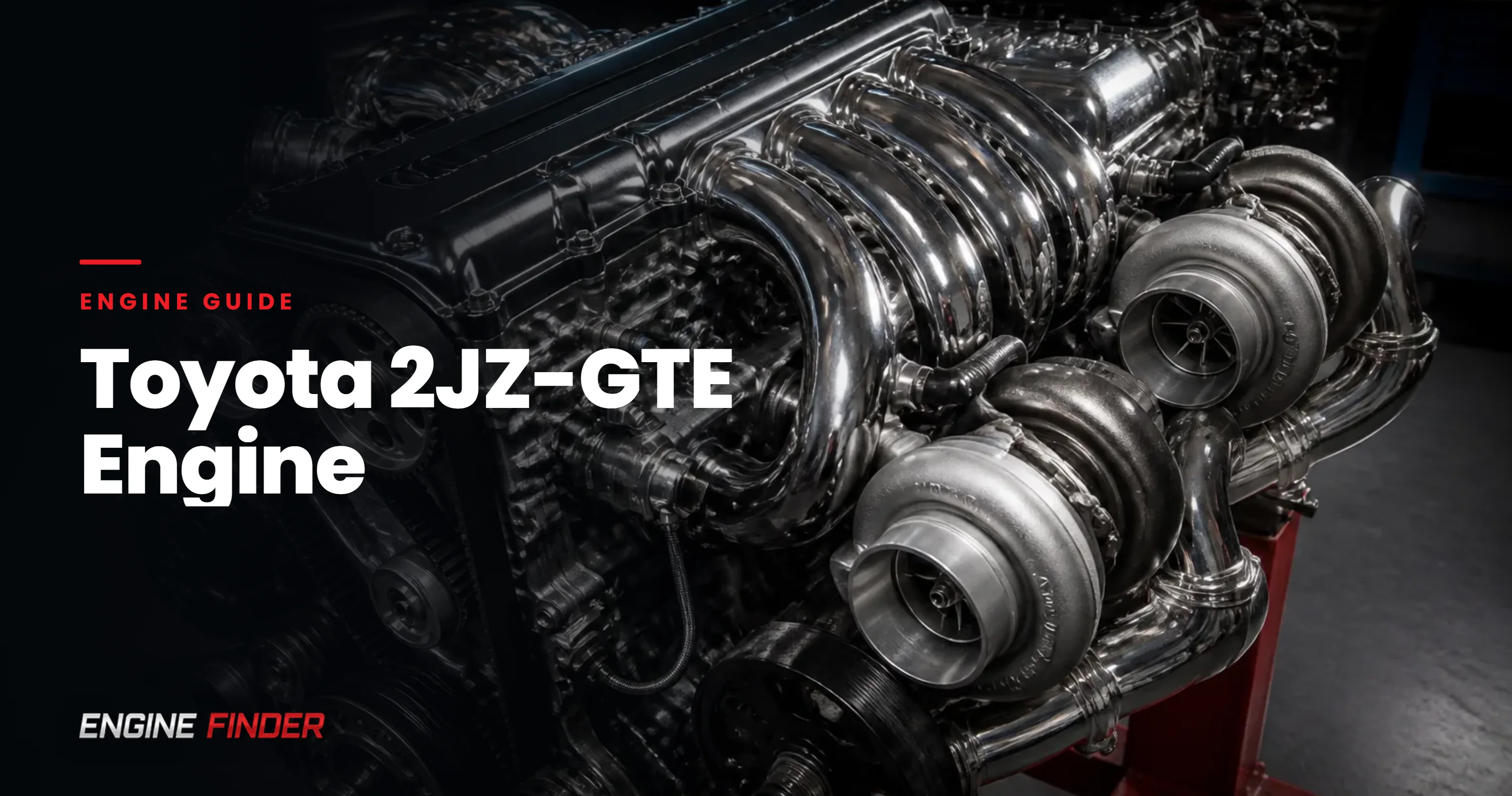
Toyota 2JZ-GTE Engine Guide: The Legendary 3.0L Twin-Turbo Powerplant

Key Takeaways
| Topic | Key Information | Important Details |
|---|---|---|
| Specifications | 2,997cc DOHC inline-6, 206 kW / 431 Nm | Sequential twin turbos, 24 valves |
| Applications | Supra JZA80, Aristo, Crown | Production 1991–2007 |
| Timing | Timing belt — replace every 100,000 km | NOT a chain — critical maintenance item |
| VVT-i | Only 2002+ 2JZ-GTE (Aristo facelift) | Early Supra units have NO VVT-i |
| Tuning Potential | 600–1,000+ kW on built engines | Forged internals, single-turbo conversion popular |
| Oil Spec | 5W-30 or 10W-30 (Toyota spec) | Full synthetic recommended for forced-induction use |
What Is the Toyota 2JZ-GTE?
The Toyota 2JZ-GTE is a 3.0-litre twin-turbocharged inline-6 petrol engine produced by Toyota from 1991 to 2007. It is widely regarded as one of the greatest performance engines ever built — not just for its factory specifications, but for its extraordinary aftermarket potential. A stock block with modest upgrades can reliably produce two or three times its factory power output, a capability that has made the 2JZ-GTE a benchmark in the global tuning community.
The 2JZ family has two primary variants:
- 2JZ-GTE — twin-turbocharged, this guide’s subject
- 2JZ-GE — naturally aspirated, lower output, used in broader Toyota models
These two engines share the same block architecture but are not interchangeable in terms of tune or output expectations.
2JZ-GTE Engine Specifications
| Specification | Details |
|---|---|
| Engine Code | 2JZ-GTE |
| Displacement | 2,997 cc (3.0 L) |
| Configuration | Inline-6, DOHC, 24-valve |
| Bore × Stroke | 86.0 mm × 86.0 mm (square engine) |
| Compression Ratio | 8.5:1 (turbo spec) |
| Turbochargers | Sequential twin-turbo — CT12A (primary + secondary) |
| JDM Power Output | 206 kW (280 PS / 276 hp) |
| JDM Torque | 431 Nm @ 4,000 rpm |
| Fuel System | Sequential multi-port fuel injection (SFI) |
| Redline | 6,500 rpm |
| Firing Order | 1-5-3-6-2-4 |
| Oil Capacity | ~5.7 L with filter |
A Note on Power Figures
The factory 280 PS (206 kW) figure is the JDM-spec output — adhering to the Japanese domestic market gentleman’s agreement that capped passenger-car power claims at 280 PS. Independent dyno tests have placed real output closer to 220–230 kW at the crank. European and North American spec figures differ slightly. All modern aftermarket ECU tunes work from the actual engine output, not the capped figure.
Sequential Twin Turbochargers — How They Work
One of the most technically interesting aspects of the 2JZ-GTE is its sequential twin-turbocharger system. The two CT12A turbochargers do NOT operate in parallel. Instead, they work sequentially:
- Below ~4,000 rpm: Only the primary (smaller) turbocharger is active. Exhaust gases are directed entirely through it, spooling quickly for low-end response.
- Above ~4,000 rpm: The secondary turbocharger begins to spool up. At around 5,000–5,500 rpm, both turbos operate together, sharing the load and sustaining boost through the top of the rev range.
This system reduces turbo lag at low rpm while delivering sustained high-rpm power — a significant engineering achievement for 1991. A set of solenoid valves and exhaust switching valves control the transition. These valves are a known maintenance item: the rubber hoses degrade over time and can cause boost irregularities if neglected.
Sequential vs Parallel Twin-Turbo
“Twin-turbo” can mean two different things. The 2JZ-GTE uses a sequential setup (one turbo at a time, then both). Some other engines use parallel twin-turbos (both turbos always active, each handling half the exhaust). Do not confuse the two — they behave very differently on a dyno and respond differently to tuning.
Vehicle Applications
The 2JZ-GTE was fitted to a relatively small number of vehicles given its reputation:
| Vehicle | Market | Notes |
|---|---|---|
| Toyota Supra (JZA80) | Global | 1993–2002; the most famous application |
| Toyota Aristo (JZS147) | Japan | 1993–1997; early 2JZ-GTE without VVT-i |
| Toyota Aristo (JZS161) | Japan | 1997–2004; facelift model |
| Toyota Crown (JZS171) | Japan | Rare application in the Crown Athlete |
The JZA80 Supra is the global icon — the car that introduced the 2JZ-GTE to enthusiasts worldwide. In Japan, the Aristo (sold in other markets as the Lexus GS) was the principal luxury application.
Why the Supra JZA80?
Toyota produced the JZA80 Supra from 1993 to 2002 (with the 2JZ-GTE variant). After initial production ended, demand sustained a healthy used-car market. The engine’s tuning potential attracted builders globally, and the Supra’s cultural footprint — amplified by media appearances — pushed used prices far above original MSRP by the 2020s.
Timing Belt — Not Chain
The 2JZ-GTE uses a timing belt, not a timing chain. This is one of the most commonly confused facts about the engine:
- The belt drives the twin camshafts and the water pump on one run
- Toyota’s factory service interval is 100,000 km or 6 years — many enthusiasts replace it earlier (every 80,000 km) given the consequences of failure
- Belt failure on this DOHC engine is an interference failure — meaning the valves will contact the pistons, causing catastrophic and expensive damage
- Always replace the water pump, tensioner, and idler pulleys at the same time
Do Not Neglect the Timing Belt
A 2JZ-GTE with an unknown service history needs a timing belt inspection before driving. The cost of a belt kit (R3,500–R6,000 installed) is nothing compared to the cost of a bent-valve cylinder head rebuild (R25,000–R60,000+).
VVT-i: Only on Later Models
Not all 2JZ-GTE engines have Variable Valve Timing with intelligence (VVT-i):
- Non-VVT-i: All JZA80 Supra units (1993–2002) and early Aristo JZS147 units (1993–1997)
- VVT-i equipped: 2002+ 2JZ-GTE in the Aristo JZS161 facelift (from approximately 2002 onwards)
The VVT-i system adjusts intake camshaft timing dynamically, improving low-end torque and fuel economy. For tuners, the VVT-i variant adds ECU complexity but brings marginal performance gains on a heavily modified engine. The non-VVT-i Supra unit is arguably simpler to tune for high power and remains the more commonly transplanted version.
Identifying VVT-i vs Non-VVT-i
Check the intake camshaft sprocket — the VVT-i variant has a variable timing gear hub. The ECU connector count and wiring harness also differ. Non-VVT-i engines have a simpler single-run intake cam sprocket.
Aftermarket and Tuning Potential
The 2JZ-GTE’s legendary tuning reputation is built on a foundation of sound engineering:
Why It Builds Power So Well
- Iron block: Cast-iron construction provides structural rigidity under high cylinder pressure, unlike aluminium blocks that require sleeving at high power levels
- Long-stroke inline-6 layout: Even cylinder firing with a 120° crank throw interval; inherently balanced
- Forged crankshaft (some variants): Factory forged crank on JDM turbo spec variants — holds up to power levels that would destroy lesser parts
- Large oiling passages: Designed with headroom for forced-induction demands
- 7-bolt main bearing caps: Later engines had additional main cap bolts for extra rigidity
Common Power Milestones
| Power Target | Key Modifications |
|---|---|
| 250–300 kW | Boost increase, ECU tune, upgraded intercooler, exhaust |
| 400–500 kW | Single-turbo conversion (GT35/GTX series), fuelling upgrade, built head |
| 600–800 kW | Fully built block, rods, pistons, E85 or methanol injection |
| 1,000+ kW | Full race build, billet internals, purpose-built fuelling and cooling |
Single-Turbo Conversion
The most popular upgrade path removes the sequential twin-turbo system entirely and replaces it with a single large turbocharger. This eliminates the sequential system’s solenoid valves (a reliability concern), increases spool speed with a modern ball-bearing turbo, and simplifies the plumbing. A GT35-series turbo in the 600–700 kW range is a realistic street-and-strip setup.
Aftermarket Support
The 2JZ-GTE has one of the deepest aftermarket support libraries of any engine:
- Cylinder head gaskets rated to 1,500+ hp (1,100+ kW)
- Billet connecting rods from multiple manufacturers
- Custom camshaft grinds optimised for sequential or single-turbo setups
- Standalone ECU maps (Haltech, Link G4+, AEM Infinity) with decades of community tune data
Maintenance and Service Intervals
Oil Specification
Toyota recommends 5W-30 or 10W-30 engine oil for the 2JZ-GTE. For turbo-charged operation — particularly on engines running elevated boost — a full synthetic 5W-30 is the preferred choice in South Africa’s climate range.
| Item | Interval | Notes |
|---|---|---|
| Engine oil & filter | 5,000–7,500 km | Full synthetic 5W-30 recommended for turbo use |
| Timing belt, tensioner, idler, water pump | 80,000–100,000 km | Replace all components together — interference engine |
| Turbo boost solenoid hoses | Inspect every 50,000 km | Rubber degrades; boost irregularities if split |
| Spark plugs | 30,000 km (iridium) | NGK iridium plugs preferred; gapped to 0.7–0.8 mm for stock boost |
| Coolant flush | Every 2 years or 40,000 km | Use Toyota Super Long Life Coolant (SLLC) |
| Gearbox oil (R154 / V160) | 40,000–60,000 km | Different gearbox types depending on market/spec |
Common Issues to Watch
- Boost solenoid hose deterioration: The sequential turbo system’s vacuum lines are rubber and crack with age. Symptoms include boost spikes, boost cuts, or the secondary turbo failing to engage.
- Oil leaks from cam seals and valve cover: Standard for a 30-year-old engine; budget for reseal on any high-mileage unit.
- Turbo actuator wear: The pneumatic actuators on the CT12A turbos lose accuracy over time; rebuilt or new actuators restore factory boost control.
- Head gasket (high-boost builds): The factory MLS head gasket handles stock power well. Above approximately 350 kW, an uprated head gasket (Cometic or OEM upgrade) and ARP head studs are standard practice.
Sourcing a 2JZ-GTE in South Africa
Used 2JZ-GTE engines enter South Africa through Japanese import channels. Key considerations:
- Mileage declarations from Japan are generally reliable — the Japanese inspection (Shaken) system and odometer fraud penalties mean low-km engines from Japan are broadly trustworthy
- Always verify the sequential turbo system is functional before purchase; testing the secondary turbo engagement requires a road test or a boost controller scan
- Import engines typically arrive without the wiring harness — budget for a local harness or swap-specific adapter
- Price range: Expect to pay R25,000–R60,000+ for a running low-km 2JZ-GTE with ancillaries, depending on VVT-i spec and turbo condition
Find a 2JZ-GTE or Toyota engine replacement through Engine Finder — connect with South African suppliers who stock Japanese import engines and can advise on specification matching for your application.
Production History
| Period | Variant | Application |
|---|---|---|
| 1991–1993 | 2JZ-GTE (early) | Aristo JZS147 (Japan only) |
| 1993–2002 | 2JZ-GTE (non-VVT-i) | Supra JZA80 (global); Aristo JZS147 |
| 1997–2007 | 2JZ-GTE (Aristo facelift / VVT-i from ~2002) | Aristo JZS161; Crown JZS171 |
Toyota ceased production of the 2JZ-GTE in 2007. No direct successor carries the same cult status, though the GR-series engines in modern performance Toyotas have begun building their own following.
Summary
The Toyota 2JZ-GTE remains one of the most capable and versatile performance engines ever produced. Its combination of an iron-block inline-6 architecture, sequential twin-turbocharging, and deep aftermarket support means that — 30+ years after its introduction — it is still being installed in new race builds and street cars worldwide. For buyers in South Africa, sourcing a well-maintained unit from Japan and pairing it with local tuning expertise delivers a performance package that remains difficult to beat at equivalent budget levels.
Key facts to remember:
- Displacement: 2,997 cc (not 3.0 L exactly — the 2JZ-GTE and 2JZ-GE share the same square 86 × 86 mm bore/stroke)
- Power: 206 kW / 280 PS factory JDM spec (capped by gentleman’s agreement)
- Torque: 431 Nm @ 4,000 rpm
- Turbos: Sequential CT12A twin-turbo system (NOT parallel)
- Timing: Belt — replace at 80,000–100,000 km intervals
- VVT-i: 2002+ Aristo only — not on Supra JZA80 units
- Oil: 5W-30 or 10W-30 Toyota spec
Related Articles
Explore more insights on similar topics
Toyota 1ZZ & 3ZZ Engine Guide: Specs, Problems & SA Prices
1ZZ vs 3ZZ Toyota engine guide: specs, common faults, oil consumption fix, and used prices in South Africa (R8,000-R25,000). Find a replacement engine fast.
Volkswagen VR6 Engine Guide: The Revolutionary Narrow-Angle Six-Cylinder
Complete guide to Volkswagen's revolutionary VR6 engine. Discover its unique narrow-angle design, technical innovations, and 33-year production legacy that redefined compact performance.
Toyota 2.8 GD6 Engine Problems: 5 Known Issues
Toyota 2.8 GD6 DPF clogging, injector failure, and manifold leaks — the top Hilux diesel problems. SA repair costs from R5,000-R60,000 and how to fix them.
Important Disclaimer
This content is for informational purposes only and is based on research from automotive industry sources. Engine Finder is not a certified automotive repair facility. Always consult with qualified automotive professionals before performing any repairs or maintenance. Improper repairs can result in personal injury, property damage, or vehicle malfunction. We assume no responsibility for actions taken based on this information.