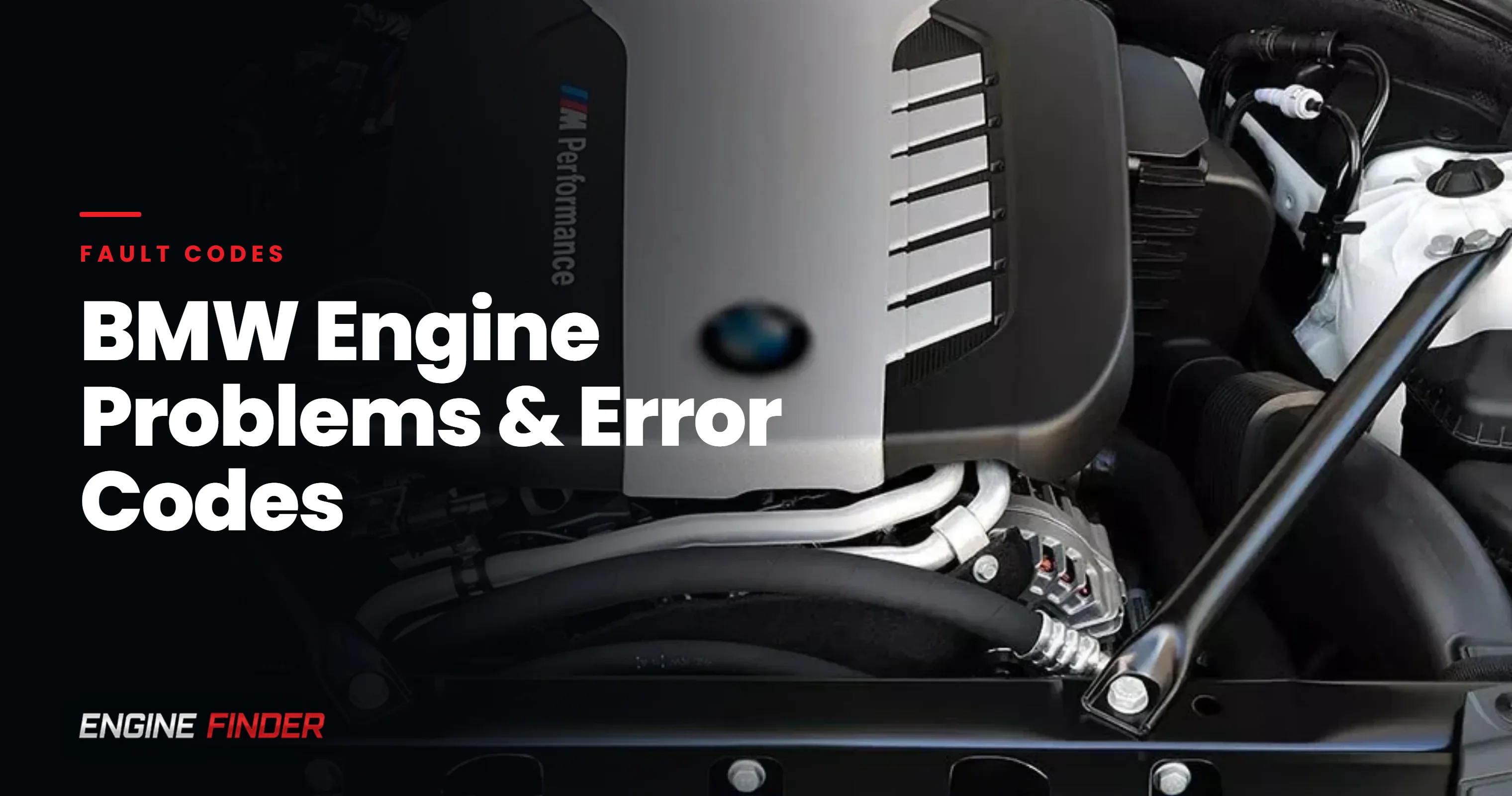
BMW Engine Problems & Error Codes: Complete Diagnostic Guide

Key Takeaways
- BMW stores faults twice. A cheap R150 OBD-II dongle only reads the generic P-codes (P0301, P0171 and the like) that emissions law forces every car to expose. Your BMW’s real diagnosis lives in five-character hexadecimal codes (2A82, 30FF, 29CD) that only a BMW-aware scanner such as ISTA, INPA, Carly or a good workshop tool can read.
- The hex code is more specific than the P-code. Where a generic scanner shows P0011 (“camshaft timing over-advanced”), BMW shows 2A82 — telling you it’s the intake VANOS solenoid, not the exhaust.
- Some codes signal cheap fixes; some signal an engine-out job. A dirty MAF (P0102) is an afternoon. A P0016 crank/cam correlation code on an N47 diesel usually means the timing chain has stretched — a rear-of-engine, gearbox-off repair that can cost more than the car is worth.
- Cold-start rattle + a timing code = stop driving. On N47/B47 diesels a stretched chain that snaps bends every valve and writes off the engine.
- When a repair quote tops R25,000–R85,000, a good used engine is often the smarter buy. Engine Finder connects you to verified BMW suppliers across South Africa.
If your BMW has thrown a fault code, here’s the short version: the P-code your generic scanner shows (like P0301) tells you roughly what’s wrong, but BMW’s own hexadecimal code (like 29CD) tells you exactly which part in which cylinder. Reading both is the difference between a guessed repair and a fixed car. This guide decodes the BMW engine codes South African owners actually see — across the N47 and B47 diesels, the N20 and B48 petrols, and the N54/N55 twin-turbos — and flags which ones point to a cheap sensor and which point to a scrapped engine.
Why BMW uses hex codes and not just P-codes
Every car sold since the mid-2000s must expose OBD-II P-codes — the “P” standing for powertrain, followed by four digits (P0301, P0171, P2002). These are standardised under SAE J2012 and readable by any R150 scan-tool from a parts shop. The catch: they only cover emissions-related faults the law cares about, which is a small slice of what the car actually monitors.
BMW’s own control modules — the DME (petrol engine computer) or DDE (diesel engine computer) — store faults in a far more detailed hexadecimal format. These are four- or five-character codes mixing numbers and the letters A–F: 2A82, 30FF, 4B90. As Bimmerfest, e90post and other established BMW communities document, the same physical fault produces both: your generic scanner sees the blunt P-code, while a BMW tool (ISTA/D, INPA, Carly, Autologic) reads the precise hex code the DME actually logged.
The two codes describe the same fault at different resolutions
Think of the P-code as the postal code and the hex code as the street address:
- Generic scanner: P0011 — “Intake camshaft timing over-advanced, Bank 1.”
- BMW scanner: 2A82 — “VANOS intake solenoid, position not reached.” Same fault, but the hex code names the exact solenoid to test first.
This is why a BMW that “has no codes” on a cheap reader can still be logging a wall of hex faults on a proper scan. If you’re paying a workshop, always ask them to read the DME/DDE hex codes, not just the generic OBD-II codes.
Common BMW engine fault codes: the reference table
Every code below is verified against BMW technical references and established BMW diagnostic communities. The Type column tells you whether it’s a universal P-code (any scanner) or a BMW hex code (BMW-aware scanner only).
| Code | Type | What it means (verified) | Common cause | Typical fix |
|---|---|---|---|---|
| P0301–P0306 | Generic P-code | Misfire detected, cylinders 1–6 respectively | Spark plugs, ignition coils, injector | Replace plugs/coil for the named cylinder |
| 29CD–29D2 | BMW hex | Combustion misfire, cylinders 1–6 respectively (29CD = cyl 1 … 29D2 = cyl 6) | Coil or plug on that cylinder; on N54, also low fuel | Swap coil/plug; check fuelling if multiple cylinders |
| P0171 / P0174 | Generic P-code | System too lean, Bank 1 / Bank 2 | Vacuum/intake leak, dirty MAF, weak fuel delivery | Smoke-test for leaks, clean/replace MAF |
| 2A82 | BMW hex | VANOS intake solenoid — commanded position not reached | Clogged solenoid screen, dirty oil, stretched chain | Clean/replace intake VANOS solenoid; check oil |
| 2A87 | BMW hex | VANOS exhaust solenoid — commanded position not reached | Same as 2A82 but exhaust side | Clean/replace exhaust VANOS solenoid |
| P0011 / P0014 | Generic P-code | Intake / exhaust camshaft timing over-advanced, Bank 1 | VANOS solenoid, oil pressure, chain wear | Diagnose VANOS (2A82/2A87), verify oil condition |
| P0016 | Generic P-code | Crankshaft/camshaft position correlation mismatch, Bank 1 | Stretched/jumped timing chain, cam sensor | Inspect timing chain — often engine-out on N47 |
| 30FF | BMW hex | Turbocharger, low-pressure side (underboost) | Boost/vacuum leak, wastegate rattle, charge-pipe | Pressure-test boost system, check wastegate |
| 30FE | BMW hex | Turbocharger, high-pressure side (overboost) | Stuck wastegate, boost-control fault | Inspect wastegate actuator and control |
| P0299 | Generic P-code | Turbocharger/supercharger underboost condition | As per 30FF — leak, wastegate, actuator | Boost leak test, wastegate check |
| 29DC | BMW hex | Cylinder injection switch-off (fuel supply shortfall) | Failing HPFP, low rail pressure (common N54) | Test rail pressure, replace HPFP if low |
| 29E2 | BMW hex | Fuel rail pressure sensor signal fault | Rail pressure sensor or wiring | Test/replace rail pressure sensor |
| 4B90 | BMW hex | Diesel rail-pressure monitoring at engine start (low pressure) | Failing diesel HPFP, leaking injectors, contamination | Test rail pressure, inspect HPFP & injectors |
| P0401 | Generic P-code | EGR flow insufficient (diesel) | Carbon-clogged EGR valve/cooler (common N47) | Clean or replace EGR valve |
| P2002 | Generic P-code | DPF efficiency below threshold, Bank 1 (diesel) | Clogged/cracked DPF, thermostat blocking regen | Check thermostat & DPF pressure sensor, regen/replace |
| 2C3200 | BMW hex | Swirl flap actuator mechanically faulty (lever broken) | Broken swirl-flap lever/actuator (N47) | Replace actuator or delete flaps per spec |
| 2C32 | BMW hex | O2 sensor before catalyst, Bank 2 (fuel-trim/cat fault) | Failing pre-cat O2 sensor, ageing catalyst | Test O2 sensor; assess catalytic converter |
| P0102 | Generic P-code | Mass Air Flow (MAF) sensor, low signal | Dirty/failing MAF, intake leak | Clean or replace MAF sensor |
Reading the table: if your scanner only shows the P-code column, you’re seeing the emissions-legal minimum. Ask for the BMW hex read to pin the exact component — it saves guessing (and money) on VANOS, turbo and injector faults especially.
Which codes point to major engine damage
Most fault codes are annoying, not fatal. A handful are a genuine warning that the engine itself is at risk. These are the ones to never ignore:
Timing-chain codes (the expensive ones)
P0016 (and BMW’s related crank/cam correlation hex codes) means the crankshaft and camshaft are no longer in sync. On the N47 and B47 diesels — the 118d, 320d, 520d and X-models sold heavily in SA — this is the notorious timing chain stretch. The chain sits at the back of the engine against the bulkhead, so replacing it means dropping the gearbox and often pulling the engine. A cold-start rattle of 1–3 seconds is the early warning; if the chain snaps, valves and pistons collide and the engine is usually a write-off. If you see P0016 alongside a start-up rattle, stop driving and get it inspected before it becomes a new-engine bill. Our dedicated BMW N47 timing chain guide covers the SA repair costs in detail.
Turbo codes (30FF / 30FE / P0299)
On the twin-turbo N54 and single-turbo N55, 30FF (underboost) is one of the most common faults — frequently traced to wastegate rattle as the turbo actuators wear. Left alone, worn wastegates can eventually damage the turbochargers themselves. Start with a boost-pressure leak test before condemning the turbos.
Fuel-delivery codes (29DC / 29E2 / 4B90)
The N54’s high-pressure fuel pump (HPFP) is a well-documented weak point; codes 29DC and 29E2 often accompany a failing pump. On N47/B47 diesels, 4B90 flags low rail pressure at start-up — usually a failing diesel HPFP or leaking injectors. Metal debris from a disintegrating diesel pump can contaminate and jam every injector, turning a pump job into a full fuel-system rebuild, so act early.
DPF and EGR codes (P2002 / P0401)
On diesels, P0401 (EGR flow) and P2002 (DPF efficiency) are usually secondary faults — a carbon-clogged EGR or a thermostat that never lets the engine get hot enough to burn off the DPF. Cheap to catch early; a multi-thousand-rand DPF if ignored into limp mode.
When to repair vs source a used engine
Use the fault code to size the job before you spend:
- Sensor and ignition codes (P0102 MAF, P0301 misfire, 2A82 VANOS solenoid): repair. These are hundreds to a few thousand rand.
- EGR/DPF codes (P0401, P2002): repair if caught early; budget more if the DPF is already clogged.
- Timing-chain codes (P0016 + rattle on N47/B47) and spun/knocking bottom ends: this is where a repair quote of R25,000–R85,000 for a rebuild often exceeds the value of fitting a good used engine. A tested, low-kilometre replacement from a verified supplier is frequently the smarter spend — and gets the car back on the road faster.
If you’ve reached that point, it’s worth comparing prices before committing to a rebuild. Engine Finder lets you request quotes for used BMW engines from suppliers across South Africa in one go.
Get the hex read first. Before authorising any big repair, insist the workshop reads and shows you the BMW hex fault codes (via ISTA/INPA/Carly), not just the generic P-codes. It’s the single best way to confirm whether you’re facing a solenoid or a stretched chain.
FAQ
What’s the difference between BMW hex codes and generic P-codes?
Generic P-codes (like P0301) are the standardised OBD-II codes any scanner reads — but only for emissions-related faults, roughly 10–15% of what the car monitors. BMW’s own hex codes (like 29CD) are five-character codes stored by the DME/DDE that pinpoint the exact component and are far more granular. Many BMW faults exist only as a hex code with no P-code equivalent, which is why a cheap reader often shows “no faults” on a car that’s clearly running badly.
Why does my cheap OBD-II scanner show no codes when my BMW runs badly?
Because a basic ELM327-type reader only sees the generic P-codes the DME exposes through the legal emissions interface. The deeper BMW hex codes — VANOS, fuel-rail, turbo, transmission, chassis — need a BMW-aware tool such as ISTA, INPA, Carly or a workshop-grade scanner to read.
Is a P0016 code serious on a BMW diesel?
Yes. On N47/B47 diesels, P0016 (crank/camshaft correlation) very often means the timing chain has stretched. Because the chain is at the back of the engine, the repair is expensive, and a snapped chain typically writes off the engine. If it’s paired with a cold-start rattle, stop driving and get it checked immediately.
Can I clear BMW fault codes myself?
You can clear codes with a scanner, but clear the cause first. Erasing a code without fixing the underlying fault just lets it return — and can mask a serious problem (like a stretching chain) until it becomes catastrophic.
When is it cheaper to buy a used engine than repair mine?
Once a quote for a rebuild or major internal repair approaches R25,000–R85,000, a tested used engine from a verified supplier is often the better value — especially on higher-mileage cars. Compare quotes for a used BMW engine before committing to a rebuild.
Sources
- BMW Fault Codes Explained — Bimmertalk
- BMW N54 Common Fault Codes — BMWtuning.co
- P2002 DPF Efficiency on BMW N47/B47 Diesel — Go-Parts
- P0016 Crankshaft–Camshaft Correlation — RepairPal
Related Services
Facing a major BMW engine fault? Engine Finder connects you with verified South African suppliers for used BMW engines, BMW parts recyclers, and BMW parts from stripped vehicles. Request quotes across the network in one step and compare before you commit.
Related Articles
Explore more insights on similar topics
BMW 3 Series Gearbox Replacement Cost in South Africa (2026 Guide)
Full 2026 cost guide for BMW 3 Series (E46, E90, F30) automatic gearbox replacement in South Africa. ZF 6HP and 8HP prices, mechatronic repair vs full replacement, and how to find a quality recon unit.
Nissan NP200 Gearbox Problems: JR5 Manual, Clutch & Costs (SA Guide)
Nissan NP200 gearbox problems explained — the Renault JR5/JH3 manual, crunchy shifts, 5th-gear whine, soft-clutch cylinder faults, and what a used or recon NP200 gearbox costs in SA.
BMW B47 Engine Problems: EGR Recall & SA Repair Costs (2026)
BMW fixed the N47's chain-snap epidemic with the B47 — but the EGR cooler fire-risk recall, DPF clogging and carbon build-up became the new headaches. Symptoms, SA repair costs, and when a used engine wins.
Important Disclaimer
This content is for informational purposes only and is based on research from automotive industry sources. Engine Finder is not a certified automotive repair facility. Always consult with qualified automotive professionals before performing any repairs or maintenance. Improper repairs can result in personal injury, property damage, or vehicle malfunction. We assume no responsibility for actions taken based on this information.