Importing a Car into South Africa: Rules, Costs and How It Actually Works (2026 Guide)

Here’s the honest answer most people don’t want to hear: for the vast majority of South Africans, you cannot simply import a used car — not to drive, and definitely not to resell. The government heavily restricts second-hand vehicle imports to protect the local motor industry. Importing is only realistic if you fall into a specific permitted category (you’re a returning resident, an immigrant, you’ve inherited the car, it’s a genuine vintage collector’s vehicle, a racing car, or a vehicle adapted for a person with a disability). If you do qualify, the process runs through three gatekeepers — ITAC, the NRCS, and SARS — plus shipping, police clearance and registration. This guide walks through each step and what it costs.
Key Takeaways
| Step | Who handles it | What it's for |
|---|---|---|
| Qualify first | ITAC | Confirm you're in a permitted import category at all |
| Import permit | ITAC | Legal permission to bring a used vehicle in |
| Letter of Authority | NRCS | Vehicle meets SA compulsory safety specs |
| Shipping | Vehicle shipping company | Move the car by RoRo or container |
| Duties & VAT | SARS | Import duty, ad valorem and 15% VAT |
| Register | SAPS / eNaTIS | Police clearance, roadworthy, licence |
Already imported a car and can't find an engine for it? We can help.
Grey-import and discontinued models are exactly where local parts dry up. Post one enquiry and our network of suppliers comes back to you.
Find an EngineCan You Even Import a Car into South Africa?
This is the question to settle before you spend a cent. The International Trade Administration Commission (ITAC) controls used-vehicle imports, and a blanket ban applies to importing second-hand cars for personal use or resale. You can only apply for an import permit if you fall into one of a handful of recognised categories:
- Returning South African residents who lived abroad for at least six months and owned the vehicle, registered in their own name, for a qualifying period before coming home.
- Immigrants taking up permanent residence.
- Inheritance — a vehicle left to you by a deceased estate.
- Vintage / collectors’ vehicles manufactured 40 or more years ago — the genuine classic threshold, not a five-year-old import.
- Racing vehicles not intended for normal road use, with motorsport authorisation.
- Vehicles specially designed for a person with a physical disability.
Left-hand-drive vehicles are a separate headache — they generally can’t be registered for normal road use unless they fall under the vintage or specialist exemptions. If you don’t fit a category, the honest move is to buy locally.
Step 1: Get Your ITAC Import Permit
If you qualify, the import permit from ITAC is the first formal document and nothing moves without it. You apply with proof of your category — for returning residents that means evidence you owned and used the vehicle abroad for the required period; for immigrants, your permanent residence documentation; for an inheritance, the estate paperwork. Get this approved before you ship anything. Shipping a car to a South African port without a valid import permit is how people end up with a vehicle stuck in a bonded warehouse, racking up storage fees, that customs will not release. ITAC permits are also vehicle-specific, so the VIN and details on the permit must match the car you actually send. Most importers use a registered clearing agent to lodge and track the application, because a rejected or mismatched permit is expensive to unwind once the car is already at sea. One catch to plan for: a vehicle imported under these concessions generally cannot be sold or transferred for two years after it lands.
Step 2: The NRCS Letter of Authority
The National Regulator for Compulsory Specifications (NRCS) issues a Letter of Authority (LOA) confirming the vehicle complies with South Africa’s compulsory safety and technical specifications. This is a genuine sticking point for grey imports: a model built for the US, Japanese or European market may not meet SA homologation requirements out of the box, and modifications to comply can be costly or, in some cases, not feasible at all. Before you commit to a specific car, check whether that exact model and specification can realistically obtain an LOA. This is where a lot of “I found a great deal overseas” plans quietly fall apart — the car is cheap because it was never built to South African spec. Confirm LOA feasibility in parallel with your ITAC application, not after the car arrives.
Step 3: Shipping the Car to South Africa
With your permit in hand, the car has to physically get here — and that means an ocean crossing to Durban, Cape Town or Port Elizabeth. There are two common methods. Roll-on/roll-off (RoRo) drives the car onto a dedicated vehicle vessel; it’s usually the cheapest option for a single running car. Container shipping seals the car (sometimes alongside personal effects) inside a container, which costs more but offers better protection and is the norm for high-value or non-running vehicles.
For a US-origin vehicle you’ll want a licensed international vehicle shipping company — a specialist like A1 Auto Transport to help import the car handles port-to-port booking, marine insurance and the export-side paperwork. Get a written, all-in quote (ocean freight, insurance, port handling) and confirm the destination port matches where your clearing agent operates.
Step 4: Customs, Duties and VAT (SARS)
This is where the “bargain from overseas” maths usually collapses. When the car lands, SARS clears it and levies several charges on the customs value — and they stack:
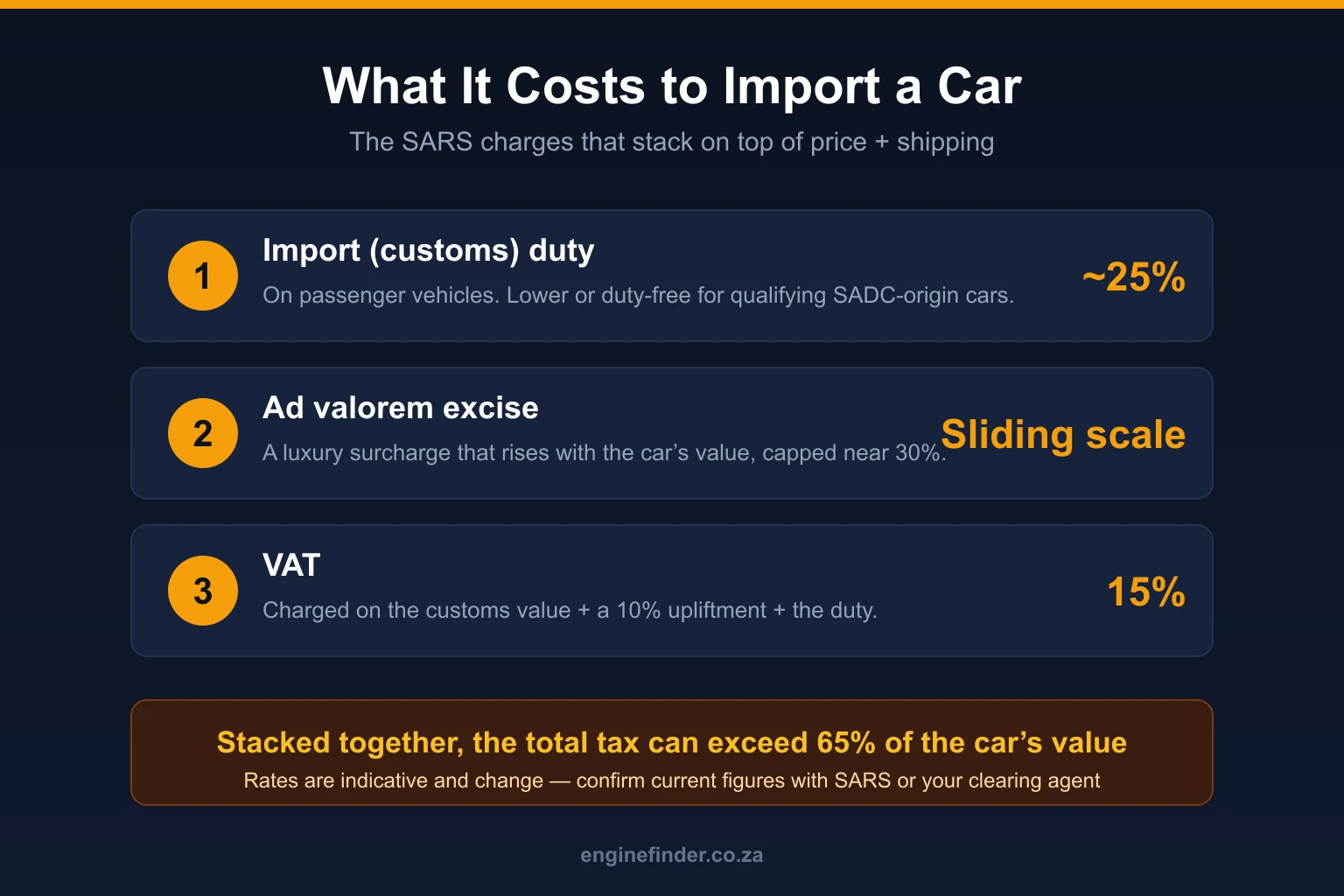
| Charge | Indicative rate | Notes |
|---|---|---|
| Import (customs) duty | ~25% on passenger vehicles | Lower or duty-free for qualifying SADC-origin vehicles |
| Ad valorem excise | Sliding scale by value | A luxury surcharge that rises with value, capped at 30% |
| VAT | 15% | Charged on the customs value + a 10% upliftment + the duty |
⚠️ Watch out
These rates are indicative and change — confirm the current duty, ad valorem and VAT with SARS or your clearing agent before you commit. Stacked together, the total tax bill on an imported car can exceed 65% of its value — so an "affordable" import frequently lands well above the local price for an equivalent car.
A returning resident or immigrant bringing a vehicle they already owned may qualify for rebates, but the conditions are strict and the paperwork must back it up.
Step 5: Police Clearance, Registration and Roadworthy
Almost there, but the car still isn’t yours to drive. An imported vehicle needs SAPS police clearance (the engine and chassis numbers are checked against stolen-vehicle records), a roadworthy certificate, and then registration and licensing on eNaTIS at your local licensing authority. You’ll need your ITAC permit, NRCS Letter of Authority, the SARS clearance documents, proof of identity and proof of address. Build in time — clearance and registration of an imported vehicle takes longer than a normal local change of ownership, and any mismatch between the documents (a VIN that doesn’t match the permit, for example) stalls the whole thing. Only once it’s registered and roadworthy can you legally put it on the road.
What we see on Engine Finder
The enquiries that sit unanswered longest on our platform are almost always for grey-import or discontinued models — the car came in fine, but two years later the owner needs an engine or gearbox and the local supply just isn't there. If you're set on importing something unusual, factor lifetime parts availability into the decision, not just the landed price.
Is Importing Actually Worth It?
For most people, no. Between the ITAC permit, NRCS compliance, shipping, and the SARS duty-plus-VAT stack, the total landed cost of an imported used car frequently exceeds what you’d pay for an equivalent vehicle already on a South African forecourt — and you take on the long-term risk of scarce parts and specialist servicing. Importing genuinely makes sense in a narrow set of cases: you’re a returning resident or immigrant moving a car you already own and love, you’ve inherited a vehicle, or you’re a collector after a specific classic that simply isn’t available locally. If you’re chasing a cheaper everyday runabout, buying locally almost always wins once you’ve done the full sum. And if you do bring something rare in, plan for the parts side early — it’s worth knowing where to buy a used engine in South Africa and what current used-engine prices look like before you commit.
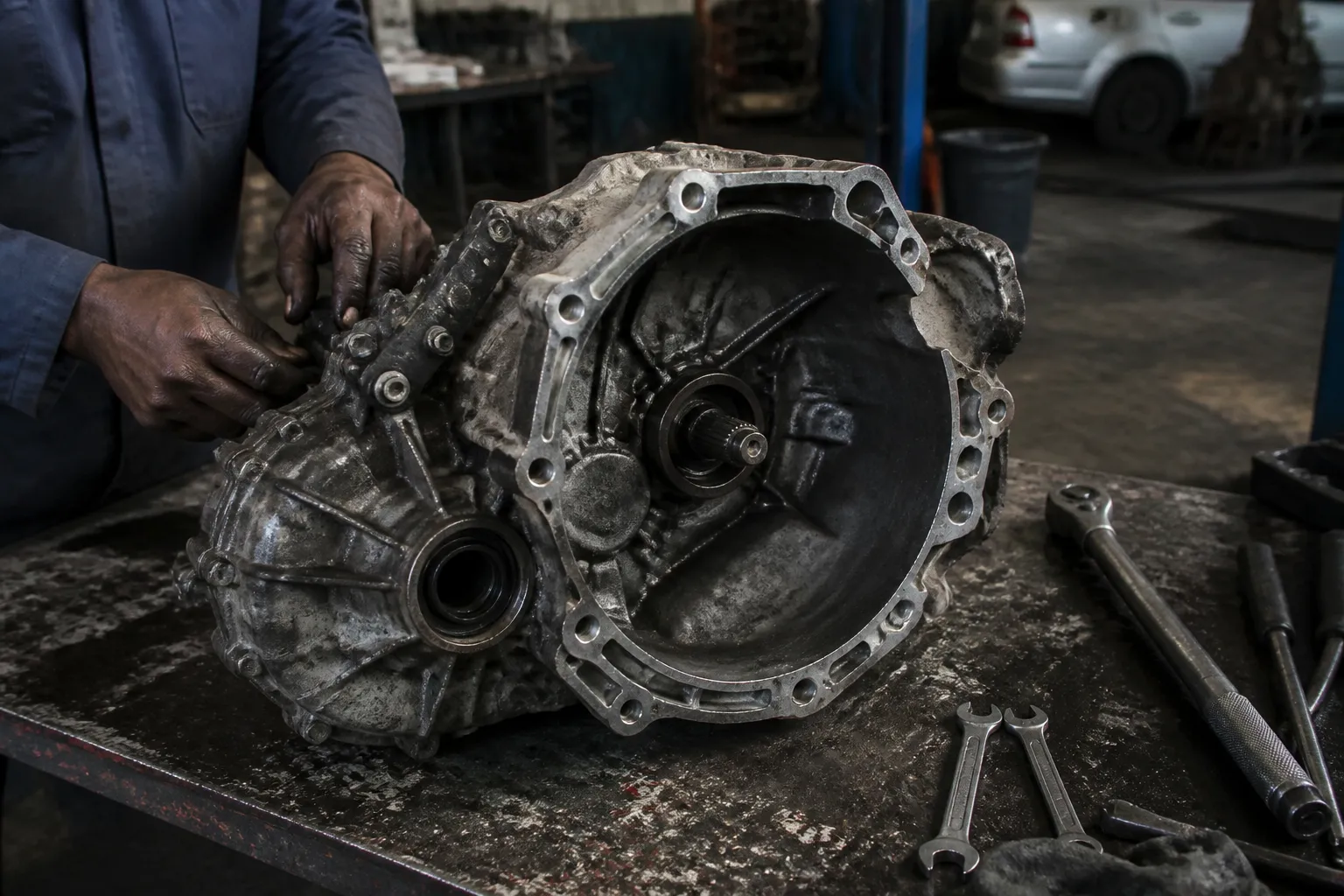
Gearboxes for Imported & Discontinued Models
Engines aren't the only headache — a scarce gearbox can ground an imported car for weeks. Tell us the make and our nationwide supplier network comes back to you with what they have in stock.
Find a GearboxFAQ
Can I import a used car into South Africa to resell it?
No. Importing used vehicles for resale is not permitted. Import permits are issued only for specific categories such as returning residents, immigrants, inheritances, genuine vintage collectors’ vehicles, racing cars and vehicles adapted for people with disabilities.
Do I need a permit before I ship the car?
Yes — get your ITAC import permit approved before the car leaves the origin country. A vehicle that arrives without a valid permit can be held by customs and run up storage costs while you sort it out.
What is an NRCS Letter of Authority?
It’s confirmation from the National Regulator for Compulsory Specifications that the vehicle meets South Africa’s compulsory safety and technical standards. Some foreign-spec models can’t easily qualify, so check feasibility before you buy.
How much are import duties on a car?
Expect import duty (commonly around 25% on passenger vehicles), an ad valorem excise on a sliding scale, and 15% VAT calculated on the combined value. Rates change — confirm the current figures with SARS or a clearing agent.
Is it cheaper to import a car than to buy one locally?
Usually not. Once shipping, duties, ad valorem and VAT are added, imported used cars often cost more than an equivalent vehicle already in South Africa — and parts can be harder to source.
Sources
Related Articles
Explore more insights on similar topics
DSG vs CVT vs Torque-Converter: Automatic Gearboxes Explained
DSG vs CVT vs torque-converter gearbox explained for SA buyers, how each works, what fails, and how to compare gearbox quotes before you buy.
Where to Buy a Used Engine in South Africa: 2026 Buyer's Guide
Five places to source a used engine in SA — marketplaces, scrap yards, auctions, importers, classifieds. Compare prices, warranty, risk and which suits you.
Suzuki Baleno Engine Maintenance Cost in South Africa (2026 Guide)
Suzuki Baleno annual maintenance costs R3,500-R8,000 in South Africa. Full service cost breakdown, common engine issues, dealer vs independent pricing, and used engine prices.
Important Disclaimer
This content is for informational purposes only and is based on research from automotive industry sources. Engine Finder is not a certified automotive repair facility. Always consult with qualified automotive professionals before performing any repairs or maintenance. Improper repairs can result in personal injury, property damage, or vehicle malfunction. We assume no responsibility for actions taken based on this information.