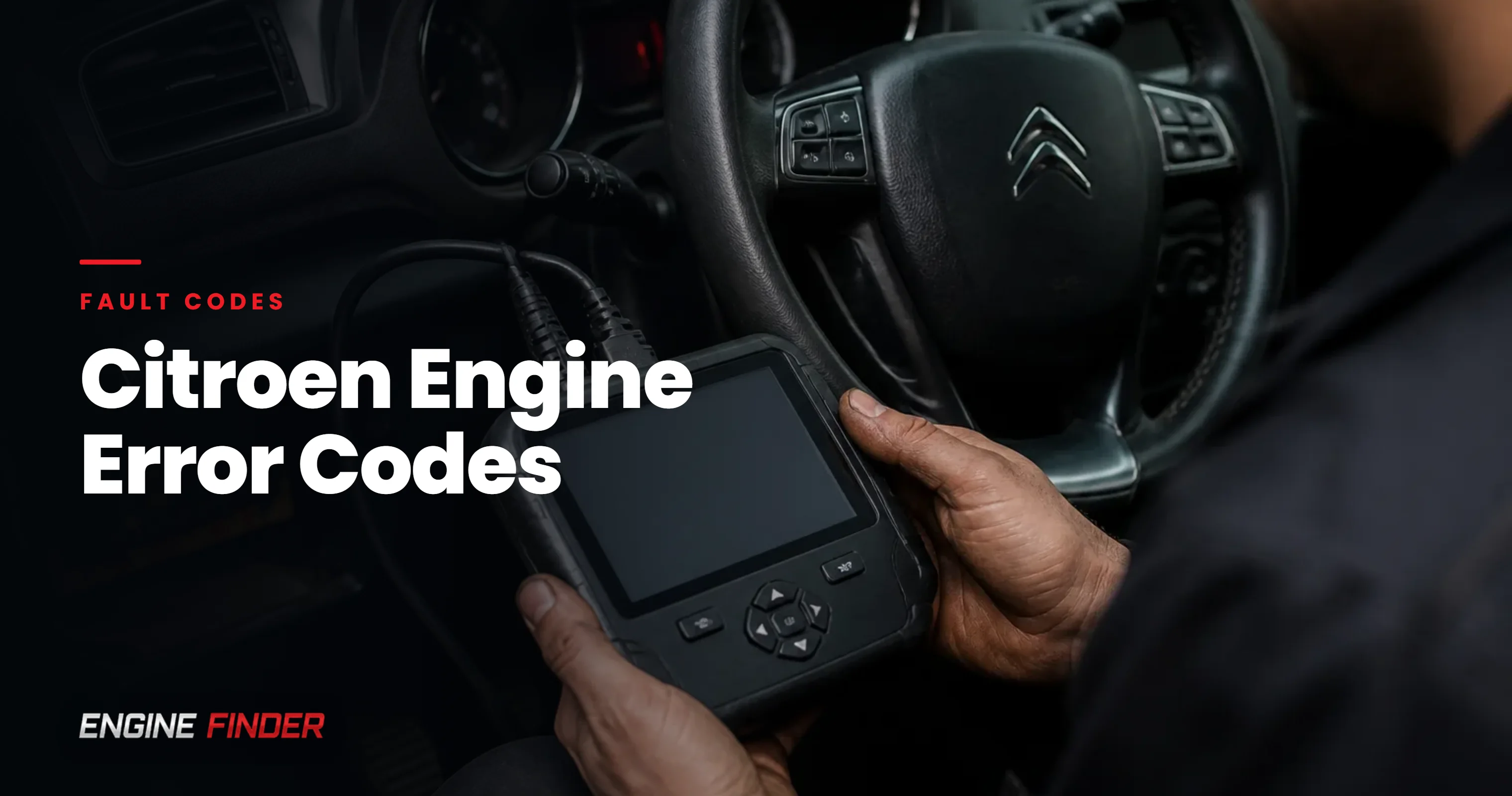
Citroen Engine Error Codes: Diagnostic & Fix Guide (SA)

Citroen Engine Error Codes: Diagnostic & Fix Guide (SA)
When your Citroen throws an engine warning light, the fault code behind it tells you exactly what the ECU has detected — and getting the meaning right is the difference between a R450 sensor reset and an unnecessary R15,000 turbo. This guide decodes the engine fault codes SA workshops see most on the models sold here: the C3, C4 and Berlingo running the 1.6 HDi (DV6) diesel and the 1.2 PureTech / 1.6 THP (EP6) petrol engines.
Codes come in two families. Generic SAE codes (starting P0xxx) mean the same thing on any car. PSA manufacturer-specific codes (P1xxx) are unique to Peugeot and Citroen, which share the same platform — so a generic OBD-II reader often can’t decode them, and a lot of the “definitions” floating around online are mistranslated. Every code below has been checked against the SAE J2012 standard or a reputable PSA source.
Key Takeaways
- A code is a clue, not a diagnosis. P0299 (underboost) is usually a split hose — not a dead turbo. Test before you replace.
- P1xxx codes are PSA-specific. You need a Citroen/Peugeot-capable scanner (Diagbox-class) to read them correctly. Generic readers miss or misname them.
- The 1.6 HDi turbo dies from a blocked oil feed, not from bad luck. Carbon sludge starves the bearings — a P0299 or a suddenly smoky, gutless engine is your early warning.
- DPF/FAP codes (P2002, P1435) on diesels are urgent. Ignoring the Eolys additive warning permanently clogs the filter — a much bigger bill than a top-up.
- P0420 on petrol rarely needs a new catalytic converter first — check the oxygen sensor.
- If codes point to a seized turbo, stretched EP6 timing chain, or blown head, a used replacement engine is often the cheapest honest fix.
Diagnostic cost (SA): R450–R750 for a proper Citroen-specific scan · Generic OBD-II scan R250–R400 (won’t read P1xxx)
How to read Citroen fault codes
Every Citroen since 1996 has a 16-pin OBD-II port, usually under the dashboard near the steering column. A basic plug-in reader will pull generic P0xxx codes and clear the check-engine light. But because so many Citroen faults live in the PSA-specific P1xxx range, a generic reader will either skip them or show a raw number with no meaning.
For anything beyond a simple sensor code, use a Citroen/Peugeot-capable tool (a Diagbox-class scanner or a specialist workshop). These read the manufacturer codes, show live sensor data, and — crucially — let you run the adaptation procedures (like crankshaft target-wheel learning) that several PSA codes actually need.
One rule that saves money: clearing a code doesn’t fix the fault. If the underlying problem is still there, the code returns within a few drive cycles, and emissions-related codes won’t reset the readiness monitors needed to pass a roadworthy.
The most common Citroen engine fault codes
The table below is the working reference. Codes are split into generic (SAE) — same meaning on any car — and PSA/Citroen-specific, which need a Citroen-capable scanner.
| Code | Correct meaning | Common cause | Typical fix |
|---|---|---|---|
| Generic (SAE) codes | |||
| P0171 | System too lean, Bank 1 (too much air / too little fuel) | Vacuum/intake leak, dirty MAF, weak fuel supply | Smoke-test intake, clean MAF, check fuel pressure |
| P0234 | Turbo/supercharger “A” overboost | Wastegate stuck closed, faulty wastegate solenoid, soot on VGT vanes | Free/replace wastegate actuator or solenoid, clean vanes |
| P0299 | Turbo/supercharger “A” underboost | Boost leak (split hose / cracked air-dosing housing on 1.6 HDi), soot-seized VGT, faulty turbo sensor | Smoke-test intake first, replace hoses/housing, decarbonise or replace turbo |
| P0087 | Fuel rail pressure too low (common-rail diesel) | Clogged fuel filter, weak HP pump, leaking injector return | Replace filter(s) first, test HP pump & rail pressure |
| P0088 | Fuel rail pressure too high (common-rail diesel) | Rail pressure regulator stuck closed, over-reading sensor | Compare desired vs actual pressure, replace regulator/sensor |
| P0401 | EGR flow insufficient | Carbon/soot blocking EGR valve, cooler or intake ports (very common on HDi) | Clean or replace EGR valve, decarbonise intake |
| P0402 | EGR flow excessive | EGR valve stuck open, faulty EGR position sensor | Clean/replace EGR valve, check pintle position |
| P0420 | Catalyst efficiency below threshold, Bank 1 (petrol) | Worn catalytic converter, faulty downstream O2 sensor, exhaust leak | Check O2 sensor before condemning the cat |
| P0016 | Crank/cam correlation fault (Bank 1) — common on 1.6 THP EP6 | Stretched timing chain / worn guides, slipped tone ring, cam/crank sensor | Verify timing with locking tools, replace chain kit if stretched |
| P0011 | Camshaft timing over-advanced, Bank 1 (EP6 petrol) | Low/contaminated oil, faulty VVT (dephaser) solenoid, chain wear | Change oil, clean/replace VVT solenoid, inspect chain |
| P0670 | Glow-plug control module circuit / open (diesel) | Failed glow-plug control module, wiring fault | Test module & wiring, replace module |
| P2002 | Diesel Particulate Filter (DPF/FAP) efficiency below threshold | Clogged/failed DPF, exhaust leak, faulty back-pressure sensor | Forced regen or motorway run, replace DPF if saturated |
| PSA / Citroen-specific codes | |||
| P1336 | Crankshaft target-wheel adaptation not learned (NOT a misfire) | Adaptation skipped after crank-sensor swap or battery disconnect, damaged flywheel tone ring | Run the crank target-wheel adaptation with a PSA scanner |
| P1351 | Pre/post-heating (glow plug) relay circuit fault (HDi diesel) | Faulty preheat relay, failed glow plugs — poor cold starting | Test & replace preheat relay and/or glow plugs |
| P1435 | DPF additive (Eolys) system fault | Empty/low Eolys tank, failed additive pump — dash shows “risk of particle filter blocking” | Refill Eolys additive, reset counter, repair pump |
The codes that mean real engine, turbo or DPF damage on the HDi
Not every code is a five-minute fix. On the 1.6 HDi (DV6) diesel especially, a few of these point to failures that get expensive fast if you keep driving.
Turbo starvation — the HDi’s signature failure
The 1.6 HDi turbo has a well-documented weak spot: a small strainer in the oil-feed banjo bolt that clogs with carbon sludge and starves the turbo bearings of oil. Once the bearings run dry, the turbo is finished. If you see P0299 (underboost), lose power, or notice blue smoke and turbo whine, stop and investigate — this is the classic early warning. The fix isn’t just a turbo: the oil feed and return pipes must be replaced too, or the fresh turbo dies the same way. Reputable rebuilders won’t supply a DV6 turbo without new feed pipes for exactly this reason. (Professional Motor Mechanic)
The prevention is boring but real: use the correct fully-synthetic oil and change it on time. Skipping services is what sludges the feed in the first place.
DPF and additive codes — don’t “drive it and see”
P2002 (DPF efficiency below threshold) and P1435 (Eolys additive system fault) are both urgent on a diesel. The PSA additive (Eolys) system injects a fluid that lowers the soot burn-off temperature so the DPF can regenerate. If the additive runs low or the pump fails, regeneration stops and the filter clogs with soot — turning a top-up into a full DPF replacement. If your dash reads “Risk of Particle Filter Blocking,” treat it as a job for this week, not next month. (FAP Cleaner — DPF fault codes)
EP6 petrol timing — P0016 and P0011
On the 1.6 THP (EP6) petrol, P0016 (crank/cam correlation) and P0011 (timing over-advanced) frequently trace back to a stretched timing chain or worn guides — a known EP6 weakness. Left alone, a chain that jumps can bend valves and wreck the engine. If these codes appear with a rattle on cold start-up, get the timing checked before driving further.
P1336 — the code everyone mistranslates
You’ll see P1336 described online as a “random misfire.” On a Citroen it isn’t. The correct PSA meaning is crankshaft target-wheel system variation not learned — the ECU needs the flywheel target (tone ring) adaptation run, typically after a crank-sensor replacement or a battery disconnection. The fix is a software adaptation procedure with a PSA-capable scanner, not a hunt for a misfiring cylinder. (Go-Parts — P1336) For other model-specific quirks beyond fault codes, see our guide to Citroen C1 engine problems.
When a used replacement engine is the smart call
Some codes are cheap to chase; others are the engine telling you it’s near the end. If diagnosis confirms a seized turbo that took the bearings and oil galleries with it, a stretched EP6 chain that skipped and bent valves, or low compression from a blown head gasket or scored bores, the repair bill can climb past what the car is worth.
At that point a good used engine — imported low-mileage or from a stripped local donor — is usually the cheapest way to get years more life out of the car. Because Citroen and Peugeot share the PSA platform, the same DV6 and EP6 engines are widely available across both brands, which keeps supply healthy and prices sensible in South Africa. Browse used Citroen engines for sale from verified SA scrap yards and importers, or grab affordable used parts from Citroen scrap yards near you.
Frequently Asked Questions
What’s the most common engine error code on a Citroen in South Africa?
On the diesels, turbo and EGR codes dominate — P0299 (turbo underboost) and P0401 (EGR flow insufficient) are the everyday callers, both usually caused by carbon and soot rather than a failed major part. On the petrol EP6, P0016 (crank/cam correlation) is the one to watch because it often signals timing-chain wear. Always confirm the exact code with a Citroen-capable scanner before spending money.
Can I clear a Citroen error code without fixing the problem?
You can clear it with any OBD-II scanner, but if the underlying fault remains the code returns within a few drive cycles. On emissions-related codes (P0420, P0171, P2002) the readiness monitors won’t reset either — which fails a roadworthy inspection.
Why won’t my generic OBD-II reader show my Citroen’s fault code?
Because many Citroen faults are PSA manufacturer-specific P1xxx codes (like P1336 or P1435). Generic readers only decode standard P0xxx codes — for the P1xxx range you need a Citroen/Peugeot-capable tool or a specialist workshop.
How much does a Citroen diagnostic scan cost in South Africa?
Expect R450–R750 for a proper Citroen-specific diagnostic at a specialist. Generic OBD-II scans are cheaper (R250–R400) but won’t read the manufacturer P1xxx / DPF-additive codes.
Need a replacement Citroen engine or part?
If your fault codes point to terminal damage — a seized turbo, stretched timing chain, or a blown head — Engine Finder connects you with verified SA scrap yards and engine importers in one request. Tell us your model and engine code, and get quotes for a used Citroen engine or the exact part you need. No hunting yard-to-yard — the suppliers come to you.
Resources
- Used Citroen Engines For Sale
- Citroen Scrap Yards in SA
- Citroen C1 Engine Problems
- OBD-Codes.com — P0299 Turbo Underboost
- KBB — P2002 Diesel Particulate Filter
Related Articles
Explore more insights on similar topics
Nissan NP200 Gearbox Problems: JR5 Manual, Clutch & Costs (SA Guide)
Nissan NP200 gearbox problems explained — the Renault JR5/JH3 manual, crunchy shifts, 5th-gear whine, soft-clutch cylinder faults, and what a used or recon NP200 gearbox costs in SA.
BMW B47 Engine Problems: EGR Recall & SA Repair Costs (2026)
BMW fixed the N47's chain-snap epidemic with the B47 — but the EGR cooler fire-risk recall, DPF clogging and carbon build-up became the new headaches. Symptoms, SA repair costs, and when a used engine wins.
Toyota Hilux Gearbox Problems: GD6, 4Y, Auto & Manual (SA Guide)
Toyota Hilux gearbox problems explained, manual & auto faults, clutch costs, GD6 vs older boxes, and how to compare Hilux gearbox prices in SA.
Important Disclaimer
This content is for informational purposes only and is based on research from automotive industry sources. Engine Finder is not a certified automotive repair facility. Always consult with qualified automotive professionals before performing any repairs or maintenance. Improper repairs can result in personal injury, property damage, or vehicle malfunction. We assume no responsibility for actions taken based on this information.