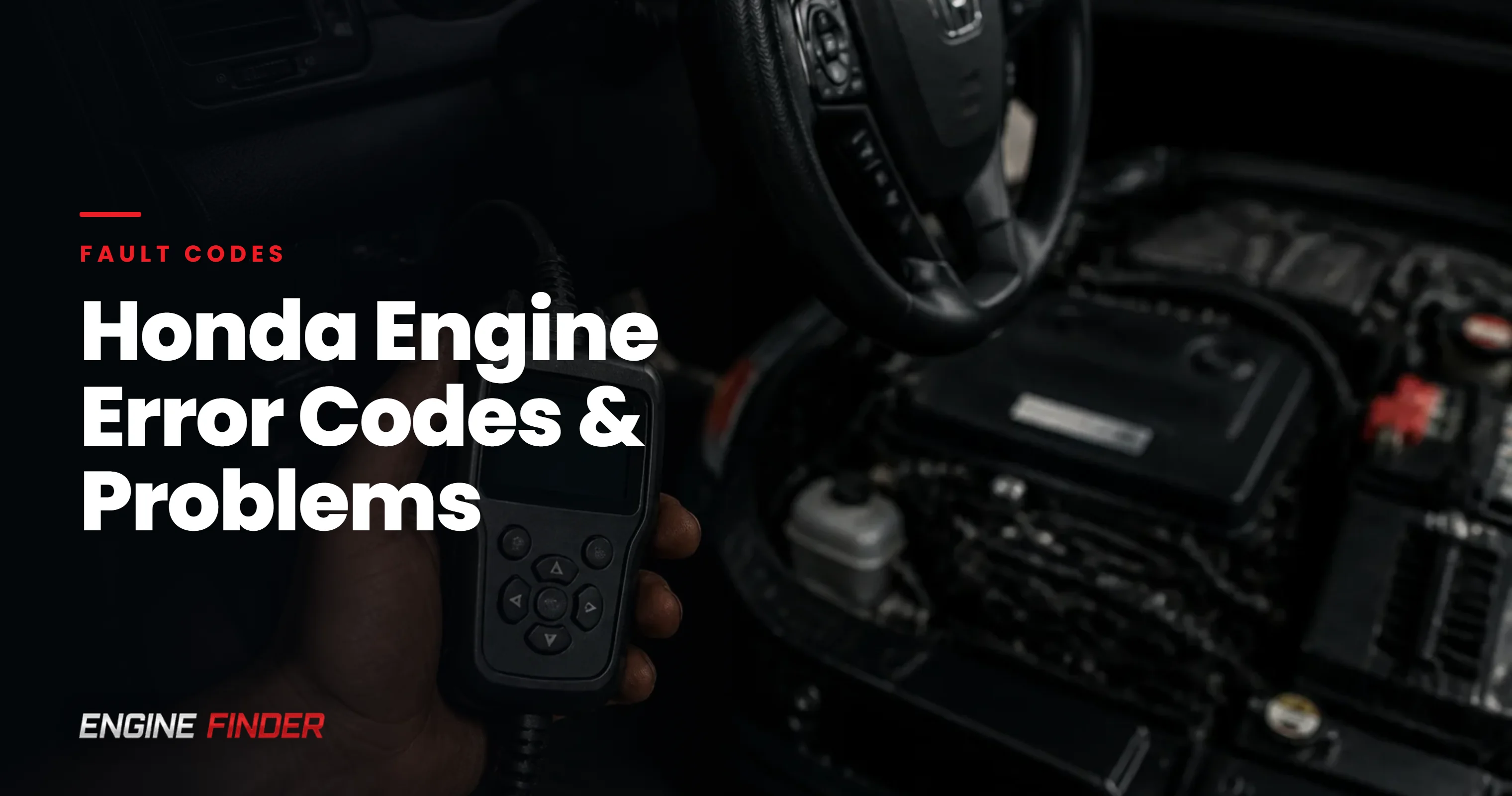
Honda Engine Error Codes & Problems

If your Honda has flashed a check-engine light and thrown a code like P0011, P1259 or P2646, the code itself tells you exactly where to start — but only if you read it correctly. A cheap OBD-II scanner will pull the five-character code in under a minute; the trick is knowing which codes are cheap electrical faults and which ones warn of real internal engine damage. This guide gives you the correct, verified meaning of the Honda petrol-engine codes South African owners see most often on the Jazz/Fit, Civic, Ballade, CR-V and Accord — split into generic OBD-II codes and Honda-specific P1xxx codes — plus the common cause and the typical fix for each.
Key Takeaways
| What you need to know | Detail |
|---|---|
| Read it yourself | Any R400–R800 Bluetooth OBD-II adapter + a free app (Torque, Car Scanner) reads Honda codes. |
| Cheapest fixes | P1456 (gas cap), P0301-type misfires (plug/coil), P0507 (vacuum leak/throttle body). |
| Watch-out codes | P0011, P0341, P1259, P2646/P2647 — point at VTEC/VTC (variable valve timing) faults; ignore them and you risk cam and valve-train damage. |
| Damage warning | A live misfire (P0300–P0304) can dump raw fuel into the catalytic converter and melt it — don’t keep driving. |
| Diagnostic cost (SA) | R450–R750 for a professional scan and read-out; R1,000–R1,500 for full system diagnosis. |
How to read Honda fault codes
Every Honda sold since the 1996 model year is OBD-II compliant, with the standard 16-pin diagnostic port sitting under the dashboard on the driver’s side. Reading a code takes five steps:
- Plug in the scanner to the OBD-II port under the dash.
- Turn the ignition to “ON” (position II) — you don’t need to start the engine.
- Read the stored and pending codes through your scanner or app.
- Write down every code, including pending ones, before you clear anything.
- Look up the exact code against a reliable source (this page, or Honda’s service data) before spending money.
Only clear codes after the repair is done and verified — clearing them beforehand just erases the evidence and resets the readiness monitors.
How to read a Honda code
The five-character format is standardised across all cars by SAE J2012:
- First letter — the system: Powertrain, Body, Chassis, Un(network/communication).
- First digit — 0 = generic OBD-II code (same meaning on any make), 1 = manufacturer-specific (Honda’s own definition).
- Last three digits — the specific fault.
So a P0171 is a generic “system too lean” code that means the same thing on a Toyota, while a P1259 is a Honda-defined VTEC code you won’t find on other makes.
Common Honda engine fault codes (verified)
The table below lists the Honda petrol-engine codes we see most often on SA cars, with the correct meaning, the usual cause and the typical fix. Generic OBD-II codes come first, then the Honda-specific P1xxx codes.
| Code | Correct meaning | Common cause | Typical fix |
|---|---|---|---|
| P0011 | ”A” camshaft timing over-advanced (Bank 1) — intake cam more advanced than commanded | Stuck VTC oil control valve or sludge-clogged oil passages starving the VTC actuator | Clean/replace VTC oil control solenoid; fresh oil at correct grade; check timing chain |
| P0171 | System too lean (Bank 1) — too much air or too little fuel | Vacuum/intake gasket leak, dirty MAF, weak fuel pump or clogged injectors | Fix vacuum leak, clean/replace MAF, restore fuel pressure |
| P0174 | System too lean (Bank 2) — V6 engines only | Same as P0171 but on the opposite bank | Same as P0171, on Bank 2 |
| P0300 | Random/multiple-cylinder misfire | Worn plugs or coils, vacuum leak, low fuel pressure, carbon build-up | Replace plugs/coils, fix underlying air-fuel fault |
| P0301 / P0302 / P0303 / P0304 | Misfire in cylinder 1 / 2 / 3 / 4 respectively | Failed spark plug or coil on that cylinder, or a leaking injector | Swap the coil/plug to a neighbouring cylinder — if the misfire follows, replace it |
| P0341 | Camshaft position sensor “A” circuit range/performance (Bank 1) | Faulty VTC actuator (rattle on cold start) or stretched timing chain — mechanical, not usually the sensor | Replace VTC actuator or timing chain; check cam-to-crank correlation |
| P0420 | Catalyst system efficiency below threshold (Bank 1) | Worn catalytic converter — but often really a lazy downstream O2 sensor or exhaust leak | Diagnose O2 sensors and exhaust leaks first; replace cat only if confirmed |
| P0507 | Idle control system RPM higher than expected | Vacuum leak, dirty throttle body or a sticking idle-air control passage | Smoke-test for vacuum leaks, clean throttle body |
| P0847 | Transmission fluid pressure sensor/switch “B” circuit low (Jazz/Fit auto) | Failed 3rd-clutch pressure switch — a known weak point on 2nd-gen Fit autos | Replace the transmission fluid pressure switch |
| P1259 | VTEC system malfunction (Bank 1) — Honda-specific | Low/dirty oil, faulty VTEC solenoid, or open/short in the solenoid harness | Change oil and filter first; test/replace VTEC solenoid and check wiring |
| P1456 | EVAP system leak — fuel-tank side (Honda-specific) | Loose, worn or non-OEM fuel (petrol) cap | Tighten or replace the fuel cap with an OEM part |
| P1457 | EVAP system leak — canister side (Honda-specific) | Faulty canister vent shut valve or a leak near the charcoal canister | Replace the vent valve; smoke-test the canister side |
| P2646 | Rocker arm oil pressure switch circuit low voltage (VTEC) — Honda-specific | Low/dirty oil, clogged VTEC solenoid screen, or faulty VTEC oil pressure switch | Oil and filter change; clean solenoid screen; replace the oil pressure switch |
| P2647 | Rocker arm oil pressure switch circuit high voltage (VTEC) — Honda-specific | Oil pressure present at the rocker when VTEC is off — usually a faulty switch or solenoid | Replace the VTEC oil pressure switch/solenoid assembly |
A note on some widely-copied “Honda code lists”: many of them (the ones floating around with definitions like P0303 = “cylinder 4” or garbled VTEC descriptions) are machine-translated and simply wrong. The codes above are cross-checked against SAE J2012 and Honda-specific diagnostic data — if you can’t verify a code against a reputable source, don’t act on it.
Which codes mean serious engine trouble?
Not every code is an emergency. Here’s how to triage the common Honda ones.
Cheap, low-risk fixes
- P1456 (fuel-tank EVAP leak) is almost always a loose or perished petrol cap. It won’t hurt the engine — but it will fail a roadworthy emissions check.
- P0507 (high idle) is usually a vacuum leak or a gummed-up throttle body — annoying, not dangerous.
- A single misfire code (P0301 etc.) caught early is often just one worn plug or coil.
VTEC and VTC codes — fix promptly
Honda’s VTEC (Variable Valve Timing and Lift Electronic Control) and VTC (Variable Timing Control) systems rely on clean oil at the right pressure. The codes P0011, P0341, P1259, P2646 and P2647 all point at this area. The single most common root cause is neglected oil — sludge blocks the tiny screens and passages that feed the VTC actuator and VTEC solenoid. Left alone, that can progress from a warning light to a rattling actuator, a stretched timing chain or worn cam lobes. The good news: on a huge share of these, an overdue oil-and-filter change with the correct-grade oil clears the fault. These are the same oil-pressure-dependent faults behind many common Honda VTEC engine problems.
When a misfire becomes a damage risk
A live misfire (P0300–P0304) is the one code you should not keep driving on. Unburned petrol passes through the cylinder and overheats the catalytic converter — enough to melt it, which turns a R500 coil job into a converter replacement, and can eventually cause a P0420 when the ruined cat stops scrubbing the exhaust. If the check-engine light is flashing, that means an active misfire severe enough to damage the cat — pull over and don’t drive it.
When to source a used engine
Some codes are symptoms of wear that has already gone too far. If a misfire traces back to low compression across several cylinders (worn rings or burnt valves), if the VTC/timing-chain damage has spread, or if a Honda has knocking with metal in the oil, you’re past the point of a sensor swap. At that stage a good used Honda engine is usually far cheaper than a full rebuild — especially on the older L-series i-VTEC and K-series units that are plentiful in SA stripping yards. If the damage is bad enough that a rebuild is on the table, it’s worth understanding the engine overhaul process before you commit to either route.
Frequently asked questions
What is the most common Honda error code? On higher-mileage Hondas, P0420 (catalyst efficiency below threshold) and the misfire codes (P0300–P0304) are among the most frequent. On Jazz/Fit and Civic models, the EVAP code P1456 — usually just a loose petrol cap — is also very common.
Can I drive with a Honda error code showing? It depends. A steady check-engine light for something like P1456 or P0420 is fine to drive to a workshop. A flashing light — typically an active misfire (P0300–P0304) — means stop driving: you risk melting the catalytic converter.
What does a Honda VTEC code like P1259 or P2646 actually mean? Both are Honda-specific codes telling you the VTEC oil-pressure control isn’t behaving as commanded. Nine times out of ten the first thing to check is the oil — low level or old, dirty oil clogs the VTEC solenoid screen. If clean oil doesn’t clear it, the VTEC oil pressure switch or solenoid is the next suspect.
How much does a Honda diagnostic cost in South Africa? A professional scan and code read-out typically runs R450–R750. Full system diagnosis on a stubborn fault can reach R1,000–R1,500.
Can I clear Honda codes myself? Yes — any OBD-II scanner can clear codes. But only clear them after you’ve completed and verified the repair. Clearing a code without fixing the cause just hides the problem until it returns.
Conclusion
Honda’s OBD-II system is one of the most useful diagnostic tools you own — but only when you read the codes correctly. Get the meaning right and you’ll know in minutes whether you’re looking at a R150 petrol cap, a worn coil, or a VTEC oil-starvation fault that needs attention before it costs you a cam. Keep the oil clean and changed on schedule and you’ll head off the majority of the VTEC and VTC codes on this list.
When a code points at damage that’s gone beyond a sensor or a service item, Engine Finder connects you with stripping yards and suppliers across South Africa for quality used Honda engines and parts — get a free quote and compare prices before you commit to an expensive rebuild.
Sources: SAE J2012 DTC standard; CarParts.com DTC library (P0011, P0171, P0301, P0420); AutoCodes Honda code database (P1259, P2646, P2647, P1456); Ricks Free Auto Repair Advice — Honda P2647 and the VTEC system.
Related Articles
Explore more insights on similar topics
Nissan NP200 Gearbox Problems: JR5 Manual, Clutch & Costs (SA Guide)
Nissan NP200 gearbox problems explained — the Renault JR5/JH3 manual, crunchy shifts, 5th-gear whine, soft-clutch cylinder faults, and what a used or recon NP200 gearbox costs in SA.
BMW B47 Engine Problems: EGR Recall & SA Repair Costs (2026)
BMW fixed the N47's chain-snap epidemic with the B47 — but the EGR cooler fire-risk recall, DPF clogging and carbon build-up became the new headaches. Symptoms, SA repair costs, and when a used engine wins.
Toyota Hilux Gearbox Problems: GD6, 4Y, Auto & Manual (SA Guide)
Toyota Hilux gearbox problems explained, manual & auto faults, clutch costs, GD6 vs older boxes, and how to compare Hilux gearbox prices in SA.
Important Disclaimer
This content is for informational purposes only and is based on research from automotive industry sources. Engine Finder is not a certified automotive repair facility. Always consult with qualified automotive professionals before performing any repairs or maintenance. Improper repairs can result in personal injury, property damage, or vehicle malfunction. We assume no responsibility for actions taken based on this information.