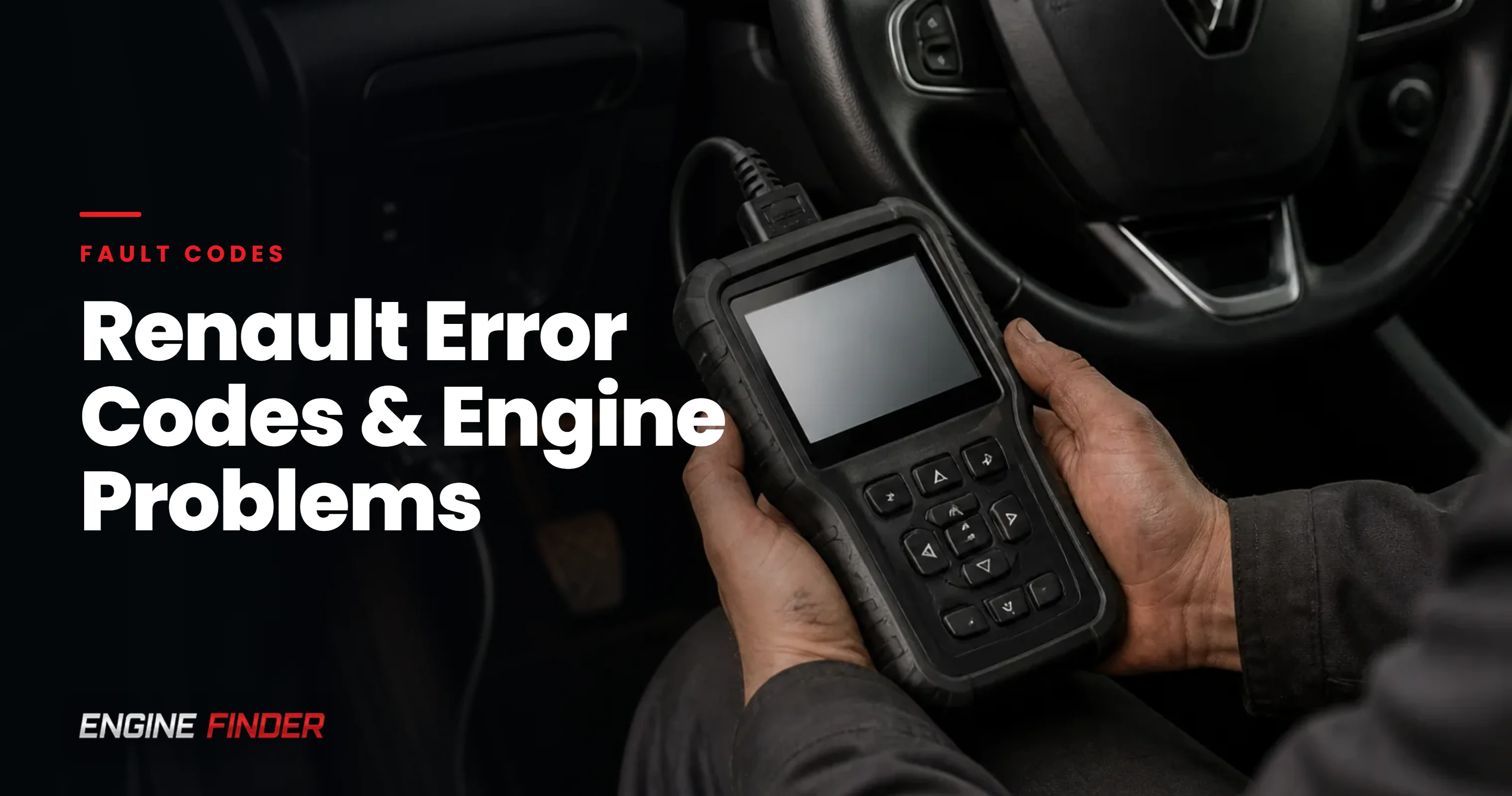
Renault Error Codes & Engine Problems: Complete Diagnostic Guide

If your Renault Duster, Sandero or Kwid has thrown a warning light, the fault code behind it will be one of two kinds: a generic P-code (like P0335) that any R400 OBD-II reader can pull, or a Renault-specific DF code (like DF001) that only a Renault-aware tool such as CLIP or a good app will show. This guide explains both, gives you a verified code table covering the faults South African Renault owners actually see, and flags the ones that can mean serious damage to a 1.5 dCi (K9K) diesel engine.
Key Takeaways
- Two code systems: P-codes are the universal OBD-II standard (SAE J2012); DF codes (“Défaut” = fault) are Renault’s own numbering, used by CLIP and Renault-specialist scanners. A single fault can show up as both.
- DF meanings are ECU-specific. The same DF number can mean different things on different engines/model years, so always confirm the description against the exact reading on your scanner — don’t assume a number seen online applies to your car.
- On the 1.5 dCi (K9K) diesel, fuel-injector, fuel-rail-pressure, EGR and DPF codes are the ones to take seriously — left alone they can escalate into a scored bore, a seized turbo or a ruined DPF.
- Petrol Kwid/Sandero (1.0 and 1.6) throw more misfire, crank/cam-sensor and catalyst codes.
🔧 Equipment Needed: OBD-II scanner (Renault-capable for DF codes)
💰 Diagnostic Cost: R450–R750 for a professional scan and read-out
⏱️ Repair Time: 1–6 hours depending on the fault
Why Renault Uses DF Codes (and How They Differ from P-Codes)
Every car sold since the OBD-II mandate reports faults using the standardised P-code system defined by SAE J2012 and ISO 15031-6 — that’s why “P0335” means the same crankshaft-sensor fault on a Renault, a Toyota or a Ford.
Renault (and its Dacia and Nissan Alliance partners) layers its own internal numbering on top: DF codes, short for the French Défaut (“fault”). These are read by Renault’s factory CLIP tool and Renault-aware aftermarket scanners. A DF code often points to the exact circuit or component Renault’s engineers care about, which is why a workshop with the right tool can sometimes pinpoint a fault faster than a generic reader.
Two things to keep in mind:
- The same underlying fault can appear as both — e.g. a coolant-temperature sensor fault may log as generic P0115 and Renault’s DF001.
- DF numbers are not universal. Renault has reused numbers across different ECUs and model years, so the meaning of a given DF code depends on the specific control unit fitted to your car. Treat any DF list (including this one) as a starting point and confirm the description your own scanner prints alongside the number.
Because the P-code layer is standardised and reliable, the practical advice is: read the P-code first, then use the DF code to narrow it down with a Renault-capable tool.
Common Renault Fault Codes: The Verified Table
The table below lists the codes South African Renault owners see most often. Generic P-codes are standardised and their meanings are fixed; the DF codes included are the well-established ones, but always verify against your own scanner’s description because DF meanings vary by ECU.
| Code | Type | What it means (verified) | Common cause | Typical fix |
|---|---|---|---|---|
| P0335 | Generic | Crankshaft position sensor “A” circuit malfunction | Failed crank sensor; damaged wiring; debris on the reluctor ring | Replace crank sensor; repair wiring |
| P0340 | Generic | Camshaft position sensor “A” circuit malfunction | Failed cam sensor; wiring fault; timing out of sync | Replace cam sensor; check timing |
| P0380 | Generic (diesel) | Glow plug / heater circuit “A” malfunction | Failed glow plug(s); glow-plug relay; wiring | Replace faulty glow plugs / relay |
| P0087 | Generic (diesel) | Fuel rail / system pressure too low | Weak lift pump; clogged fuel filter; leaking injector; worn HP pump | Replace fuel filter; test pump & injector leak-off |
| P0088 | Generic (diesel) | Fuel rail / system pressure too high | Stuck fuel-pressure regulator (IMV/DRV); faulty rail sensor | Replace regulator or rail pressure sensor |
| P0299 | Generic | Turbocharger underboost | Boost/vacuum leak; sticking variable-vane turbo; actuator fault | Fix boost leak; free or replace turbo actuator |
| P0234 | Generic | Turbocharger overboost | Stuck wastegate/vane; boost-control solenoid fault; blocked DPF | Free wastegate/vanes; check DPF back-pressure |
| P0401 | Generic | EGR flow insufficient | Sooted-up EGR valve/passages; faulty EGR sensor | Clean or replace EGR valve; clear passages |
| P0402 | Generic | EGR flow excessive | Stuck-open EGR valve; sensor fault | Replace EGR valve; check sensor |
| P0470 | Generic (diesel) | Exhaust (DPF) pressure sensor “A” circuit malfunction | Failed differential-pressure sensor; blocked sensor pipes | Replace DPF pressure sensor; clear pipes |
| P2002 | Generic (diesel) | Diesel particulate filter efficiency below threshold | Soot-overloaded DPF; failed regeneration; short-trip use | Forced regen; DPF clean or replacement |
| P0420 | Generic (petrol) | Catalyst system efficiency below threshold (Bank 1) | Worn catalytic converter; failing O2 sensor; rich/lean running | Replace cat; replace O2 sensor; fix mixture |
| DF001 | Renault DF | Coolant temperature sensor circuit (≈ P0115) | Failed coolant temp sensor; wiring/connector fault | Replace sensor; repair connector |
| DF002 | Renault DF | Intake air temperature sensor circuit (≈ P0110) | Failed air-temp sensor; wiring; can trigger limp mode | Replace air-temp sensor; check wiring |
| DF038 | Renault DF | Engine control unit (ECU) internal fault | Internal ECU electronic fault; corrupt data | Re-flash or replace/repair ECU |
| DF137 | Renault DF | Fuel rail pressure regulation fault | Fuel-pressure regulator; rail sensor; supply issue | Diagnose fuel supply; replace regulator/sensor |
| DF297 | Renault DF | Diesel particulate filter (clogging / regeneration fault) | Overloaded DPF; incomplete regens; short trips | Forced regen; professional DPF clean/replace |
Reading the table
Match your reader’s output to the Type column. A cheap generic scanner shows the P-codes; a Renault-capable tool (CLIP or equivalent) is what surfaces the DF codes. If you only see a DF number with no P-code, note it exactly and have a Renault specialist confirm the description for your ECU.
The Codes That Mean Serious K9K (1.5 dCi) Damage
The 1.5 dCi (K9K) — fitted to the Duster, Sandero, Logan, Kwid 1.0 diesel derivatives and shared across Dacia and Nissan — has powered more than ten million vehicles worldwide, and its weak points are well documented. A few codes on this engine are early warnings of expensive damage:
Fuel injector and rail-pressure faults (P0087 / P0088 / DF137)
The K9K’s common-rail injectors are widely regarded as a weak design point, sometimes failing at modest mileage. A leaking injector or worn high-pressure pump drops rail pressure (P0087), causing hard starting, misfires and power loss. Ignored, excessive injector leak-off can wash oil off the bores and cause long-term wear. Injectors on this engine also usually need coding to the ECU after replacement — a job for a shop with Renault software, not a plug-and-play swap.
EGR faults (P0401 / P0402)
Soot build-up in the EGR valve, cooler and pipes is a chronic K9K issue. Beyond the fault code, a heavily clogged EGR system chokes airflow, drops power and pushes more soot into the DPF — accelerating the next problem.
DPF faults (P2002 / P0470 / DF297)
Short-trip town driving never gets the exhaust hot enough to complete a DPF regeneration, so soot accumulates until the filter blocks. Once it’s severely loaded, forced regeneration may not save it and you’re looking at a costly clean or replacement. A faulty differential-pressure sensor (P0470) can also trigger false DPF warnings.
Turbo faults (P0299 / P0234)
Underboost (P0299) or overboost (P0234) on the K9K’s small turbo often trace back to a sticking variable-vane mechanism gummed up with soot, a split boost pipe, or a failing actuator. Left unresolved, a seized vane mechanism can destroy the turbo.
When several serious codes appear together
If a K9K logs injector/rail-pressure, EGR and DPF faults at the same time — especially alongside low compression or heavy blue/black smoke — the repair bill can approach or exceed the value of a used engine. At that point it’s worth pricing a replacement 1.5 dCi rather than chasing individual faults. Our walkthrough on how an engine overhaul works covers the decision points.
Petrol Kwid, Sandero and Duster (1.0 and 1.6)
The petrol engines — the 1.0 (B4D/three-cylinder) in the Kwid and Sandero, and the older 1.6 (K7M/K4M) — tend to throw a different set of codes:
- Misfire codes (P0300–P0304): worn spark plugs, failing ignition coils, or poor-quality fuel. A flashing engine light means an active misfire severe enough to damage the catalyst — stop driving and investigate.
- Crank and cam sensor codes (P0335 / P0340): cause hard starting and stalling.
- Catalyst efficiency (P0420): a worn catalytic converter or lazy oxygen sensor; common on higher-mileage petrols.
These petrol engines have no DPF or glow plugs, so the diesel-specific codes above don’t apply to them.
How To Read Renault Fault Codes
- Connect an OBD-II scanner to the 16-pin port under the dashboard.
- Turn the ignition to ON (don’t start the engine).
- Read the codes — note both the P-codes and any DF codes your tool shows.
- Record them exactly, including the description your scanner prints for each DF code.
- Fix the fault first, then clear the codes — clearing without repairing just hides the problem until it returns.
- Test drive to confirm the code doesn’t come back.
For a full standardised reference, the generic codes here follow SAE J2012 / ISO 15031, and Renault-specific DF codes can be cross-referenced through Renault fault-code documentation.
When To Source a Used Engine Instead of Repairing
Repairing individual sensors or a single injector is usually worth it. But when a K9K stacks multiple serious faults — rail pressure, EGR, DPF and turbo together — the combined parts-and-labour bill often makes a replacement engine the smarter buy. The same applies to a petrol unit with low compression across cylinders.
If you reach that point, Renault engines for sale through Engine Finder connects you with SA suppliers holding used and reconditioned K9K, K7M and K4M units, so you can compare prices before committing to an open-ended repair. You can also browse Renault scrap yards for individual parts like injectors, EGR valves and turbos.
Preventative Maintenance Tips
| Service Type | Interval | Components |
|---|---|---|
| Engine Oil Change | Every 10,000–15,000 km | Oil, filter (use correct dCi-spec oil) |
| Air Filter | Every 20,000 km | Engine air filter, cabin filter |
| Fuel Filter (diesel) | Every 30,000–60,000 km | Protects injectors and HP pump |
| Spark Plugs (petrol) | Every 40,000–80,000 km | Inspect, gap, replace as needed |
| DPF Service (diesel) | As needed / every 80,000 km | Professional clean or replacement |
Critical habits for K9K diesels:
- Drive on the highway regularly — a 20–30 minute run at speed lets the DPF complete a regeneration.
- Use good-quality diesel and change the fuel filter on schedule to protect the injectors.
- Don’t ignore early EGR/DPF codes — cleaning is cheap; a blocked DPF or ruined turbo is not.
- Scan periodically — an annual OBD read catches faults before the warning light comes on.
FAQ
What’s the difference between DF codes and P codes on a Renault?
P-codes are the universal OBD-II standard (SAE J2012) that any scanner can read, so “P0335” means the same thing on any car. DF codes are Renault’s own internal fault numbers, read by Renault-capable tools like CLIP. A single fault can appear as both — and DF meanings can vary by ECU, so always confirm the description your scanner shows.
Can I read Renault DF codes with a cheap generic scanner?
Usually not. A basic generic reader shows P-codes only. To see DF codes you need a Renault-aware tool (the factory CLIP system or an aftermarket scanner/app that supports Renault manufacturer codes).
Which fault codes are most serious on a 1.5 dCi (K9K)?
Fuel-injector and rail-pressure codes (P0087/P0088/DF137), EGR flow codes (P0401/P0402), DPF codes (P2002/DF297) and turbo boost codes (P0299/P0234). Left unaddressed these can escalate into bore wear, a seized turbo or a ruined DPF.
Why does my Renault diesel DPF keep blocking?
Short-trip town driving never gets the exhaust hot enough to burn off soot, so the DPF can’t regenerate and eventually clogs. A weekly 20–30 minute highway run usually prevents it; a failing DPF pressure sensor (P0470) can also cause false blockage warnings.
Do injectors need coding after replacement on a Renault dCi?
Yes. K9K common-rail injectors carry calibration data that must be coded to the ECU with Renault software after fitting, or the engine will run poorly. It’s a specialist job, not a straight swap.
When is it cheaper to replace the engine than fix the codes?
When several serious faults appear together — injector, EGR, DPF and turbo — or when there’s low compression, the combined repair cost can approach the price of a used engine. At that point, compare replacement prices before committing to open-ended repairs.
Conclusion
Renault’s two-layer diagnostic system — universal P-codes plus manufacturer DF codes — gives you a clear path to a diagnosis if you read them in the right order: pull the standardised P-code first, then use a Renault-capable tool to confirm the DF detail. On the 1.5 dCi (K9K) in particular, catching injector, EGR, DPF and turbo faults early is the difference between a cheap sensor job and a four-figure repair.
When the codes point to damage that’s no longer economical to chase, Engine Finder connects you with South African suppliers for Renault engine and parts quotes — so you can compare real prices before deciding whether to repair or replace.
References and Further Reading
- SAE J2012 / ISO 15031 OBD-II Diagnostic Standards
- Renault fault-code diagnostic documentation
- 1.5 dCi (K9K) common problems — injectors, turbo, oil consumption
Related Articles
Explore more insights on similar topics
Nissan NP200 Gearbox Problems: JR5 Manual, Clutch & Costs (SA Guide)
Nissan NP200 gearbox problems explained — the Renault JR5/JH3 manual, crunchy shifts, 5th-gear whine, soft-clutch cylinder faults, and what a used or recon NP200 gearbox costs in SA.
BMW B47 Engine Problems: EGR Recall & SA Repair Costs (2026)
BMW fixed the N47's chain-snap epidemic with the B47 — but the EGR cooler fire-risk recall, DPF clogging and carbon build-up became the new headaches. Symptoms, SA repair costs, and when a used engine wins.
Toyota Hilux Gearbox Problems: GD6, 4Y, Auto & Manual (SA Guide)
Toyota Hilux gearbox problems explained, manual & auto faults, clutch costs, GD6 vs older boxes, and how to compare Hilux gearbox prices in SA.
Important Disclaimer
This content is for informational purposes only and is based on research from automotive industry sources. Engine Finder is not a certified automotive repair facility. Always consult with qualified automotive professionals before performing any repairs or maintenance. Improper repairs can result in personal injury, property damage, or vehicle malfunction. We assume no responsibility for actions taken based on this information.