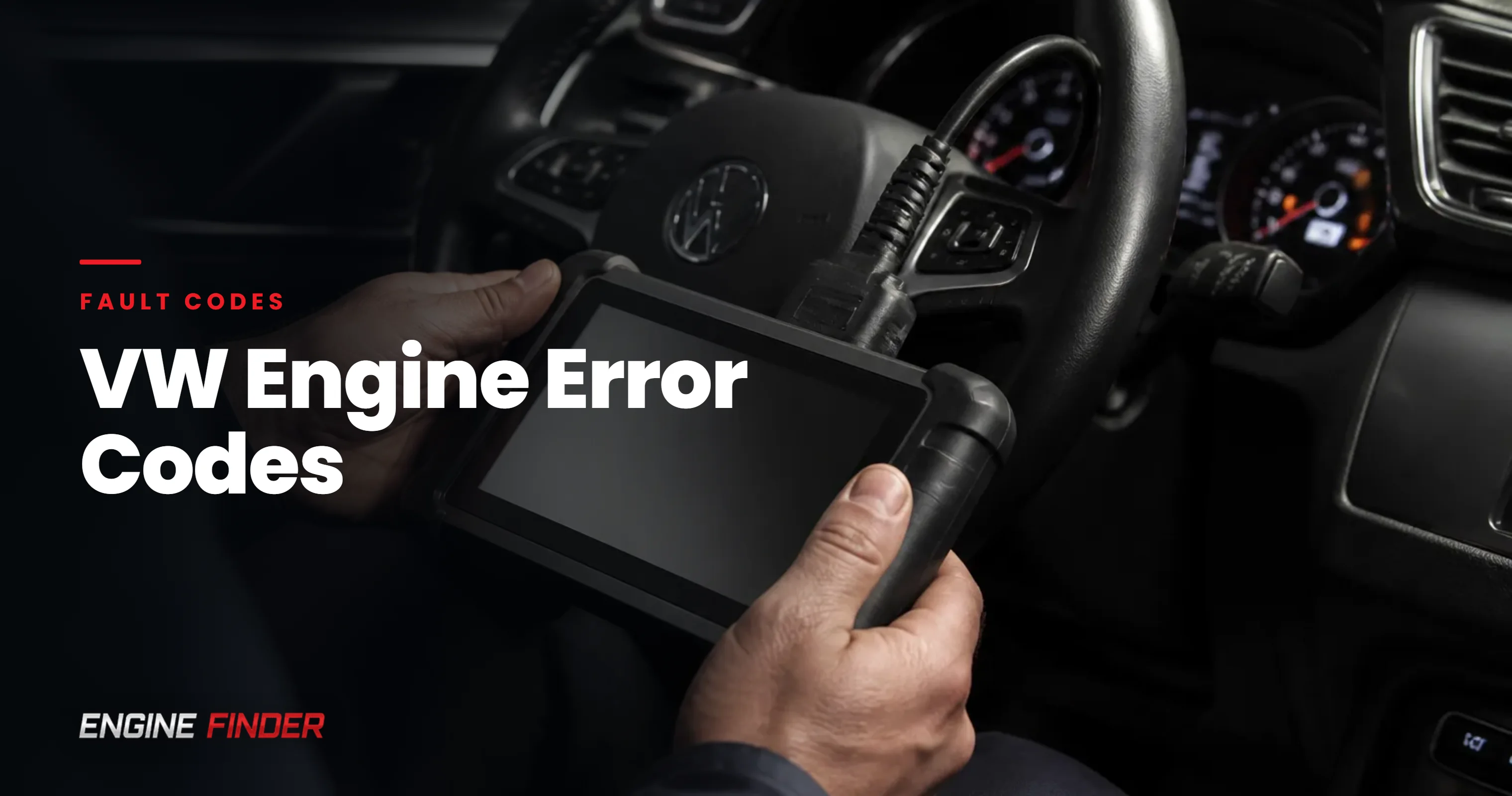
VW Fault & Error Codes: P0016, P0299, P0401 Explained

If your Volkswagen has thrown a check-engine light, the fault code behind it tells you exactly which system the ECU is unhappy with. Most VW codes fall into a handful of families — misfires (P0300–P0304), fuel-pressure faults (P0087), turbo boost problems (P0299/P0234), timing faults (P0016/P0341), intake-flap faults (P2015), EGR/DPF faults (P0401/P2463) and catalyst faults (P0420). This guide gives the correct, verified meaning of the codes South African VW owners see most often on the Polo, Golf, Tiguan, Amarok and Jetta — plus which ones point to serious engine or timing damage.
Key Takeaways
| Error Code | What it means | Common cause on VW |
|---|---|---|
| P0087 | Fuel rail pressure too low | Failing high-pressure fuel pump (HPFP) or clogged filter |
| P0299 | Turbo underboost | Boost/charge-pipe leak, wastegate or N75 fault |
| P0300–P0304 | Cylinder misfire | Coil packs, plugs or carbon build-up (TSI) |
| P0016 / P0341 | Cam/crank correlation | Stretched timing chain + worn tensioner |
| P2015 | Intake-flap sensor implausible | Broken flap linkage or carbon-jammed flap |
| P0420 | Catalyst efficiency low | Failed catalytic converter or O2 sensor |
| P2463 | DPF soot overload | Clogged DPF or faulty pressure sensor |
Volkswagen’s engine-management systems monitor dozens of sensors and store a Diagnostic Trouble Code (DTC) whenever a reading falls outside its expected range. Reading the code correctly is the difference between a R500 sensor and a R30,000 mistake — several VW codes that look like a cheap sensor swap are actually early warnings of a stretched timing chain or a dying fuel pump.
This guide covers the codes we see most often on South African VWs — the 1.0/1.4 TSI petrols (EA211/EA111) and the 1.6/1.9/2.0 TDI diesels (EA189/EA288). For engine-specific troubleshooting, see our guides on VW Polo BAH 1.6 engine problems and VW CLP engine problems. When your diagnosis reveals a part that needs replacing, used Volkswagen engines, Volkswagen stripping for spares and Volkswagen scrap yards can supply affordable OEM components.
How to Read VW Error Codes
Any generic OBD-II scanner will read the standard P0xxx codes through the port under the dashboard. But VW’s ECU also stores manufacturer-specific fault text — for that you need a VW-aware tool.
Generic codes vs VW-specific codes
- Generic OBD-II P-codes (P0016, P0087, P0299, P0300–P0304, P0401, P0420, P2015, P2463) are defined by the SAE J2012 standard and mean the same thing on every car. Any cheap scanner reads them.
- VW/VAG-specific tools such as VCDS (VAG-COM) or OBDeleven show the ECU’s own internal fault memory. These often display the same fault as a 5-digit VAG number alongside the P-code — for example VCDS lists the intake-flap fault as
18447 / P2015. The 5-digit number is VW’s internal reference; the P-code is the SAE equivalent. Treat them as two labels for the same fault, not two separate problems.
Reading process
- Plug the scanner into the OBD-II port (usually under the dashboard, driver’s side).
- Turn the ignition to ON — don’t start the engine.
- Select Read Codes / Scan for DTCs and note every code, including any “pending” ones.
- Use VCDS/OBDeleven for freeze-frame data and VW measuring blocks (e.g. camshaft adaptation) when a generic code needs deeper context.
- Only clear codes after the repair — clearing without fixing just hides the fault until it returns.
Generic engine codes on VW
These are standard SAE OBD-II codes, but the causes below are the ones that actually apply to VW engines.
P0087 — Fuel Rail / System Pressure Too Low
Meaning: The ECM has detected that fuel pressure in the common rail feeding the injectors has dropped below the required minimum.
- Common VW cause: A failing high-pressure fuel pump (HPFP) or a clogged fuel filter. On TDI diesels the Bosch CP4 pump is the notorious culprit — as it wears it can shed metal debris right through the fuel system. A key diagnostic step is checking the fuel filter housing and metering valve for metal “glitter”; any metal means a full fuel-system replacement.
- Symptoms: Power loss, hesitation, hard starting, stalling or limp mode — often worst under hard acceleration when the pump is asked for maximum pressure.
- Typical fix: Test rail pressure, replace the fuel filter, and replace the HPFP if it is failing. If CP4 debris is found, the injectors and lines must go too.
P0299 — Turbocharger Underboost
Meaning: The turbo is producing less boost than the ECU commanded (Turbocharger “A” Underboost Condition).
- Common VW cause: The most frequent cause is a boost leak — a split silicone coupler, loose clamp or cracked plastic charge pipe (the EA888 charge pipes crack in cold weather). Other causes: a torn diverter valve on TSI petrols, a worn wastegate actuator, or a faulty N75 boost-control solenoid. On TDIs a sticking turbo actuator or DPF backpressure is common.
- Symptoms: Reduced power, limp mode (often capped near 40 km/h) and sometimes black smoke on diesels.
- Typical fix: Pressure-test the intake for leaks first, then check the diverter/wastegate and N75 valve before condemning the turbo.
P0234 — Turbocharger Overboost
Meaning: The opposite of P0299 — the turbo is producing more boost than the engine should handle.
- Common VW cause: A wastegate stuck closed, a blocked or deformed wastegate control hose, or a faulty boost-pressure solenoid, so pressure isn’t relieved in time.
- Symptoms: Check-engine light, power cut/limp mode, and a risk of engine damage if driven hard.
- Typical fix: Inspect the wastegate and its control hoses for blockage or damage; repair or replace the wastegate/actuator or the boost-control valve.
P0300 / P0301–P0304 — Cylinder Misfire
Meaning: P0300 is a random/multiple-cylinder misfire (the ECU can’t isolate one cylinder). P0301–P0304 name the specific cylinder — P0301 = cyl 1, P0302 = cyl 2, P0303 = cyl 3, P0304 = cyl 4.
- Common VW cause: On TSI direct-injection petrols, ignition coil packs and spark plugs are the usual wear items, but carbon build-up on the intake valves is a very frequent hidden cause — because fuel is injected straight into the cylinder, the intake valves are never washed clean and can carbon up badly by 80,000–100,000 km. A failing PCV valve (vacuum leak) is another common trigger.
- Symptoms: Rough idle, hesitation, lost power, higher fuel use. A flashing engine light means an active severe misfire that can destroy the catalytic converter — stop driving.
- Typical fix: Swap the coil from the misfiring cylinder to a neighbour and re-scan to confirm a bad coil; replace plugs/coils, and walnut-blast the intake valves if carbon is the cause.
P0401 — EGR Flow Insufficient
Meaning: Not enough exhaust gas is flowing through the EGR system when the ECU commands it open. (P0402 is the opposite — excessive flow.)
- Common VW cause: On VAG diesels this is almost always a carbon-clogged or sticking EGR valve, a blocked EGR cooler, or a sooted-up intake manifold restricting the flow path.
- Typical fix: Clean the EGR valve, tube and passages first; replace the valve or EGR cooler if cleaning doesn’t restore flow.
P0420 — Catalyst Efficiency Below Threshold (Bank 1)
Meaning: The catalytic converter on bank 1 isn’t cleaning the exhaust as efficiently as required, judged by comparing the upstream and downstream O2 sensors.
- Common VW cause: A worn or contaminated catalytic converter is most common, but a faulty downstream O2 sensor, an exhaust leak, or an upstream misfire/fuel-mixture problem can all trigger it.
- Typical fix: Rule out O2-sensor faults and exhaust leaks first; replace the converter only once it’s confirmed inefficient.
P2463 — Diesel Particulate Filter: Excessive Soot Accumulation
Meaning: The ECM has detected the DPF is clogged with more soot than it can regenerate, based on the differential pressure sensor across the filter.
- Common VW cause: On TDIs, a faulty DPF differential-pressure sensor giving false readings is a common and relatively cheap culprit; otherwise the filter is genuinely clogged, often from too much short-distance driving that never lets it regenerate. VW issued a software update (addressing P2458/P2463) for several 2015 TDI models.
- Typical fix: Check/replace the DPF pressure sensor, run a forced regeneration with VCDS, or clean/replace the DPF if truly blocked.
VW-specific & timing codes (the expensive ones)
These codes point at mechanical timing or intake hardware — the faults that can turn into a rebuilt or replacement engine if ignored.
P0016 & P0341 — Camshaft / Crankshaft Correlation
Meaning: P0016 means the crankshaft and intake camshaft (bank 1) are out of their correct rotational relationship. P0341 means the camshaft position sensor’s signal is out of range or out of sync with the crankshaft signal.
- Why it matters on VW: On the 1.4 TSI (EA111) and 2.0 TSI (EA888), these codes usually mean a stretched timing chain and worn tensioner — not a bad sensor. The 1.4 TSI is notorious for chain stretch as early as 60,000–80,000 km. If P0016 and P0341 appear together, treat it as a mechanical timing fault. In VCDS/OBDeleven, a camshaft adaptation value more negative than about −5° confirms chain stretch.
- Typical fix: Replace the timing chain, tensioner and guides. Don’t just swap the cam/crank sensors — that’s usually wasted money, and a chain that jumps a tooth can bend valves.
P0011 — Intake Camshaft Timing Over-Advanced (Bank 1)
Meaning: The variable-valve-timing system has advanced the intake cam further than commanded and the ECU can’t pull it back into range.
- Common VW cause: The N205 oil-control valve (VVT solenoid) sticks — very often from dirty or low oil clogging the valve — or the cam phaser/timing components are worn.
- Typical fix: Start with a correct-viscosity oil and filter change (a frequent cure); if that fails, replace the N205 valve and inspect the timing chain/phaser.
P2015 — Intake Manifold Flap Position Sensor (Implausible Signal)
Meaning: The intake-manifold swirl-flap position sensor is reporting an implausible signal — the ECU can’t confirm the flap is where it should be. (VCDS shows this as 18447 / P2015.)
- Common VW cause: On 2.0 TDIs the flap linkage/actuator arm breaks or the sensor wears; carbon build-up can also jam the flap. On many 2009–2014 TDIs with the aluminium intake manifold, the actuator-arm mount is a known weak point — an aftermarket bracket fixes it far cheaper than a whole manifold.
- Typical fix: Inspect the flap linkage and connector; fit the repair bracket or replace the manifold if the flap mechanism is broken.
Which codes mean serious engine damage?
Most sensor codes are annoying but cheap. These are the VW codes that warrant stopping and getting a proper diagnosis before you drive further:
- Timing chain (P0016 + P0341, low/negative cam adaptation) — a stretched chain that jumps a tooth on a TSI can bend valves and wreck the engine. This is the single most important VW code family to take seriously.
- HPFP failure (P0087 with metal in the fuel filter) — a disintegrating CP4 pump contaminates the entire fuel system; keep driving and you can turn a pump job into a full injector-and-lines replacement.
- Flashing misfire light (active P0300–P0304) — a live severe misfire dumps raw fuel into the catalytic converter and can melt it. Stop and fix the coil/plug.
- Overboost (P0234, stuck wastegate) — sustained overboost can cause catastrophic engine damage; don’t ignore it.
When it’s cheaper to source a used engine
If a diagnosis confirms internal damage — bent valves from a jumped chain, scored bores from a hydro-locked cylinder, or CP4 debris through a whole engine — a good low-mileage used or imported engine is often cheaper than a full rebuild. That’s especially true on TSI and TDI engines where machine work and timing kits add up fast.
Engine Finder connects South African VW owners with used-engine and parts suppliers nationwide — you submit one enquiry and multiple verified suppliers quote you. Browse used Volkswagen engines for sale to get started.
Frequently Asked Questions
How do I clear VW error codes after repairs?
Use an OBD-II scanner or VCDS/OBDeleven to clear stored codes — but only after the fault is actually fixed. If the underlying problem remains, the code will return on the next drive cycle.
Can I drive my VW with an error code showing?
It depends on the code. A steady light for a minor sensor fault may allow limited, careful driving. But a flashing engine light (active misfire), a suspected stretched timing chain (P0016/P0341), or a fuel-pump fault with metal in the filter (P0087) mean you should stop and get it diagnosed to avoid engine damage.
What’s the difference between a generic P-code and a VAG 5-digit code?
The generic P-code (e.g. P2015) is the SAE J2012 standard label every scanner reads. The 5-digit VAG number (e.g. 18447) is VW’s own internal fault reference shown by VCDS/OBDeleven — it’s the same fault, just VW’s naming for it.
Does P0341 on my VW mean the timing chain is stretched?
On the 1.4 and 2.0 TSI it very often does — especially alongside P0016. Before replacing the camshaft sensor, have the camshaft adaptation value checked in VCDS; a strongly negative reading confirms chain stretch rather than a bad sensor.
Why do some VW error codes come back after I clear them?
Because the root cause wasn’t fixed. Intermittent faults, partial repairs (e.g. replacing a sensor when the real fault is a chain or a leak) or a related fault in the same system will re-set the code.
What tools do I need for VW-specific diagnostics?
A basic OBD-II scanner reads the generic P-codes. For VW’s manufacturer-specific fault memory, measuring blocks (like cam adaptation) and forced DPF regeneration, use VCDS (VAG-COM) or OBDeleven.
Need a VW engine or part?
Once your scan points to serious damage — a stretched timing chain, a failed HPFP or a misfire that’s cost you a piston — Engine Finder makes sourcing the fix simple. Send one enquiry and verified South African suppliers come back to you with quotes on used engines and OEM parts. Start with our used Volkswagen engines for sale page and let the suppliers compete for your business.
References and Sources
- FCP Euro — How to fix a Volkswagen TDI intake flap (P2015)
- Ross-Tech VCDS Wiki — 18447/P2015 intake manifold flap position sensor
- Go-Parts — P0016 & P0341 timing chain vs sensor on VW 2.0T TSI
- CarParts.com — P0420 catalyst system efficiency below threshold (Bank 1)
- SAE J2012 standard Diagnostic Trouble Code definitions
Related Articles
Explore more insights on similar topics
Nissan NP200 Gearbox Problems: JR5 Manual, Clutch & Costs (SA Guide)
Nissan NP200 gearbox problems explained — the Renault JR5/JH3 manual, crunchy shifts, 5th-gear whine, soft-clutch cylinder faults, and what a used or recon NP200 gearbox costs in SA.
BMW B47 Engine Problems: EGR Recall & SA Repair Costs (2026)
BMW fixed the N47's chain-snap epidemic with the B47 — but the EGR cooler fire-risk recall, DPF clogging and carbon build-up became the new headaches. Symptoms, SA repair costs, and when a used engine wins.
Toyota Hilux Gearbox Problems: GD6, 4Y, Auto & Manual (SA Guide)
Toyota Hilux gearbox problems explained, manual & auto faults, clutch costs, GD6 vs older boxes, and how to compare Hilux gearbox prices in SA.
Important Disclaimer
This content is for informational purposes only and is based on research from automotive industry sources. Engine Finder is not a certified automotive repair facility. Always consult with qualified automotive professionals before performing any repairs or maintenance. Improper repairs can result in personal injury, property damage, or vehicle malfunction. We assume no responsibility for actions taken based on this information.