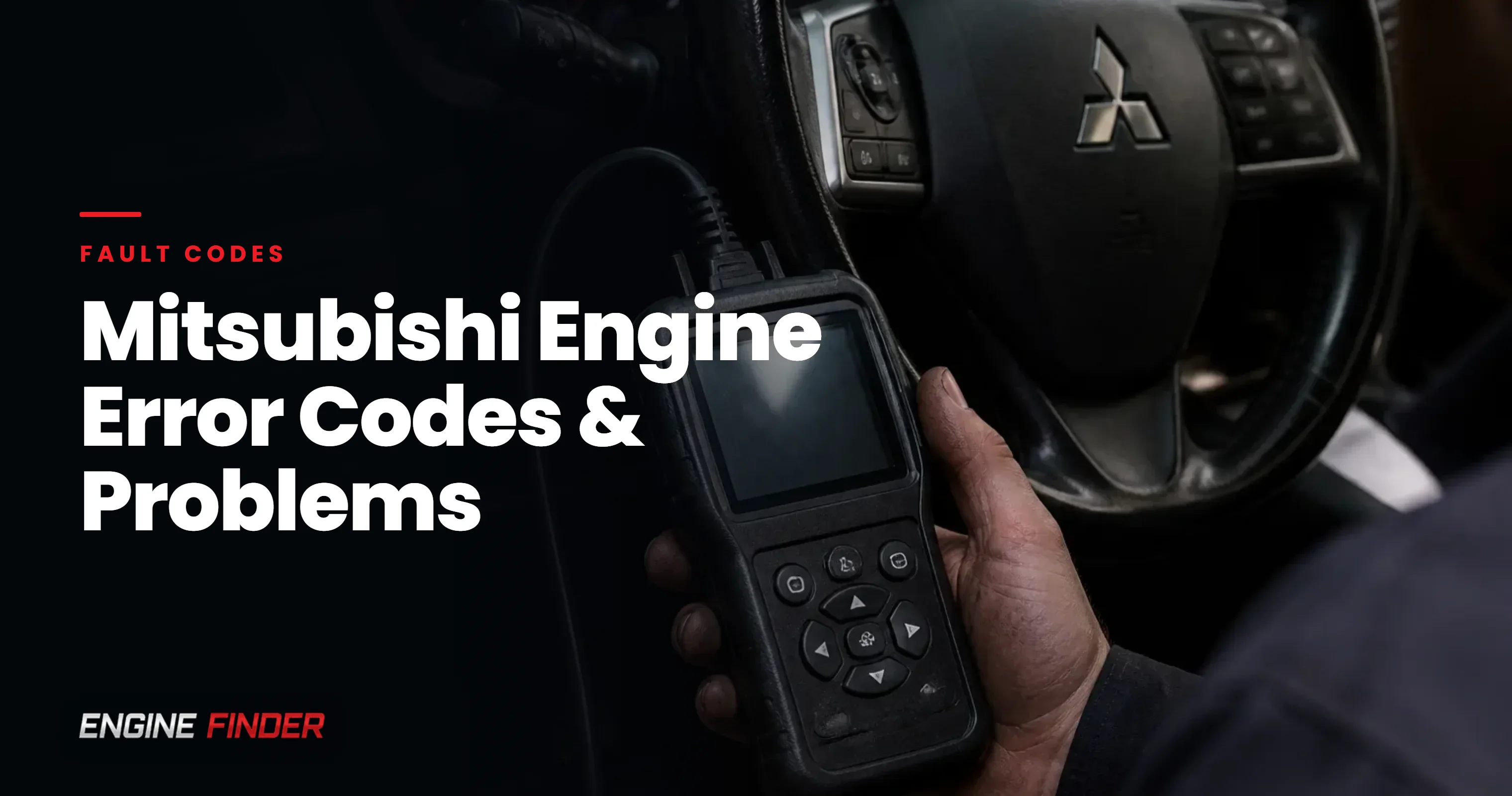
Mitsubishi Engine Error Codes & Problems

Key Takeaways
- A Mitsubishi fault code is a starting point, not a diagnosis — a code like P0234 or P0299 tells you which system is unhappy (the turbo), not which part has failed.
- On South African diesels (Triton, Pajero Sport with the 4N15 2.4 or older 4D56 2.5), the codes you’ll see most are turbo boost (P0234/P0299), EGR flow (P0401), DPF (P2002/P242F) and glow plug (P0670) faults.
- P0xxx codes are generic SAE codes that mean the same thing on any make; only P1xxx codes are Mitsubishi-specific and need a Mitsubishi-aware scanner or workshop to read fully.
- Some codes (misfires that scored the bore, a snapped 4D56 timing belt, low rail pressure that starved the injectors) point to major engine damage — that’s when sourcing a good used engine is the sensible call.
🔧 You’ll need: an OBD-II scanner (ideally one that reads Mitsubishi P1xxx codes), a multimeter, and — for boost faults — a way to log intake pressure. 💰 Typical workshop diagnosis: R450–R750 in South Africa.
Overview
Every Mitsubishi built for the South African market since 1996 runs OBD-II self-diagnostics: when the ECU spots a reading outside its expected window, it stores a Diagnostic Trouble Code (DTC) and, usually, lights the check-engine lamp. This guide corrects the meanings of the codes Mitsubishi owners actually see and tells you which ones are cheap sensor fixes versus which point to a tired engine. For model-specific mechanical faults, see our guide to 5 common Mitsubishi Triton 2.5 diesel problems.
A quick note before the table: a DTC is a symptom pointer, not a parts list. P0401 tells you EGR flow is low — it does not tell you whether the valve is clogged, the sensor has failed, or a pipe has cracked. Read the freeze-frame data and test the parts before you spend money.
How to read Mitsubishi fault codes
- Plug an OBD-II scanner into the 16-pin port under the dashboard (driver’s side, near the steering column on Tritons and Pajero Sports).
- Read the stored codes and the freeze-frame data — the freeze-frame captures RPM, load, coolant temp and speed at the moment the fault set, which is often more useful than the code itself.
- Separate generic from Mitsubishi codes. Any cheap reader shows the
P0xxxgeneric codes. TheP1xxxmanufacturer codes need a scanner with a Mitsubishi database (or a workshop) to decode and to access live sensor data. - Don’t just clear and drive. Clearing a code without fixing the cause resets the readiness monitors and the fault returns — sometimes worse.
A code’s letter tells you the family: P = powertrain (engine/transmission), B = body, C = chassis, U = network/communication. The overwhelming majority of engine faults are P codes.
Common Mitsubishi engine fault codes (verified)
The table below lists the codes we see most often on South African Mitsubishis, with the correct SAE / Mitsubishi meaning, the usual cause, and the typical fix. Generic (P0xxx) and Mitsubishi-specific (P1xxx) codes are separated.
Generic (SAE) codes — same meaning on any make
| Code | Correct meaning | Common cause | Typical fix |
|---|---|---|---|
| P0011 | ”A” Camshaft position — timing over-advanced (Bank 1). On MIVEC petrols the intake cam is advanced more than the ECU commanded. | Sticking VVT (MIVEC) oil-control valve, sludged/low oil, worn cam phaser. | Change to correct-viscosity oil, replace the MIVEC/OCV solenoid, check timing. |
| P0016 | Crankshaft–camshaft position correlation (Bank 1, Sensor A) — cam and crank are out of sync. | Stretched/jumped timing chain or belt, worn tensioner, faulty cam/crank sensor. | Inspect timing components; replace tensioner/belt or sensor. Do not ignore — can be catastrophic. |
| P0087 | Fuel rail / system pressure too low (common-rail diesel). Actual rail pressure is below what the ECU commands. | Clogged fuel filter, weak lift/high-pressure pump, air in fuel, leaking injectors. | Replace filter, test pump and rail-pressure sensor, measure injector return. |
| P0234 | Turbocharger overboost condition. On Mitsubishi diesels this sets as Turbocharger Wastegate System Malfunction when boost runs too high. | Stuck/failed wastegate or actuator, boost sensor error. | Test wastegate actuator and boost sensor; free or replace the wastegate. |
| P0299 | Turbocharger under-boost condition — measured boost is below target. | Boost leak (split intercooler pipe), sticking VGT vanes, cracked hose, faulty boost sensor. | Pressure-test the intake side, clean/replace the turbo actuator, fix leaks. |
| P0300–P0304 | Misfire detected: P0300 = random/multiple; P0301–P0304 = cylinder 1, 2, 3 or 4. | Worn plugs/coils (petrol), injector or compression fault, vacuum leak. | Diagnose per cylinder; fix ignition/fuel/compression before it ruins the cat. |
| P0401 | Exhaust Gas Recirculation (EGR) flow insufficient. | Carbon-clogged EGR valve or cooler (very common on diesels), faulty sensor/actuator. | Clean or replace the EGR valve/cooler; check the actuator and wiring. |
| P0420 | Catalyst system efficiency below threshold (Bank 1) — the cat isn’t cleaning the exhaust well enough (petrol). | Aged/contaminated catalytic converter, faulty O₂ sensor, exhaust leak, upstream misfire. | Fix any misfire/leak first, test O₂ sensors, then replace the cat if needed. |
| P0670 | Glow-plug control module circuit fault (diesel). | Failed glow-plug control module, blown fuse/bad ground, shorted glow plug, chafed wiring. | Test the module, fuse and glow plugs; repair wiring or replace the module. |
| P2002 | Diesel Particulate Filter (DPF) efficiency below threshold (Bank 1). | Soot-clogged DPF from short/slow trips (failed regen), exhaust leak, faulty pressure sensor. | Forced/highway regen, DPF clean or replacement, check the differential-pressure sensor. |
| P242F | Diesel Particulate Filter restriction — ash accumulation (not soot). Ash cannot be burned off in a regen. | High-mileage ash loading, wrong (high-SAPS) engine oil, oil-burning engine. | DPF removal-and-clean or replacement; switch to correct low-SAPS diesel oil. |
Mitsubishi-specific (P1xxx) codes — need a Mitsubishi-aware scanner
| Code | Correct meaning | Common cause | Typical fix |
|---|---|---|---|
| P1299 | Variable-geometry turbo (VGT) control fault — the ECU can’t achieve the commanded boost via the VGT vanes. | Seized/sooted VGT vane mechanism, sticking actuator, low control pressure. | Clean or replace the VGT actuator/turbo; verify with live boost data. |
These are the codes we can verify against SAE J2012 and Mitsubishi service data. The internet is full of “Mitsubishi P-code lists” with garbled or invented definitions — if a code isn’t confirmed against the factory data, don’t trust the definition. Always confirm your exact code and cause with a scan-tool live-data test.
Which codes mean major engine, turbo or DPF damage?
Most codes above are repairable. A handful, left alone, either are serious or become serious:
Serious for the engine
- P0016 / timing correlation — on the older 4D56, a snapped or jumped timing belt is an interference event: bent valves, sometimes worse. Treat any correlation or timing rattle code as urgent.
- Persistent misfires (P0300–P0304) — an untreated misfire washes the bore with fuel, scores the cylinder and dumps raw fuel into the catalytic converter, destroying it.
- P0087 low rail pressure — sustained low pressure runs the injectors and high-pressure pump dry; ignore it and you can lose the whole injection system.
Serious for the turbo
- P0234 overboost repeatedly can crack pistons or the turbo; P0299/P1299 under-boost usually starts as a cheap boost leak but a seized VGT means a turbo rebuild.
Serious for the DPF
- P2002 (soot) is often recoverable with a proper regen; P242F (ash) means the filter is physically full of non-burnable ash — clean or replace, and fix the cause (oil grade, short trips) or it returns.
When to source a used engine instead of repairing
If the codes and a compression/leak-down test point to internal damage — a spun bearing, scored bores from a long-ignored misfire, a bent-valve timing failure on a 4D56, or a hydro-locked/oil-burning engine feeding the DPF with ash — the repair bill can climb past the value of the vehicle. At that point a good low-mileage used engine is often the cheaper, faster route back on the road than a full rebuild.
Engine Finder connects you with scrapyards and engine suppliers across South Africa: post one request and suppliers who have your Mitsubishi 4N15, 4D56, 4B11 or 4J11 engine in stock come back to you with quotes. Browse used Mitsubishi engines for sale to see what’s currently available.
Frequently Asked Questions
Can I clear a Mitsubishi engine code myself?
Yes, most OBD-II scanners clear codes — but only clear a code after fixing the cause. Clearing without repair just resets the readiness monitors and the fault (and often the check-engine light) returns.
Do I need a special scanner for Mitsubishi codes?
Any generic OBD-II reader shows the P0xxx codes. For the Mitsubishi-specific P1xxx codes and live sensor data (boost, rail pressure, DPF soot load) you need a scanner with a Mitsubishi database or a workshop tool.
Is it safe to keep driving with the check-engine light on?
A steady light on a minor code (say an EGR fault) may be fine for a short trip to the workshop. A flashing light, limp mode, or any misfire/timing/low-rail-pressure code means stop and get it checked — those can cause further damage fast.
Why does my Triton keep throwing DPF codes?
DPF codes like P2002 usually come from short, low-speed trips that never let the filter reach regeneration temperature. Regular longer runs at highway speed, correct low-SAPS diesel oil, and a healthy EGR/turbo help keep it clear.
Get a quote for your Mitsubishi engine or part
Got a code that points to a tired engine, turbo, injector or DPF? Instead of guessing at prices, request a free quote through Engine Finder and let South African Mitsubishi specialists come back to you with what they have in stock. It’s the quickest way to compare real prices before you commit to a repair.
Sources
- SAE / OBD-II P2002 — DPF Efficiency Below Threshold (Bank 1){target=“_blank” rel=“noopener noreferrer”}
- Mitsubishi service data — P0234 Turbocharger Wastegate System Malfunction{target=“_blank” rel=“noopener noreferrer”}
- AutoZone — P0401 Insufficient EGR Flow{target=“_blank” rel=“noopener noreferrer”}
- OBD-Codes — P242F DPF Restriction, Ash Accumulation{target=“_blank” rel=“noopener noreferrer”}
Related Articles
Explore more insights on similar topics
Nissan NP200 Gearbox Problems: JR5 Manual, Clutch & Costs (SA Guide)
Nissan NP200 gearbox problems explained — the Renault JR5/JH3 manual, crunchy shifts, 5th-gear whine, soft-clutch cylinder faults, and what a used or recon NP200 gearbox costs in SA.
BMW B47 Engine Problems: EGR Recall & SA Repair Costs (2026)
BMW fixed the N47's chain-snap epidemic with the B47 — but the EGR cooler fire-risk recall, DPF clogging and carbon build-up became the new headaches. Symptoms, SA repair costs, and when a used engine wins.
Toyota Hilux Gearbox Problems: GD6, 4Y, Auto & Manual (SA Guide)
Toyota Hilux gearbox problems explained, manual & auto faults, clutch costs, GD6 vs older boxes, and how to compare Hilux gearbox prices in SA.
Important Disclaimer
This content is for informational purposes only and is based on research from automotive industry sources. Engine Finder is not a certified automotive repair facility. Always consult with qualified automotive professionals before performing any repairs or maintenance. Improper repairs can result in personal injury, property damage, or vehicle malfunction. We assume no responsibility for actions taken based on this information.