Is a Renault Expensive to Maintain in South Africa? (2026 Cost Guide)

Key Takeaways
| Topic | Key Information | Important Details |
|---|---|---|
| Short answer | Middle-of-pack for SA | Cheaper than Audi/BMW, more expensive than Toyota/Honda |
| Annual budget | R5,500 – R15,000 | Varies by model, age and where you live |
| Biggest cost drivers | Parts + dealer reach | Easier in Gauteng/Cape Town, harder in smaller towns |
| Critical service item | Timing belt on 1.5 dCi | Every 120,000 km / 5 years — interference engine |
| Reliability verdict | Drivetrain is solid | Electrics and minor trim let the brand down |
| Replace vs service | After 150,000 km | Replacement engine often beats stacked repair bills |
The Short Answer
Is a Renault expensive to maintain in South Africa? The honest answer is no — but it’s not the cheapest either. Renault sits squarely in the middle of the SA maintenance-cost league table. It’s noticeably cheaper to run than premium European brands like Audi, BMW and Mercedes-Benz, but typically more expensive than a like-for-like Toyota, Honda or Suzuki.
Expect a realistic annual maintenance budget of R5,500 to R15,000 depending on the model, age and how far you live from a main centre. A new Kwid on a service plan will cost almost nothing for the first three years. A 10-year-old Megane or Koleos out of plan can quickly climb past R12,000 a year once tyres, belts and the odd electrical gremlin are factored in.
Renault has been sold in South Africa for over two decades and has a loyal owner base — particularly around the Duster and the 1.5 dCi diesel. Engine Finder has been quoting on Renault replacement engines since 2016, so this guide pulls from real customer enquiries, not brochure numbers. Costs quoted below are indicative ranges for 2026 — get a written quote for your specific vehicle.
Annual Maintenance Cost by Model
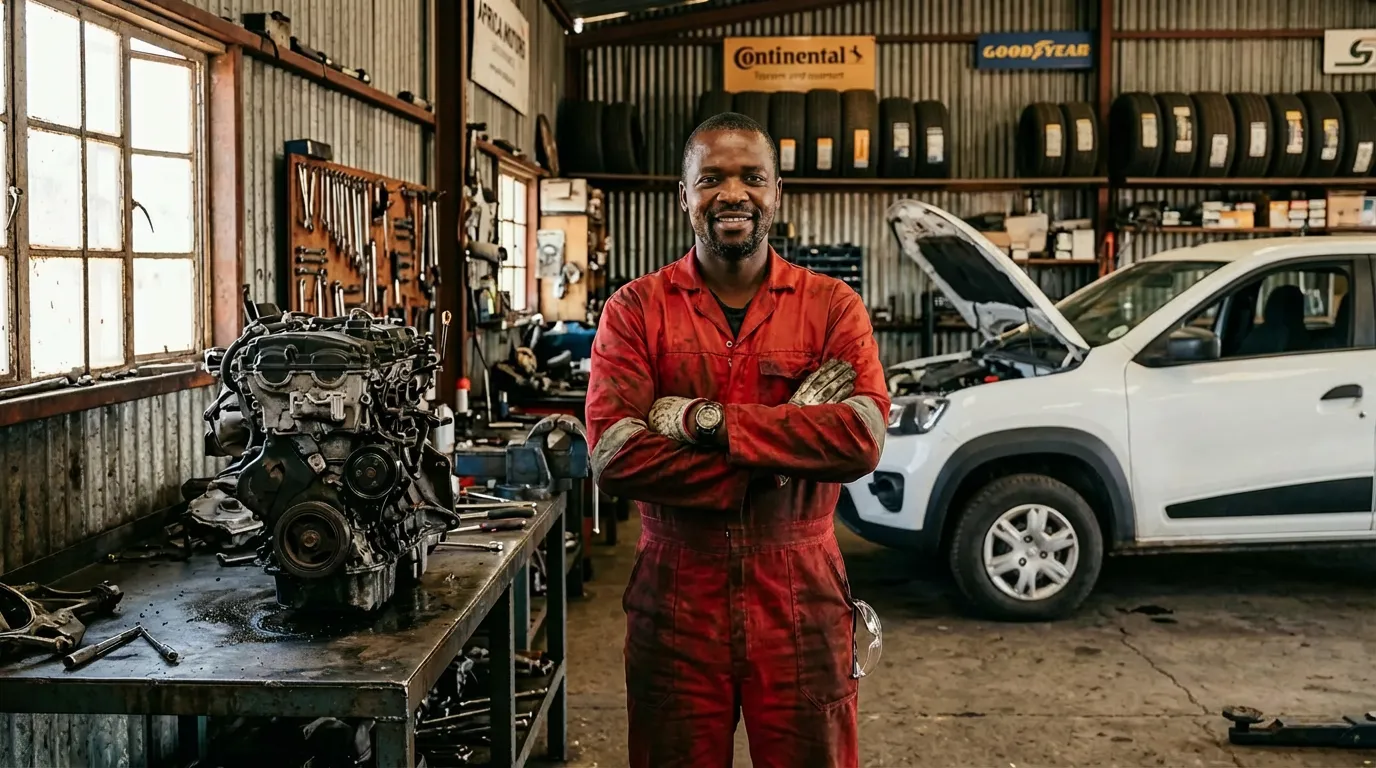
The figures below are realistic annual budgets for an out-of-plan Renault between five and ten years old, driven around 20,000 km a year on SA roads. Cars under service plan will cost dramatically less; cars over 150,000 km will start to drift above the upper bound.
| Model | Annual Maintenance | Notes |
|---|---|---|
| Kwid 1.0 | R3,500 – R6,500 | Cheapest Renault to run; small parts pool, simple mechanicals |
| Sandero 1.0 Turbo | R4,500 – R8,500 | TCe engine adds turbo + intercooler servicing |
| Duster 1.5 dCi | R6,500 – R12,000 | Diesel servicing + DPF cleaning bumps the average |
| Megane 1.6 | R5,500 – R10,000 | Older platform, parts widely available |
| Captur 1.5 dCi | R6,500 – R11,500 | Diesel premium plus more complex trim |
| Koleos 2.5 | R8,000 – R15,000 | Larger engine, AWD on some variants, costlier tyres |
Tyres, brake pads, batteries and consumables are included in those numbers. Out-of-warranty failures (gearbox mechatronic units, turbos, injector replacements) are not — those are once-off events that can easily double a year’s spend.
What Drives Renault Maintenance Cost in SA
Three factors decide whether your Renault is cheap or expensive to keep on the road:
1. Parts availability. Renault parts are well-stocked in Gauteng and the Cape Metro — most service items, sensors and wear parts can be sourced within 24 to 48 hours. In smaller centres (the Karoo, parts of KZN, Eastern Cape towns) you can wait a week or longer for non-standard items, which often pushes owners toward courier-delivered parts from used Renault engine specialists or scrap yards.
2. Dealer network. Renault SA’s official dealer footprint is more limited than Toyota or Volkswagen. If you live more than 100 km from a dealer, in-warranty work means a road trip. Out-of-warranty, this is less of an issue because independent specialists are usually closer and cheaper.
3. Specialist independents. There’s a healthy network of Renault-focused independent workshops in Johannesburg, Pretoria, Cape Town and Durban — most of them have years of dCi diesel experience and charge roughly 30–40% less per labour hour than the franchise dealers. Asking around in local Renault owner groups on Facebook is usually the fastest way to find a trusted one.
Common Service Items and Intervals
Sticking to Renault’s published service schedule is the single biggest lever you have on long-term cost. The items below are the ones owners most often skip — and regret skipping.
- Major service every 30,000 km — oils, filters (oil, air, cabin, fuel on diesels), spark plugs on petrol, brake fluid every two years.
- Timing belt — 1.5 dCi (K9K): every 120,000 km or 5 years, whichever comes first. This is critical. The K9K is an interference engine — a snapped belt means bent valves and often a destroyed cylinder head. Budget R6,000 – R9,500 for a proper belt-and-water-pump job at a specialist.
- Timing chain — TCe petrol engines: earlier 1.2 TCe engines had documented chain stretch issues. If you’re buying used, listen for rattle on cold start.
- EDC (dual-clutch) gearbox: the EDC fitted to some Captur, Clio and Megane models needs clutch and mechatronic checks at specified intervals. Replacement clutch packs are not cheap, and a failed mechatronic unit can run R25,000 – R45,000 to fix or replace.
- DPF (diesel particulate filter): Duster and Captur dCi owners doing mostly short urban trips will eventually need a forced regen or chemical clean — budget R1,500 – R4,500.
Renault Reliability — An Honest Assessment
Renault’s SA reputation is mixed, and pretending otherwise doesn’t help anyone. Here’s the balanced view.
What Renault gets right. The 1.5 dCi (K9K) diesel is one of the most widely deployed small diesels on the planet — it powers everything from the Duster to certain Nissan and Mercedes models. Parts are everywhere, specialists know it inside-out, and a well-maintained K9K will comfortably cover 300,000 km. The older K7M and K4M petrol engines are simple, durable units with low parts cost. Build quality on the Duster has been a pleasant surprise for most SA owners — Cars.co.za’s used-Duster buyer’s guide notes the second-gen models in particular have held up well against tougher rivals. The Duster has been a strong local seller since it launched here in 2013, with around 15,000 first-generation units sold before the second-gen arrived.
What lets the brand down. Electrics. Window switches, central locking, alarm modules and dashboard sensors are the most common warranty complaints across the range. Early TCe petrol engines had timing chain stretch issues that, if ignored, ended in expensive top-end damage. The K9K itself has two documented weak spots worth knowing about — Motor Reviewer’s K9K reliability writeup flags Delphi injector sensitivity to poor diesel quality and connecting-rod (big-end) bearing wear if oil changes are stretched. Some EDC dual-clutch boxes have a poor reputation among independent gearbox specialists.
Long-term ownership. Maintenance cost climbs sharply after 150,000 km. Beyond that mark, you start seeing higher-value failures — turbos, injectors, EDC clutch packs, alternators. At this point many owners reach a tipping point where replacing the engine costs less than continuing to patch failing components. That’s where our used Renault replacement engine network sees the most enquiries — owners with a tired 1.5 dCi looking at a R25,000 used engine swap versus R40,000+ of accumulated repairs.
For deeper, model-specific diagnostic info, see our Renault engine fault code reference.
Renault vs Comparable Competitors
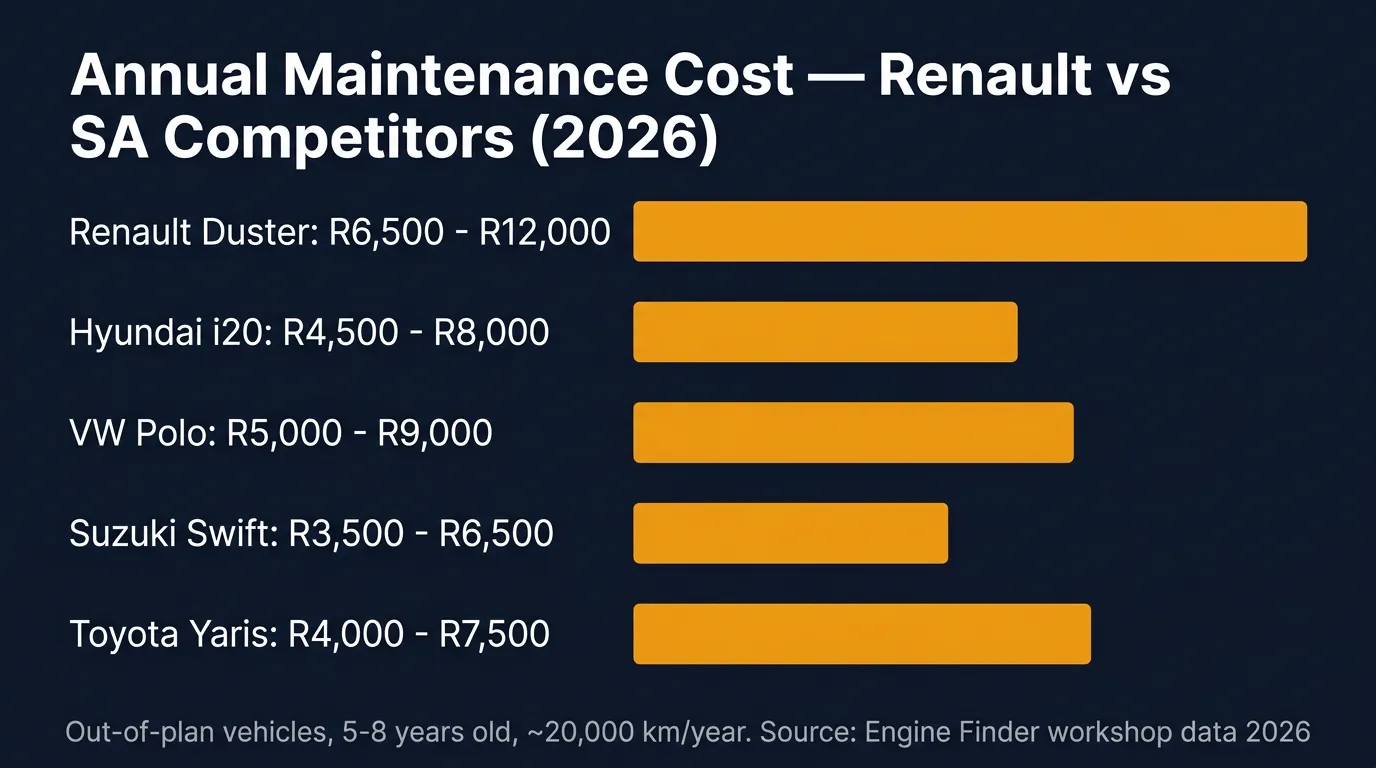
How does Renault stack up against the SA market’s other small/medium options? These are realistic comparative ranges for a five-to-eight-year-old out-of-plan vehicle.
| Brand & Model | Annual Maintenance | vs Equivalent Renault |
|---|---|---|
| Hyundai i20 1.4 | R4,500 – R8,000 | Roughly on par with Sandero, slightly cheaper parts |
| Volkswagen Polo 1.0 TSI | R6,500 – R12,000 | More expensive — parts and labour cost more |
| Suzuki Swift 1.2 | R3,000 – R6,000 | Cheapest in segment; smallest parts footprint |
| Toyota Yaris 1.5 | R3,500 – R6,500 | Cheaper to maintain, higher resale offsets purchase premium |
Renault tends to undercut VW on running cost but loses to Toyota and Suzuki. Against Hyundai it’s a near-tie — the deciding factor is usually proximity to a specialist. AutoTrader SA’s Duster pros-and-cons breakdown reaches a similar verdict — strong value and capability, with the dealer network and electrical niggles as the main caveats.
When to Replace the Engine vs Keep Servicing
A simple decision framework for owners weighing whether to fix or replace:
- Under 120,000 km, single fault: fix it. The engine has plenty of life left.
- 120,000 – 200,000 km, recurring oil burn, low compression on one cylinder, or top-end noise: get a quote for a replacement K9K or TCe engine and a rebuild estimate. Compare.
- Over 200,000 km with major engine fault: a used engine swap almost always wins on cost and turnaround time.
- Catastrophic failure (snapped timing belt, hydrolock, seized): replacement is usually the only sensible route.
For broader context on how Renault prices compare to other makes, see our used engine prices guide for South Africa and the engine lifespan averages for realistic expectations.
Frequently Asked Questions
Is Renault expensive to maintain in South Africa? Not really. Renault is mid-tier — cheaper than premium European brands, slightly more expensive than Toyota or Suzuki. Budget R5,500 – R15,000 a year depending on model and age.
Are Renault parts hard to find in SA? Not in Johannesburg, Pretoria, Cape Town or Durban — service parts are usually 24 to 48 hours away. In smaller towns it takes longer, but courier delivery from specialists and scrap yards usually closes the gap.
How long does a Renault 1.5 dCi engine last? A well-maintained 1.5 dCi (K9K) will comfortably reach 300,000 km. The most important single thing is the 120,000 km / 5-year timing belt change — skip it and the engine is finished.
Is Renault more expensive than Hyundai to maintain? Marginally. Hyundai i20 vs Renault Sandero is roughly the same annual running cost; Hyundai edges ahead on parts cost but Renault often wins on labour at independent specialists.
Should I avoid buying a used Renault? No, but buy carefully. Check service history (especially timing belt on diesels), listen for chain rattle on TCe petrols, test every electrical switch, and budget for an out-of-warranty surprise in year one.
How much does a used Renault engine cost in SA? A used 1.5 dCi (K9K) typically runs R18,000 – R32,000 depending on mileage and supplier. TCe petrols and 2.5 four-cylinders sit higher. Get multiple quotes — pricing varies more than people expect.
Looking to replace a tired Renault engine instead of pouring money into repairs? Engine Finder connects you with verified SA suppliers and Renault scrap yards carrying used engines — K9K diesel, TCe petrol and larger units across all model years. Submit one enquiry, receive multiple quotes, choose the best price.
Costs quoted in this guide are indicative ranges for 2026 and will vary by region, supplier and the specific condition of your vehicle. Always obtain a written quote before committing to work.
Related Articles
Explore more insights on similar topics
Importing a Car into South Africa: Rules, Costs and How It Actually Works (2026 Guide)
Thinking of importing a car into South Africa? Here's who is actually allowed to, the ITAC permit and NRCS Letter of Authority you need, what it costs, and how the shipping works.
DSG vs CVT vs Torque-Converter: Automatic Gearboxes Explained
DSG vs CVT vs torque-converter gearbox explained for SA buyers, how each works, what fails, and how to compare gearbox quotes before you buy.
Suzuki Baleno Engine Maintenance Cost in South Africa (2026 Guide)
Suzuki Baleno annual maintenance costs R3,500-R8,000 in South Africa. Full service cost breakdown, common engine issues, dealer vs independent pricing, and used engine prices.
Important Disclaimer
This content is for informational purposes only and is based on research from automotive industry sources. Engine Finder is not a certified automotive repair facility. Always consult with qualified automotive professionals before performing any repairs or maintenance. Improper repairs can result in personal injury, property damage, or vehicle malfunction. We assume no responsibility for actions taken based on this information.