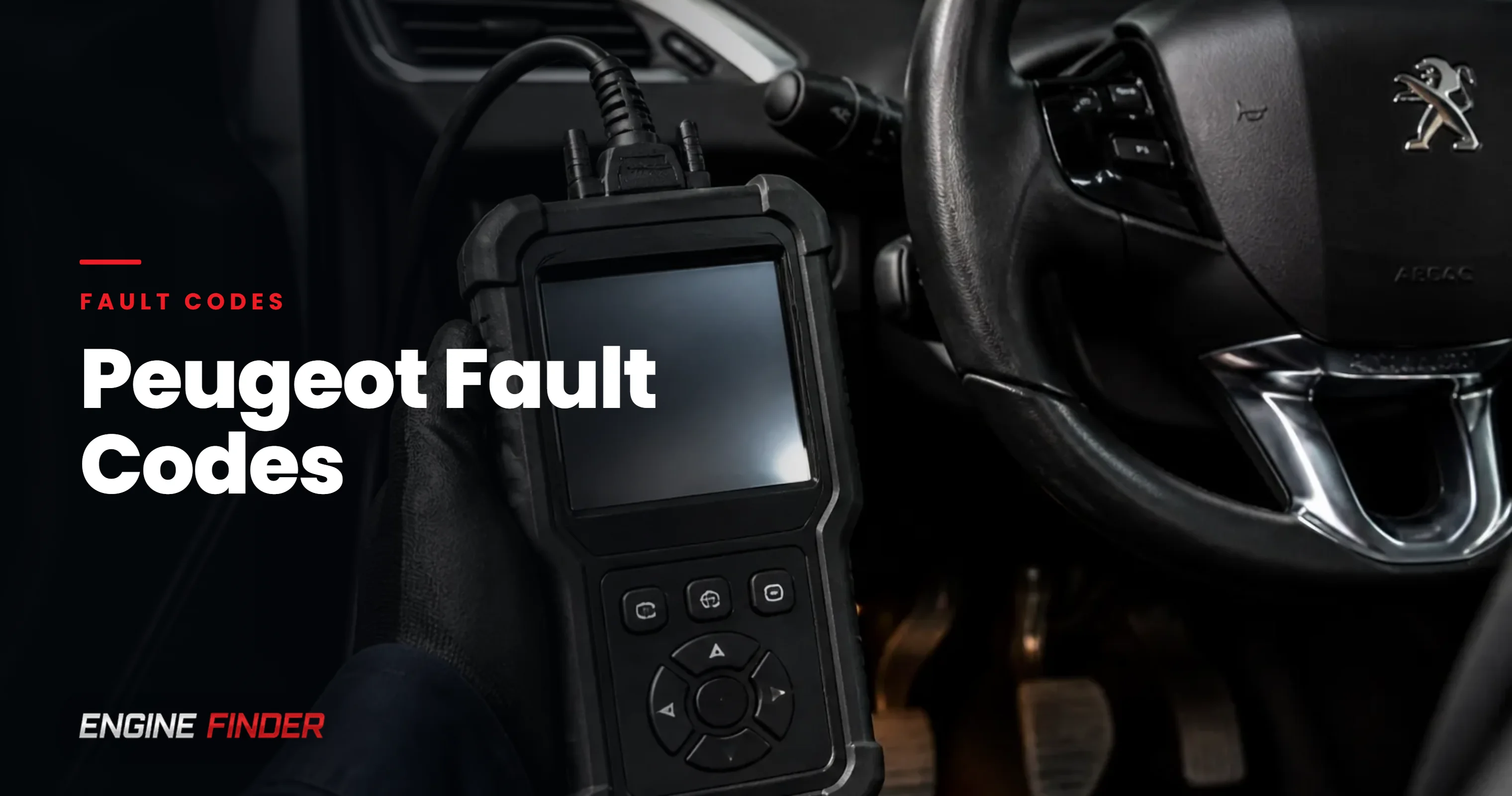
Peugeot Fault Codes: P0170, P0420, P1336 + DPF Fixes (SA)

Key Takeaways
- Most Peugeot codes are generic OBD-II (P0xxx) codes — a R450–R750 scan reads them on any 206, 207, 208, 308 or Partner from 1996 onward. The definitions below are the correct SAE/PSA meanings, not the garbled ones that circulate online.
- On the 1.6 HDi (DV6) diesel, P0299 turbo underboost is the code to fear. These turbos are starved of oil when a strainer in the oil-feed banjo silts up with carbon sludge — replace the turbo without fixing the feed and the new one dies too.
- On the 1.6 THP / VTi (EP6) petrol, P0016 means the timing chain has stretched or jumped. It is a known EP6 weakness and left alone it can bend valves.
- DPF and Eolys additive codes (P2002, P2463, P1435) are diesel-only and usually point to short-trip driving, a blocked filter or an empty additive tank — not always a failed part.
- A code names a symptom, not a verdict. Diagnose live data before replacing a catalytic converter, turbo or DPF — the expensive part is often innocent.
The short answer
A Peugeot fault code is a standard Diagnostic Trouble Code (DTC) stored by the engine ECU when a sensor reading falls outside its expected range. Most codes on South African Peugeots — the 206, 207, 208, 308 and Partner — are generic P0xxx codes shared with every other manufacturer, so any decent OBD-II scanner reads them. A smaller set of PSA manufacturer codes (P1xxx) carry Peugeot/Citroën-specific meanings and are read most reliably with a PSA-aware tool (Diagbox and equivalents).
The table below gives the correct meaning, common cause and typical fix for the codes SA owners actually see. The three engine families that matter here are the 1.6 HDi (DV6) diesel, the 1.2 PureTech three-cylinder petrol, and the 1.6 THP/VTi (EP6) petrol.
Peugeot fault code table (verified meanings)
Codes are grouped generic (P0xxx) first, then Peugeot/PSA-specific (P1xxx).
| Code | Correct meaning | Common cause | Typical fix |
|---|---|---|---|
| P0170 | Fuel Trim, Bank 1 — fuel mixture correction out of range | Vacuum/intake leak, dirty MAF, weak fuel pressure, faulty O₂ sensor | Trace vacuum leaks, clean/replace MAF, check fuel pressure, replace O₂ sensor |
| P0171 | System Too Lean, Bank 1 | Unmetered air (intake/vacuum leak), weak fuel delivery, dirty MAF | Smoke-test intake, clean MAF, verify fuel pressure |
| P0420 | Catalyst System Efficiency Below Threshold, Bank 1 | Aged/failed catalytic converter, lazy downstream O₂ sensor, exhaust leak, prior misfires | Confirm with O₂ traces first; replace cat and/or O₂ sensor, fix exhaust leaks |
| P0011 | ”A” (intake) Camshaft Timing Over-Advanced, Bank 1 | Low/dirty oil starving the VVT phaser, stuck VVT/oil-control solenoid, stretched chain | Change oil to correct grade, clean/replace VVT solenoid, inspect chain |
| P0016 | Crankshaft–Camshaft Position Correlation, Bank 1 | Stretched/jumped timing chain, worn tensioner/guides (classic EP6), faulty cam/crank sensor | Inspect and renew timing chain, tensioner and guides; replace sensor if faulty |
| P0299 | Turbocharger “A” Underboost Condition | Boost/intercooler leak, sticking wastegate/VNT actuator, boost sensor, or (DV6) oil-starved turbo | Pressure-test boost pipes, free/replace wastegate; on DV6 clear the oil-feed strainer before fitting a turbo |
| P0401 | Exhaust Gas Recirculation (EGR) Flow Insufficient | Carbon-clogged EGR valve/passages; on HDi often a knock-on of a poorly regenerating DPF | Clean or replace EGR valve, verify DPF health |
| P0087 | Fuel Rail / System Pressure Too Low | Clogged fuel filter, weak/worn high-pressure pump, failing pressure regulator, air in fuel | Renew fuel filter, test rail pressure, inspect HP pump and regulator |
| P2002 | Diesel Particulate Filter (DPF) Efficiency Below Threshold, Bank 1 | Blocked/failed DPF, faulty differential-pressure sensor, incomplete regenerations from short trips | Confirm on live data; forced regen, professional clean, or DPF replacement |
| P2463 | DPF Restriction — Soot Accumulation | Excess soot/back-pressure from limited regeneration, faulty DPF pressure sensor | Forced stationary regeneration; check pressure sensor and driving pattern |
| P0597 | Thermostat Heater Control Circuit / Open | Corroded connector or open/short in the electronic-thermostat circuit, failed map-controlled thermostat | Repair connector/wiring, replace electronic thermostat if circuit tests open |
| P1336 (PSA) | Random / multiple-cylinder misfire detected | Coils/plugs (petrol) or injectors (diesel), cam/crank sensor, fuelling fault | Read live misfire counters; renew plugs/coils or test injectors; check sensors |
| P1435 (PSA) | Fault in the DPF Eolys additive (fuel additive) system | Empty/low Eolys additive tank, failed additive pump, wiring/CAN fault to the pump | Top up/replace Eolys, test additive pump and wiring, reset additive counter |
Diagnostic tip
Never clear a code and hope. Record every stored and pending code, read live fuel trims and — on diesels — DPF soot load and differential pressure before touching parts. A P0420 or P0299 is frequently caused by something upstream (a lean condition, a boost leak), not the cat or turbo itself.
How to read Peugeot fault codes
- Plug an OBD-II scanner into the 16-pin port under the dashboard (driver’s side, near the fuse panel on most 207/208/308 models).
- Ignition on, engine off — key to position II.
- Read stored and pending codes. Pending codes flag a fault that hasn’t yet matured into a warning light.
- Write everything down before you clear anything — the code history is your diagnostic map.
- Fix first, clear second. Only clear codes once the repair is done, then road-test to confirm they don’t return.
A generic scanner reads all P0xxx codes fine. For deep PSA-specific work — the F-codes Peugeot uses internally, additive-system resets, forced DPF regens — a PSA-aware tool (Diagbox or equivalent) is worth the trip to a specialist, because generic-to-PSA code translation isn’t always exact and can send you replacing the wrong part.
Generic vs Peugeot-specific codes — what the difference means for you
Generic P0xxx codes are defined by the SAE J2012 standard and mean the same thing on a Peugeot, a Toyota or a Ford. Every code in the table above except P1336 and P1435 is generic — which is why a cheap scanner reads them and why the definitions are reliable across sources.
PSA codes (P1xxx) are Peugeot/Citroën/DS-specific. They fill gaps the generic standard doesn’t cover — the P1435 Eolys additive fault, for example, only exists because PSA’s diesels use a liquid additive (Eolys) to lower the burn temperature of soot during DPF regeneration. No other brand codes it that way. Other European makers do the same with their own numbering — compare our breakdown of Renault-specific DTC patterns and common Ford fault code diagnostics to see how each manufacturer numbers its proprietary codes. Peugeot and Citroën share the PSA platform, so most of these codes also apply to Citroën — see our Citroën error codes guide for the sister-brand reference.
Which codes mean serious engine, turbo or timing damage
Most fault codes are nuisances. A few are warnings that, ignored, turn a sensor job into an engine job.
DV6 (1.6 HDi diesel): watch P0299 and the oil-feed strainer
The 1.6 HDi DV6 — fitted to millions of 207s, 208s, 308s and Partners — has a well-documented turbo weakness. The turbo is fed oil through a banjo bolt containing a small integral strainer filter. Carbon and sludge from degraded or wrong-grade oil block that strainer, starving the turbo bearings of oil. The result is a spun bearing, low boost and a P0299 underboost code. (Professional Motor Mechanic on the PSA 1.6 HDi turbo failure)
The trap: fit a new turbo without clearing the sludged oil-feed pipe and strainer, and the replacement turbo fails within weeks. Correct repair is turbo plus oil feed, plus a strict move to the right long-life oil and shorter oil-change intervals. Because the DV6 sludge problem is fundamentally an oil-cleanliness issue, related P0011 (VVT timing over-advanced from low oil pressure) can appear on the same neglected engine.
EP6 (1.6 THP / VTi petrol): P0016 is a timing-chain warning
The EP6 family — the 1.6 VTi and turbo THP petrol shared with MINI — is prone to timing-chain stretch. When the chain stretches or a worn tensioner lets it jump a tooth, crankshaft and camshaft fall out of sync and the ECU logs P0016 (crank–cam correlation). On an interference engine, a chain that jumps far enough can let valves and pistons meet — bent valves, or worse. A rattling chain on cold start plus a P0016 is a stop-driving-and-inspect situation, not a clear-and-carry-on one.
1.2 PureTech petrol: keep oil fresh, watch VVT codes
The three-cylinder 1.2 PureTech relies on clean oil for its variable valve timing. Low or degraded oil shows up as P0011 camshaft-timing codes; keep to the correct grade and interval and most of these never appear.
Don’t drive on these
P0299 (turbo underboost) on a DV6 and P0016 (timing correlation) on an EP6 are the two codes most likely to escalate into engine damage. If either appears with a power loss, limp mode, or a rattle on start-up, stop and diagnose before you drive further.
When it’s cheaper to source a used engine
Some faults are a sensor and an afternoon. Others — a spun DV6 turbo that took the bottom end with it, a stretched EP6 chain that bent the valves, or a diesel that’s been driven hard with a blocked DPF and injector damage — add up to a repair bill that rivals the value of the car.
At that point it’s worth pricing a good second-hand engine against piecemeal repairs. A tested used DV6 or EP6 with a known history often costs less than rebuilding a failed one, and if repeated misfires have already damaged internal components it’s usually the more sensible call — weigh it against how an engine overhaul actually works before committing. Engine Finder connects you with vetted South African suppliers of quality used Peugeot engines for sale, and you can source affordable parts from Peugeot scrap yards or vehicles currently stripping for spares.
FAQ
Can I drive with a P0420 catalytic converter code on my Peugeot?
Short-term, yes — a P0420 rarely leaves you stranded. But it usually means the catalytic converter is ageing or a downstream oxygen sensor is lazy, and if an untreated misfire is feeding raw fuel into the cat you can accelerate its failure. Diagnose the cause rather than just clearing the light.
Why does my Peugeot HDi keep logging DPF codes like P2002?
Almost always short-trip driving. The DPF needs sustained hot running (a 20–30 minute highway drive) to burn off soot during regeneration. Constant short cold trips leave it clogged, which then throws P2002 or P2463 and can drag the EGR (P0401) and Eolys additive (P1435) system in with it.
What’s the difference between a P0xxx and a P1xxx code on a Peugeot?
P0xxx codes are generic OBD-II standards defined by SAE J2012 and mean the same thing on any make — any scanner reads them. P1xxx codes are PSA (Peugeot/Citroën/DS) manufacturer-specific and cover brand systems the standard doesn’t, like the Eolys additive fault P1435. PSA-specific codes are read most reliably with a PSA-aware tool.
Is P0299 turbo underboost expensive to fix on a 1.6 HDi?
It depends on the cause. A boost-pipe leak or sticking wastegate is cheap. But if the DV6 oil-feed strainer has starved the turbo bearing, you’re replacing the turbo — and you must clear the oil feed and correct the oil regime, or the new turbo fails too. Fixing the symptom without the cause is the classic costly mistake here.
Do I need a Peugeot-specific scanner or is a generic OBD-II reader enough?
A generic reader is fine to read and clear standard P0xxx codes and get you a diagnosis. For PSA-specific codes, additive-system resets, or a forced DPF regeneration you’ll want a PSA-aware tool (Diagbox or equivalent) — which is what most Peugeot specialists use.
The bottom line
A Peugeot fault code tells you where to look, not what to replace. Read it correctly — using the verified meanings above rather than the mistranslated definitions that circulate online — diagnose the cause on live data, and you’ll fix the right part the first time. The codes that deserve real caution are P0299 on the 1.6 HDi (DV6) turbo and P0016 on the 1.6 THP/VTi (EP6) timing chain; both can turn into engine damage if driven on.
When a diagnosis points to a failed turbo, a stretched chain that’s taken the valves, or an engine that’s simply reached the end of its life, Engine Finder puts you in front of vetted South African suppliers for quality used Peugeot engines and parts — get a few quotes before you commit to an expensive rebuild.
References and further reading
- Professional Motor Mechanic — Tackling Turbo Trouble on the PSA 1.6 HDi
- AutoZone — P0299 Turbocharger/Supercharger A Underboost Condition
- AutoZone — P0016 Crankshaft Position / Camshaft Position Correlation
- CarParts.com — P2002 Diesel Particulate Filter Efficiency Below Threshold
Related Articles
Explore more insights on similar topics
Nissan NP200 Gearbox Problems: JR5 Manual, Clutch & Costs (SA Guide)
Nissan NP200 gearbox problems explained — the Renault JR5/JH3 manual, crunchy shifts, 5th-gear whine, soft-clutch cylinder faults, and what a used or recon NP200 gearbox costs in SA.
BMW B47 Engine Problems: EGR Recall & SA Repair Costs (2026)
BMW fixed the N47's chain-snap epidemic with the B47 — but the EGR cooler fire-risk recall, DPF clogging and carbon build-up became the new headaches. Symptoms, SA repair costs, and when a used engine wins.
Toyota Hilux Gearbox Problems: GD6, 4Y, Auto & Manual (SA Guide)
Toyota Hilux gearbox problems explained, manual & auto faults, clutch costs, GD6 vs older boxes, and how to compare Hilux gearbox prices in SA.
Important Disclaimer
This content is for informational purposes only and is based on research from automotive industry sources. Engine Finder is not a certified automotive repair facility. Always consult with qualified automotive professionals before performing any repairs or maintenance. Improper repairs can result in personal injury, property damage, or vehicle malfunction. We assume no responsibility for actions taken based on this information.