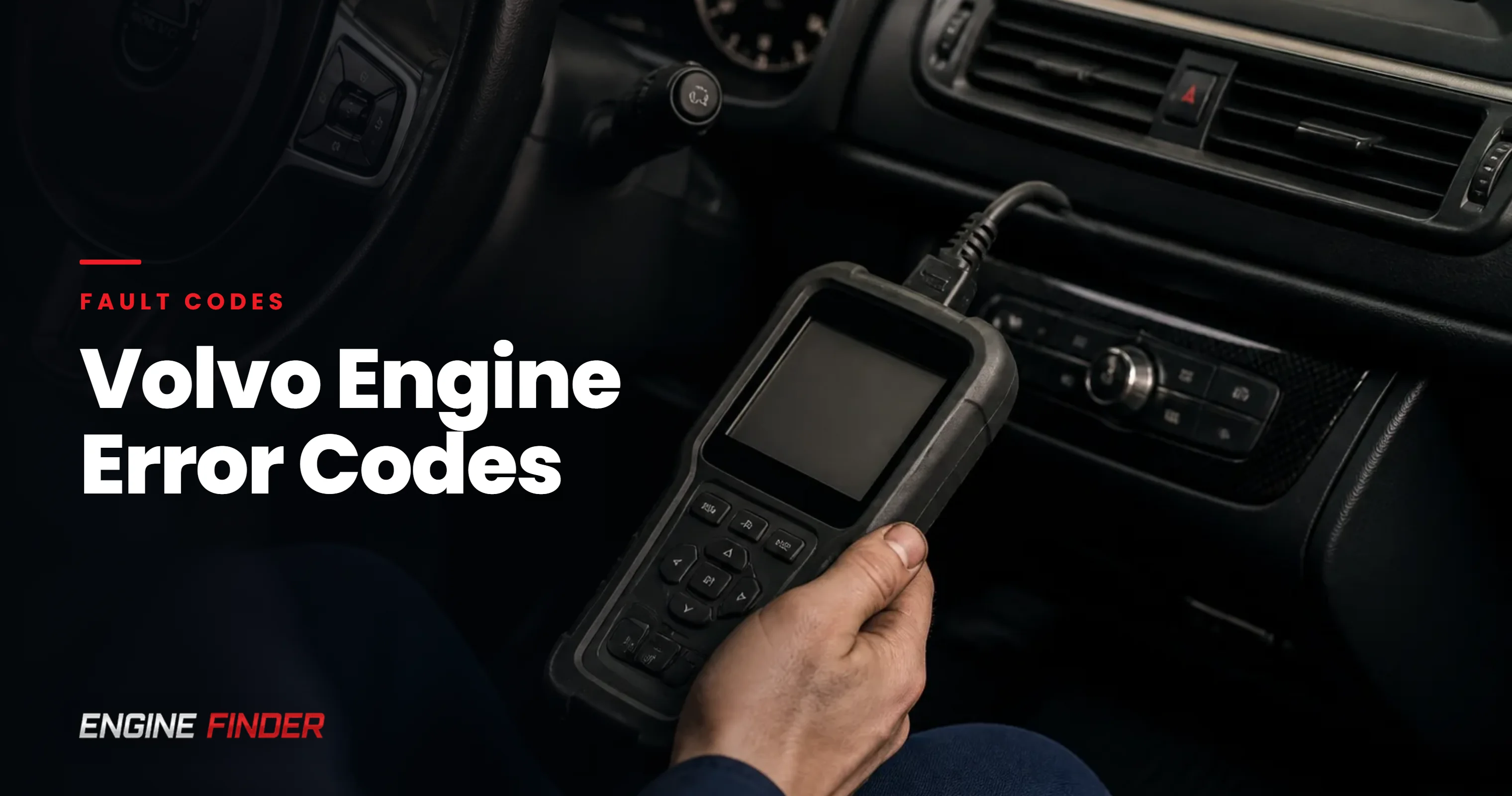
Complete Volvo Engine Error Codes Guide: Diagnostic Trouble Codes & Solutions

A warning light on a Volvo almost always comes with a stored diagnostic trouble code (DTC), and reading that code correctly is the difference between a R500 sensor and a R40,000 engine. The catch is that Volvo speaks two languages: the generic P-codes (P0171, P2002 and the like) that any OBD-II scanner can read, and Volvo’s own module-prefixed codes (shown as ECM-…) that only Volvo’s VIDA software fully translates. This guide, written for South African S60, XC60 and XC90 owners running D5/D4 diesels or T5/T6 petrol engines, explains both, lists the DTCs Volvo owners actually see most often, and flags the ones that point to serious engine damage rather than a cheap fix. If the diagnosis lands on a tired or failed engine, you can browse Volvo engines for sale from vetted suppliers across South Africa.
Key Takeaways {#key-takeaways}
| Topic | Key Point | Details |
|---|---|---|
| Two code systems | Generic P-codes vs Volvo ECM-codes | VIDA/DICE reads the descriptive Volvo-specific codes |
| DPF codes | P2002 / P242F are common on D5 diesels | Soot vs ash — one regenerates, one needs cleaning |
| Swirl flaps | P2015 is a signature D5 fault | A cheap plastic link arm, not the whole intake |
| PCV / lean codes | P0171 usually means a failed oil trap | Torn PCV diaphragm causes a vacuum leak |
| Serious codes | Misfire, timing and boost codes can mask engine wear | Compression, VVT hub or turbo damage |
How Volvo Error Codes Work {#how-volvo-codes-work}
Since 1996, every Volvo sold in South Africa has been OBD-II compliant, so a standard scanner plugged into the 16-pin port under the dash will read generic P-codes. These are standardised across all manufacturers under the SAE J2012 standard — P0171 means “System Too Lean (Bank 1)” whether it’s in a Volvo or a Toyota.
Volvo, however, stores a second, more detailed set of codes internally. These are shown as a three-letter module prefix followed by a code number — for example ECM-250A (Engine Control Module) or TCM-… (Transmission Control Module). The prefix tells you which control unit logged the fault, and the number is far more specific than the generic equivalent. Where a generic scanner shows a broad “P0171 – System Too Lean”, Volvo’s own diagnostic software (VIDA, the Vehicle Information and Diagnostics for Aftermarket application, run through a DICE interface) can map that to something like ECM-250A: long-term fuel trim, idle range, too lean — narrowing the hunt considerably.
What you need to read them
- Any OBD-II scanner reads the generic P-codes and clears them.
- VIDA with a DICE interface is needed to read and interpret the full Volvo-specific
ECM-…codes, view freeze-frame data and run guided diagnostics. - A single generic P-code can map to several Volvo-specific codes (signal too high, too low, missing or intermittent), which is why a Volvo specialist often finds the cause faster than a generic code reader.
The important thing to understand is that these are not two different faults — the ECM-… code and the P-code usually describe the same problem from two angles. Don’t chase them as separate issues.
The Volvo Engine Codes You’ll Actually See {#common-codes}
The table below lists the DTCs Volvo owners in South Africa report most often. Codes shown as Pxxxx are the generic OBD-II codes any scanner displays; where a well-documented Volvo-specific mapping exists (such as ECM-250A for a lean condition), it is noted. Volvo-specific ECM-… numbers vary by model year and software version — always confirm the exact mapping in VIDA before ordering parts.
| Code | Correct meaning | Common cause on Volvo | Typical fix |
|---|---|---|---|
| P0011 | Camshaft position — intake timing over-advanced (Bank 1) | Low/dirty oil or a failing VVT (CVVT) solenoid; sometimes a worn VVT hub | Correct oil level & grade, then replace VVT solenoid; VVT hub if it persists |
| P0016 | Crankshaft / camshaft position correlation (Bank 1) | Timing out by a tooth after belt work, stretched chain, or cam/crank sensor fault | Verify timing, replace worn chain/tensioner or sensor |
| P0101 / P0102 | Mass Air Flow circuit — range/performance or signal low | Dirty/failed MAF, or unmetered air from a vacuum leak (PCV, split intake hose) | Fix vacuum leak first; clean or replace MAF (genuine Bosch) |
| P0171 (≈ ECM-250A) | Fuel system too lean (Bank 1) | Torn PCV diaphragm in the oil-trap assembly causing a vacuum leak — very common on Volvo petrols | Replace oil-trap/PCV assembly; check filler-cap seal |
| P0234 | Turbocharger overboost condition | Sticking wastegate/variable-vane actuator, boost control fault | Test wastegate/vane actuator and control solenoid |
| P0299 | Turbocharger underboost condition | Boost leak, worn turbo, or failed vane/vacuum control (D5 sequential twin-turbo) | Pressure-test for boost leaks; check actuator/turbo |
| P0380 / P0670 | Glow-plug heater circuit / glow-plug control module fault | Failed glow-plug control module, wiring/fuse/ground, or a bad glow plug | Check fuse & ground first; replace module or glow plugs |
| P0401 / P0402 | EGR flow insufficient / excessive (Bank 1) | Heavy soot clogging the EGR valve, cooler and intake — a signature D5 problem | Clean or replace EGR valve/cooler; the D5 job is messy |
| P0403 | EGR control circuit malfunction | EGR valve actuator or wiring fault | Test actuator circuit; replace EGR valve if faulty |
| P0420 | Catalyst system efficiency below threshold (Bank 1) | Ageing/contaminated catalyst, or a lazy rear O2 sensor; oil-burning fouls the cat | Replace rear O2 sensor or catalytic converter; fix any oil burn |
| P2002 | Diesel Particulate Filter efficiency below threshold (Bank 1) | Clogged DPF, failed differential-pressure sensor, or a sensor-line/wiring fault | Force a regeneration; check DPF pressure sensor & lines; clean/replace DPF |
| P242F | DPF restriction — ash accumulation (Bank 1) | Non-burnable ash build-up (often wrong oil); can’t be regenerated away | Professionally clean or replace the DPF, then reset the ash counter |
| P2015 | Intake manifold runner position sensor/performance (Bank 1) | Broken plastic swirl-flap link arm — a classic D5 failure; part is cheap | Replace the swirl-flap link arm/actuator (flaps if seized) |
| P2004 / P2006 | Intake manifold runner (swirl flap) stuck open / stuck closed | Carbon-seized flaps or a popped-off linkage | Free/replace the swirl flaps and linkage |
Which Codes Mean Real Engine, PCV or DPF Damage {#major-damage}
Not every code is equal. Some are a cheap sensor; a handful are early warnings that the engine itself is on borrowed time. Here’s how to read the severity.
PCV / oil-trap failure (P0171 and lean codes)
On petrol Volvos, a lean code like P0171 is most often a torn PCV diaphragm inside the oil-trap assembly. The classic tell is a high-pitched whistle at idle that changes or stops when you loosen the oil filler cap. Ignored, a failed PCV system lets crankcase pressure build, which can push oil past seals and foul the catalyst — turning a cheap oil-trap job into an O2-sensor and cat replacement. Fix it early.
DPF codes on D5/D4 diesels (P2002 vs P242F)
These two get confused constantly, and the difference matters:
- P2002 points to soot efficiency — the DPF is clogged with soot that a proper regeneration cycle can burn off. Long steady drives, a forced regen, and checking the DPF pressure sensor often clear it.
- P242F is ash accumulation. Ash is the non-combustible residue left behind after regeneration and cannot be burned off — the filter has to be professionally cleaned or replaced, and the ash counter reset with a scan tool. Using the wrong (non-low-SAPS) engine oil is the number-one cause of premature ash.
Short-trip, stop-start city driving is the enemy of any DPF diesel — it never gets hot enough to regenerate. If you mostly do short SA suburban runs in a D5, expect DPF and EGR soot problems over time.
Misfire, timing and boost codes — the ones to respect
- Misfire codes on any cylinder deserve a compression test. If new plugs, coils and injectors don’t clear the misfire, low compression points to worn valves, rings or a head-gasket issue — engine-level wear.
- P0011 / P0016 timing codes can start as a cheap VVT solenoid, but if clean oil and a new solenoid don’t fix it, the mechanical VVT hub or a stretched timing chain is next — and a chain that jumps can bend valves.
- P0299 underboost on a D5 can be a simple boost leak, but a worn sequential turbo is a big-ticket repair.
When the diagnosis lands on failed compression, a spun turbo or timing damage that costs more to repair than the car is worth, sourcing a good used unit is usually the sensible call. If you’re weighing rebuild versus replacement, our breakdown of how an engine overhaul works explains the typical scope, cost and turnaround for South African owners.
When to Source a Used Volvo Engine {#when-to-replace}
Consider a replacement engine rather than a repair when:
- A compression test confirms low compression on multiple cylinders after misfire codes.
- Timing (P0011/P0016) damage has bent valves or the chain has jumped.
- The turbo has failed catastrophically and the engine has ingested debris or oil.
- Repeated, escalating repair bills on a high-mileage D5 make patching uneconomical.
Engine Finder connects you with Volvo engine and parts suppliers across South Africa in one enquiry, so you can compare prices on a low-mileage used unit instead of chasing one scrap yard at a time.
Video Guide: Volvo Error Code Diagnosis
This video demonstrates reading Volvo diagnostic trouble codes and the difference between generic OBD-II and Volvo-specific diagnostics.
Frequently Asked Questions
What’s the difference between Volvo ECM codes and generic P-codes?
Generic P-codes (like P0171) are standardised OBD-II codes that any scanner reads. Volvo’s own ECM-… codes are module-prefixed and more descriptive, but they need Volvo’s VIDA/DICE software to read fully. They usually describe the same underlying fault — the ECM code just pinpoints it more precisely.
Can I read Volvo error codes with a cheap OBD-II scanner?
Yes, for the generic P-codes and to clear them. But a cheap scanner won’t show the detailed Volvo-specific ECM-… codes or run guided diagnostics — for those you need VIDA with a DICE interface, which is why a Volvo specialist often diagnoses faster.
What’s the difference between P2002 and P242F on my Volvo diesel?
P2002 means the DPF is clogged with soot, which a regeneration cycle can often burn off. P242F means the DPF is full of ash, which cannot be burned off and requires professional cleaning or replacement plus an ash-counter reset. Using the correct low-SAPS diesel oil slows ash build-up.
Why does my Volvo keep throwing a P0171 lean code?
On petrol Volvos this is most often a torn PCV diaphragm in the oil-trap assembly causing a vacuum leak. Listen for a whistle at idle that changes when you loosen the oil filler cap. Replacing the oil-trap/PCV assembly usually resolves it.
Is P2015 an expensive repair on a Volvo D5?
Usually not. On the D5, P2015 is almost always a broken plastic swirl-flap link arm — an inexpensive part. It only gets costly if the flaps themselves have seized solid with carbon and need replacing.
Can I keep driving my Volvo with a check engine light on?
It depends on the code. A lean or MAF code may just cost you fuel, but misfire, timing, boost or DPF codes can lead to further engine or emissions damage if ignored. Get it scanned promptly and address serious codes before driving further.
Sources & Further Reading
Code definitions in this guide were verified against SAE J2012-standard OBD-II databases and Volvo-specialist references, including TroubleCodes.net’s P2002 particulate-filter reference, OBD-Codes.com on P242F ash accumulation, the FCP Euro Volvo PCV oil-trap (P0171) guide, and OBDeleven’s P0420 catalyst-efficiency explainer. Always confirm the exact fault in Volvo’s VIDA software before replacing parts.
Related Volvo Engine Resources
- BMW Engine Error Codes — compare diagnostic approaches across premium marques
- Peugeot fault codes explained
- Renault diagnostic trouble codes
- Ford error codes and engine problems
For replacement Volvo engines or specialised parts, Engine Finder connects you with quality used Volvo engines and components across South Africa. Find affordable parts through Volvo stripping for spares suppliers or locate a Volvo scrap yard near you.
Related Articles
Explore more insights on similar topics
Nissan NP200 Gearbox Problems: JR5 Manual, Clutch & Costs (SA Guide)
Nissan NP200 gearbox problems explained — the Renault JR5/JH3 manual, crunchy shifts, 5th-gear whine, soft-clutch cylinder faults, and what a used or recon NP200 gearbox costs in SA.
BMW B47 Engine Problems: EGR Recall & SA Repair Costs (2026)
BMW fixed the N47's chain-snap epidemic with the B47 — but the EGR cooler fire-risk recall, DPF clogging and carbon build-up became the new headaches. Symptoms, SA repair costs, and when a used engine wins.
Toyota Hilux Gearbox Problems: GD6, 4Y, Auto & Manual (SA Guide)
Toyota Hilux gearbox problems explained, manual & auto faults, clutch costs, GD6 vs older boxes, and how to compare Hilux gearbox prices in SA.
Important Disclaimer
This content is for informational purposes only and is based on research from automotive industry sources. Engine Finder is not a certified automotive repair facility. Always consult with qualified automotive professionals before performing any repairs or maintenance. Improper repairs can result in personal injury, property damage, or vehicle malfunction. We assume no responsibility for actions taken based on this information.